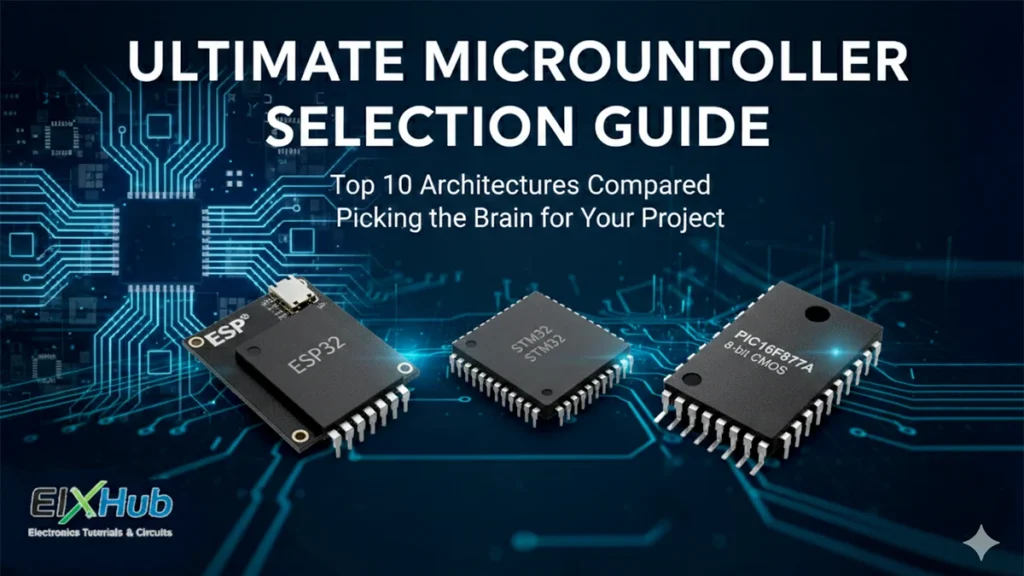
Microcontrollers (MCUs) are the command centers of modern electronic design. Unlike General Purpose ICs that perform specific hardware tasks, an MCU is a programmable computer on a single chip. This ElxHub guide organizes the 10 most influential microcontrollers by architecture and application, helping you bridge the gap between simple logic and intelligent automation.
The Master Microcontroller Comparison Table
This table helps you select an MCU based on processing power, connectivity, and voltage requirements.
| Part Number | Architecture | Bit-Width | Clock Speed | Voltage Range | Key Feature |
| ATmega328P | AVR | 8-bit | 20 MHz | 1.8V – 5.5V | Arduino Uno Standard / Huge Community |
| ESP32 | Tensilica | 32-bit | 240 MHz | 2.2V – 3.6V | Integrated Wi-Fi & Dual-Mode Bluetooth |
| STM32F103C8T6 | ARM Cortex-M3 | 32-bit | 72 MHz | 2.0V – 3.6V | The “Blue Pill” / High Performance |
| RP2040 | ARM Cortex-M0+ | 32-bit | 133 MHz | 1.8V – 3.3V | Programmable I/O (PIO) / Dual Core |
| RP2350 | ARM M33 / RISC-V | 32-bit | 150 MHz | 1.8V – 3.3V | Dual-Architecture / Enhanced Security |
| ATTiny85 | AVR | 8-bit | 20 MHz | 2.7V – 5.5V | Ultra-Compact 8-Pin DIP Package |
| STM32G071 | ARM Cortex-M0+ | 32-bit | 64 MHz | 1.7V – 3.6V | USB-C Power Delivery (UCPD) Support |
| PIC16F877A | PIC | 8-bit | 20 MHz | 2.0V – 5.5V | Industrial Reliability / 40-Pin Classic |
| MSP430G2553 | RISC | 16-bit | 16 MHz | 1.8V – 3.6V | Ultra-Low Power / Battery King |
| ESP8266 | Tensilica | 32-bit | 80 MHz | 2.5V – 3.6V | Low-Cost Wi-Fi / Simple IoT Solutions |
| ATmega2560 | AVR | 8-bit | 16 MHz | 1.8V – 5.5V | 256KB Flash / 54 Digital I/O Pins |
1. The Entry-Level Classics
Ideal for students and hobbyists learning the fundamentals of embedded C and electronics.
- The Beginner’s Standard: ATmega328P
- The High-I/O Powerhouse: ATmega2560 (Arduino Mega)
- The Academic Legend: PIC16F877A
2. IoT & Wireless Connectivity
Designed specifically for projects that need to communicate over the internet or with smartphones.
3. High-Performance 32-bit ARM
When your project requires complex math, high-speed data processing, or many peripheral connections.
- The Industry Workhorse: STM32F103C8T6
- Modern Efficiency: STM32G071
4. Ultra-Compact & Low Power
Perfect for wearables, remote sensors, and devices that must run on a coin-cell battery for years.
- Tiny but Mighty: ATTiny85
- The Energy Saver: MSP430G2553
5. The New Wave (Flexible Architectures)
Modern chips that offer unique hardware flexibility through programmable state machines or dual-core setups.
Which Microcontroller is right for your project?
- Building your first LED Cube or Robot? Start with the ATmega328P (Arduino).
- Building a 3D Printer or complex CNC? The ATmega2560 is the best choice because of its massive 256KB Flash memory and 54 I/O pins, allowing you to control dozens of sensors and motors simultaneously.
- Creating a Smart Home Thermostat? Use the ESP32 for its built-in Wi-Fi and display driving power.
- Building a battery-powered weather station? The MSP430G2553 will keep it running for months.
- Need to fit a controller inside a ring or necklace? The ATTiny85 is small enough to fit anywhere.
- Designing a custom USB-C rechargeable device? The STM32G071 has specialized hardware for USB-C.
- Developing a high-speed motor controller? The STM32F103 provides the necessary clock cycles.
- Learning industrial-grade assembly? The PIC16F877A is the perfect lab companion.
- Adding basic Wi-Fi to a legacy machine? The ESP8266 is the most cost-effective solution.
- Building a secure, modern IoT gateway? The RP2350 offers the latest security and core flexibility.
- Need ultra-flexible I/O for a custom protocol? Use the RP2040 and its unique PIO blocks.
Related Tutorials & Resources
- Step-by-Step: How to Burn the Arduino Bootloader to an ATmega328P.
- Comparison: 8-bit vs. 32-bit MCUs – When do you actually need the extra power?
- Theory: Understanding Sleep Modes and Power Consumption in the MSP430 series.
- Advanced: Getting started with RP2040 PIO (Programmable Input/Output).
Yoast SEO Settings: focus keyword: Microcontroller Selection Guide seo title: Ultimate Microcontroller Selection Guide | Top 10 MCUs compared | ElxHub slug: ultimate-microcontroller-selection-guide meta description: Choose the perfect brain for your project. Compare the top 10 microcontrollers including ESP32, STM32, PIC, and AVR by voltage, speed, and application.