
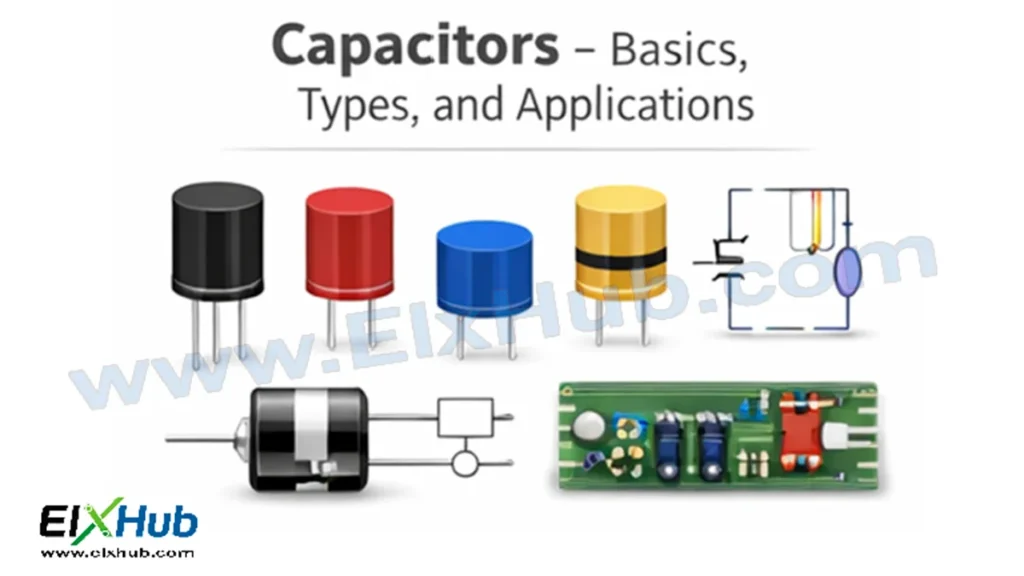
Introduction
Capacitors are one of the most fundamental and widely used passive components in electronics, second only to resistors in importance. From simple power supply circuits to advanced communication systems, capacitors play a vital role in storing energy, filtering signals, stabilizing voltages, and shaping waveforms. For beginners in electronics, understanding capacitors is essential because almost every electronic circuit relies on them in one way or another.
In basic terms, a capacitor is a device that stores electrical energy in the form of an electric field. Unlike batteries, which store energy chemically, capacitors store energy electrostatically and can release it very quickly. This unique property makes capacitors indispensable in timing circuits, signal coupling and decoupling, noise filtering, power conditioning, and many other applications.
In this article, we will explore capacitors in detail, starting from their basic working principle, construction, and key parameters. We will then discuss different types of capacitors, their characteristics, advantages, and limitations. Finally, we will look at real-world applications of capacitors in electronic circuits, helping beginners build a strong conceptual foundation.
[Image Placeholder: Capacitors overview showing different types and symbols]
What Is a Capacitor?
A capacitor is a two-terminal passive electronic component that stores electrical charge when a voltage is applied across its terminals. It consists of two conductive plates separated by an insulating material called a dielectric. When connected to a power source, electrons accumulate on one plate and are removed from the other, creating an electric field across the dielectric.
The ability of a capacitor to store charge is known as capacitance and is measured in farads (F). In practical electronics, capacitance values are usually much smaller and are expressed in microfarads (µF), nanofarads (nF), or picofarads (pF).
Unlike resistors, which oppose the flow of current, capacitors react differently depending on whether the applied voltage is constant (DC) or changing (AC). This unique behavior makes capacitors extremely useful in both DC and AC circuits.
[Image Placeholder: Basic capacitor symbol and physical structure]
Basic Construction of a Capacitor
At its simplest, a capacitor is made of three main parts:
• Two conductive plates
• A dielectric (insulating material)
• Leads or terminals for external connection
The conductive plates are usually made of metal such as aluminum, tantalum, or metal-coated films. The dielectric can be air, ceramic, plastic film, paper, mica, or an oxide layer, depending on the capacitor type.
The choice of dielectric material greatly affects the capacitor’s performance, including its capacitance value, voltage rating, temperature stability, and frequency response.
[Image Placeholder: Internal construction of a capacitor]
Working Principle of a Capacitor
When a capacitor is connected to a DC voltage source, current flows momentarily as the capacitor charges. As charge accumulates on the plates, the voltage across the capacitor increases until it equals the supply voltage. At this point, the capacitor is fully charged, and current flow stops.
When the power source is removed and a load is connected, the capacitor discharges, releasing its stored energy back into the circuit. This charge and discharge behavior allows capacitors to smooth voltage fluctuations and provide temporary energy storage.
In AC circuits, capacitors continuously charge and discharge as the voltage alternates. This causes the capacitor to allow AC signals to pass while blocking DC, a property widely used in signal coupling and filtering.
[Image Placeholder: Charging and discharging of a capacitor waveform]
Key Parameters of Capacitors
Understanding capacitor specifications is crucial for selecting the right component for a circuit.
Capacitance
Capacitance indicates how much charge a capacitor can store for a given voltage. Higher capacitance means more energy storage.
Voltage Rating
The maximum voltage a capacitor can safely handle. Exceeding this rating can cause dielectric breakdown and permanent damage.
Tolerance
Defines how much the actual capacitance may vary from its rated value, typically expressed as a percentage.
Polarity
Some capacitors are polarized, meaning they must be connected with correct polarity. Others are non-polarized and can be connected either way.
Equivalent Series Resistance (ESR)
Represents internal losses within the capacitor. Lower ESR is desirable, especially in power supply applications.
[Image Placeholder: Capacitor specifications labeling]
Types of Capacitors
Capacitors can be broadly classified into fixed capacitors and variable capacitors. Fixed capacitors are further divided based on their dielectric material.
[Image Placeholder: Classification of capacitors chart]
Ceramic Capacitors
Ceramic capacitors use a ceramic material as the dielectric and are widely used due to their small size, low cost, and non-polarized nature. They are commonly found in decoupling and bypass applications.
Advantages include good frequency response and long lifespan. However, their capacitance can vary with temperature and voltage in certain ceramic classes.
[Image Placeholder: Ceramic capacitor types]
Electrolytic Capacitors
Electrolytic capacitors offer high capacitance values in a relatively small size, making them ideal for power supply filtering. They are polarized, so correct polarity must be maintained.
Aluminum electrolytic capacitors are common in DC power supplies, while tantalum electrolytic capacitors offer better stability but are more sensitive to overvoltage.
[Image Placeholder: Electrolytic capacitor polarity marking]
Film Capacitors
Film capacitors use plastic films such as polyester, polypropylene, or polycarbonate as the dielectric. They are known for their stability, low loss, and non-polarized nature.
These capacitors are commonly used in signal coupling, timing circuits, and audio applications.
[Image Placeholder: Film capacitor construction]
Tantalum Capacitors
Tantalum capacitors provide higher capacitance per volume than aluminum electrolytics and offer better stability. However, they are sensitive to voltage spikes and must be used carefully.
They are often found in compact electronic devices such as smartphones and laptops.
[Image Placeholder: Tantalum capacitor on PCB]
Variable Capacitors
Variable capacitors allow the capacitance value to be adjusted manually or electronically. They are commonly used in tuning circuits, such as radio receivers.
[Image Placeholder: Variable capacitor used in tuning circuits]
Supercapacitors
Supercapacitors, also known as ultracapacitors, bridge the gap between conventional capacitors and batteries. They can store large amounts of energy and are used in energy backup systems, regenerative braking, and memory backup applications.
[Image Placeholder: Supercapacitor energy storage]
Applications of Capacitors
Capacitors are used in a wide range of applications across electronics.
Power Supply Filtering
Capacitors smooth out voltage ripples in rectifier circuits, providing stable DC output.
Signal Coupling and Decoupling
They block DC while allowing AC signals to pass, enabling signal transfer between circuit stages.
Timing and Oscillator Circuits
Capacitors work with resistors to create time delays and oscillations.
Energy Storage
Capacitors provide quick bursts of energy in applications like camera flashes and power backup systems.
Noise Reduction
Decoupling capacitors reduce noise and interference in digital and analog circuits.
[Image Placeholder: Capacitor applications in real circuits]
Advantages and Limitations of Capacitors
Capacitors offer fast energy delivery, long life, and low maintenance. However, they store less energy than batteries and some types have limited voltage and temperature tolerance.
Understanding these trade-offs helps in choosing the right capacitor for a given application.
[Image Placeholder: Advantages and limitations comparison]
Conclusion
Capacitors are indispensable components in basic and advanced electronics alike. By storing and releasing electrical energy, they enable voltage stabilization, signal processing, timing control, and noise reduction in countless applications. Understanding capacitor basics, construction, types, and applications provides a strong foundation for anyone learning electronics.
As you progress further into electronics, you will encounter capacitors in almost every circuit you design or analyze. Selecting the right capacitor with appropriate capacitance, voltage rating, and type is a critical skill that improves circuit reliability and performance.
Image Reference Table
Feature Image
Filename: capacitors-basics-types-applications-featured.webp
Alt Text: Capacitors basics types and applications in electronics
Description: Featured image showing different capacitor types, symbols, and their common uses in electronic circuits.
Image 1
Filename: capacitor-overview-basic-electronics.webp
Alt Text: Overview of capacitors in basic electronics
Description: Visual overview showing various capacitors and their role in electronic circuits.
Image 2
Filename: capacitor-symbol-and-structure.webp
Alt Text: Capacitor symbol and physical structure
Description: Diagram showing standard capacitor symbols and physical construction.
Image 3
Filename: capacitor-internal-construction.webp
Alt Text: Internal construction of a capacitor
Description: Cutaway illustration showing plates and dielectric material inside a capacitor.
Image 4
Filename: capacitor-charging-discharging.webp
Alt Text: Capacitor charging and discharging waveform
Description: Graphical representation of capacitor charge and discharge behavior.
Image 5
Filename: capacitor-specifications-labeled.webp
Alt Text: Capacitor specifications and ratings
Description: Image labeling key capacitor parameters such as capacitance and voltage rating.
Image 6
Filename: capacitor-types-classification.webp
Alt Text: Classification of capacitor types
Description: Chart classifying capacitors into ceramic, electrolytic, film, and variable types.
Image 7
Filename: ceramic-capacitor-types.webp
Alt Text: Ceramic capacitor types
Description: Different ceramic capacitors used for decoupling and bypassing.
Image 8
Filename: electrolytic-capacitor-polarity.webp
Alt Text: Electrolytic capacitor polarity marking
Description: Illustration highlighting polarity markings on electrolytic capacitors.
Image 9
Filename: film-capacitor-construction.webp
Alt Text: Film capacitor construction
Description: Structure of a film capacitor used in signal applications.
Image 10
Filename: tantalum-capacitor-on-pcb.webp
Alt Text: Tantalum capacitor mounted on PCB
Description: Tantalum capacitor used in compact electronic devices.
Image 11
Filename: variable-capacitor-tuning.webp
Alt Text: Variable capacitor used in tuning circuits
Description: Variable capacitor commonly used in radio tuning applications.
Image 12
Filename: supercapacitor-energy-storage.webp
Alt Text: Supercapacitor energy storage device
Description: Supercapacitor used for high-capacity energy storage.
Image 13
Filename: capacitor-power-supply-filtering.webp
Alt Text: Capacitor used in power supply filtering
Description: Capacitors smoothing DC output in a power supply circuit.
Image 14
Filename: capacitor-signal-coupling.webp
Alt Text: Capacitor signal coupling application
Description: Capacitor allowing AC signal transfer while blocking DC.
Image 15
Filename: capacitor-timing-circuit.webp
Alt Text: Capacitor in timing circuit
Description: Capacitor and resistor forming a timing network.
Image 16
Filename: capacitor-energy-storage-flash.webp
Alt Text: Capacitor energy storage in camera flash
Description: Capacitor releasing stored energy in a camera flash circuit.
Image 17
Filename: capacitor-noise-reduction.webp
Alt Text: Capacitor noise reduction in circuits
Description: Decoupling capacitors reducing noise in electronic systems.
Image 18
Filename: capacitor-advantages-limitations.webp
Alt Text: Advantages and limitations of capacitors
Description: Comparison showing benefits and constraints of capacitors.
Image 19
Filename: selecting-right-capacitor.webp
Alt Text: How to select the right capacitor
Description: Guide showing factors for choosing appropriate capacitors.
Image 20
Filename: capacitor-failure-modes.webp
Alt Text: Capacitor failure modes
Description: Visual examples of damaged and failed capacitors.
Image 21
Filename: capacitor-real-world-applications.webp
Alt Text: Real-world applications of capacitors
Description: Examples of capacitors used in consumer and industrial electronics.
SEO Title
Capacitors Explained – Basics, Types, and Applications in Electronics
Meta Description
Learn capacitors basics, working principle, types, and real-world applications. A complete beginner-friendly guide to capacitors in electronics.


