
Introduction
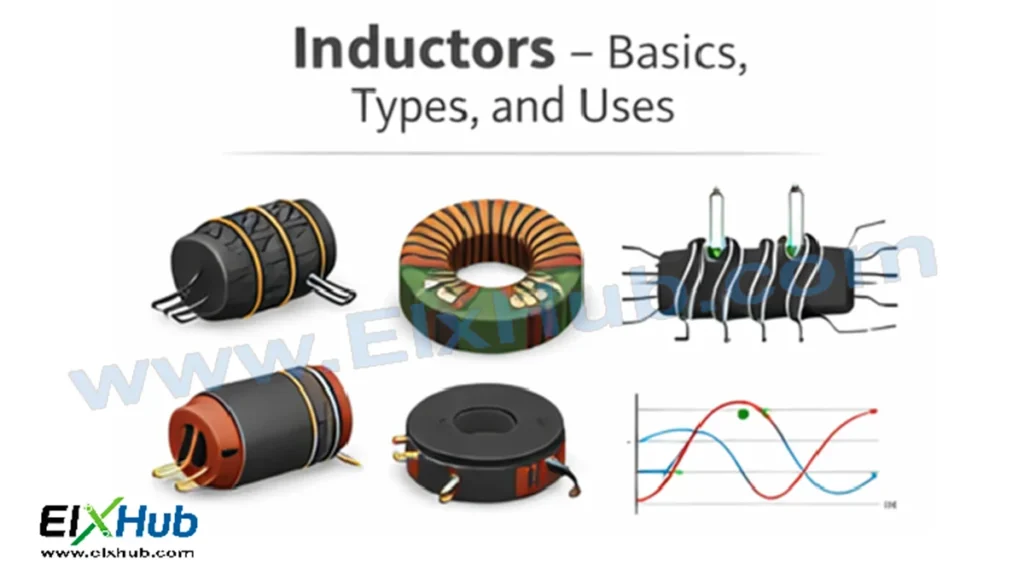
Inductors are one of the three fundamental passive components in electronics, alongside resistors and capacitors. They are essential in circuits where energy storage, current smoothing, filtering, and electromagnetic control are required. From power supplies and radio-frequency circuits to motors and communication systems, inductors play a vital role in both basic and advanced electronics.
An inductor stores energy in the form of a magnetic field when electric current flows through it. Unlike resistors, which dissipate energy as heat, and capacitors, which store energy in an electric field, inductors interact with changing currents and oppose sudden variations in current flow. This unique property makes inductors indispensable in AC circuits, switching power supplies, filters, and tuning applications.
In this comprehensive beginner-to-intermediate guide, you will learn what inductors are, how they work, their construction, key electrical characteristics, different types of inductors, symbols, practical uses, advantages, limitations, and real-world applications. This article is written to give you a strong and practical understanding of inductors in basic electronics.
[Image Placeholder: Different types of inductors overview]
What Is an Inductor?
An inductor is a passive electronic component that consists of a coil of wire, usually wound around a core made of air, iron, ferrite, or another magnetic material. The primary function of an inductor is to oppose changes in current and store energy temporarily in its magnetic field.
The ability of an inductor to store energy is measured in henries (H). Smaller inductors are often rated in millihenries (mH) or microhenries (µH).
[Image Placeholder: Inductor physical components]
Symbol and Unit of Inductance
In circuit diagrams, an inductor is represented by a coil symbol. Depending on the core material, the symbol may include straight lines to indicate a magnetic core.
The SI unit of inductance is the henry (H).
[Image Placeholder: Inductor symbols]
Construction of an Inductor
An inductor is constructed by winding a conductive wire, typically copper, into a coil. The performance of the inductor depends on several construction factors.
Key construction elements include:
Number of turns in the coil
Core material
Coil diameter and length
Wire thickness
Inductors may be air-core or use magnetic cores to increase inductance without increasing size.
[Image Placeholder: Inductor construction diagram]
Working Principle of an Inductor
The operation of an inductor is based on electromagnetic induction. When current flows through a coil, it creates a magnetic field around it. If the current changes, the magnetic field also changes, inducing a voltage that opposes the change in current.
This behavior is explained by Lenz’s Law, which states that the induced voltage always opposes the cause that produces it.
[Image Placeholder: Magnetic field around inductor]
Inductance and Energy Storage
The inductance of a coil depends on its geometry and core material. The energy stored in an inductor is given by the relationship between current and magnetic field strength.
An inductor stores energy only when current is flowing, and the energy is released back into the circuit when the current decreases.
[Image Placeholder: Energy storage in inductor]
Behavior of Inductors in DC Circuits
In DC circuits:
An inductor initially opposes current flow
After steady state is reached, it behaves like a short circuit
This makes inductors useful in smoothing current during startup conditions.
[Image Placeholder: Inductor behavior in DC circuit]
Behavior of Inductors in AC Circuits
In AC circuits, inductors oppose changes in current continuously.
Key characteristics:
Opposition to AC is called inductive reactance
Inductive reactance increases with frequency
Current lags voltage by 90 degrees in an ideal inductor
[Image Placeholder: Inductor in AC circuit waveform]
Inductive Reactance
Inductive reactance is the opposition an inductor offers to alternating current.
| Parameter | Effect |
|---|---|
| Frequency | Higher frequency increases reactance |
| Inductance | Higher inductance increases reactance |
This property is crucial in filters and tuning circuits.
[Image Placeholder: Inductive reactance graph]
Types of Inductors
Inductors are classified based on core material, construction, and application.
Air-Core Inductors
These inductors use air as the core material.
Advantages:
No core losses
Suitable for high-frequency applications
Applications include:
RF circuits
Oscillators
[Image Placeholder: Air-core inductor]
Iron-Core Inductors
Iron-core inductors use laminated iron cores.
Advantages:
High inductance values
Compact size
Applications include:
Power supplies
Audio circuits
[Image Placeholder: Iron-core inductor]
Ferrite-Core Inductors
Ferrite cores reduce losses at high frequencies.
Applications include:
SMPS
EMI suppression
[Image Placeholder: Ferrite-core inductor]
Toroidal Inductors
Toroidal inductors are wound on a ring-shaped core.
Advantages:
Low electromagnetic interference
High efficiency
Applications include:
Power filters
High-current circuits
[Image Placeholder: Toroidal inductor]
Variable Inductors
Variable inductors allow inductance adjustment.
Applications include:
Radio tuning
Oscillators
[Image Placeholder: Variable inductor]
Coupled Inductors
Coupled inductors share magnetic fields.
Applications include:
Transformers
Signal coupling
[Image Placeholder: Coupled inductors]
Inductor Specifications
Important parameters to consider include:
| Parameter | Description |
|---|---|
| Inductance | Energy storage capability |
| Current rating | Maximum safe current |
| DC resistance | Power loss factor |
| Core material | Frequency behavior |
| Tolerance | Manufacturing variation |
[Image Placeholder: Inductor datasheet parameters]
Practical Uses of Inductors
Inductors are widely used in electronic systems.
Common applications include:
Power supply filtering
Energy storage in SMPS
RF tuning circuits
Chokes for noise suppression
Motor control circuits
[Image Placeholder: Inductor applications]
Inductors in Filters
Inductors are used with capacitors to form filters.
| Filter Type | Purpose |
|---|---|
| Low-pass | Pass low frequencies |
| High-pass | Block low frequencies |
| Band-pass | Select frequency range |
[Image Placeholder: LC filter circuit]
Inductors in Power Electronics
In power electronics, inductors are critical components.
Applications include:
Buck converters
Boost converters
Inverters
They smooth current and reduce ripple.
[Image Placeholder: Inductor in SMPS]
Advantages of Inductors
Energy storage without dissipation
Effective current smoothing
Essential for AC and RF circuits
High reliability
Limitations of Inductors
Bulky for high inductance values
Core losses at high frequency
Electromagnetic interference
[Image Placeholder: Inductor size comparison]
Inductors vs Capacitors
Although both store energy, their behavior differs.
| Feature | Inductor | Capacitor |
|---|---|---|
| Energy storage | Magnetic field | Electric field |
| DC behavior | Short circuit | Open circuit |
| AC behavior | Opposes current change | Opposes voltage change |
[Image Placeholder: Inductor vs capacitor]
Selecting the Right Inductor
When choosing an inductor, consider:
Required inductance
Operating frequency
Current rating
Physical size
Core material
[Image Placeholder: Inductor selection guide]
Future Trends in Inductor Technology
Modern inductors use advanced materials to improve efficiency and reduce size. High-frequency and high-power applications are driving innovation in compact and low-loss inductors.
[Image Placeholder: Advanced inductor technology]
Conclusion
Inductors are essential components in electronics that store energy in magnetic fields and oppose changes in current. Their unique behavior makes them vital in power supplies, filters, RF circuits, and energy storage applications. Understanding how inductors work, their types, and their practical uses provides a strong foundation for learning electronics and designing reliable circuits.
As you progress in electronics, inductors will appear repeatedly in both analog and digital systems, making this knowledge extremely valuable.
Image Reference Table
| Image Purpose | Filename | Alt Text | Description |
|---|---|---|---|
| Feature Image | inductors-basics-types-uses-featured.webp | Inductors basics types uses | Featured image showing different inductors |
| Overview | inductor-types-overview.webp | Types of inductors | Overview of common inductor types |
| Physical | inductor-physical-parts.webp | Inductor physical construction | Coil and core structure |
| Symbol | inductor-symbols.webp | Inductor symbols | Circuit symbols for inductors |
| Construction | inductor-construction-diagram.webp | Inductor construction diagram | Coil and core explanation |
| Magnetic Field | magnetic-field-inductor.webp | Magnetic field around inductor | Field lines around coil |
| Energy Storage | inductor-energy-storage.webp | Energy stored in inductor | Magnetic energy storage |
| DC Behavior | inductor-dc-behavior.webp | Inductor in DC circuit | Current rise behavior |
| AC Behavior | inductor-ac-waveform.webp | Inductor AC waveform | Phase relationship |
| Reactance | inductive-reactance-graph.webp | Inductive reactance graph | Reactance vs frequency |
| Air Core | air-core-inductor.webp | Air core inductor | High-frequency inductor |
| Iron Core | iron-core-inductor.webp | Iron core inductor | High inductance design |
| Ferrite Core | ferrite-core-inductor.webp | Ferrite core inductor | SMPS inductor |
| Toroidal | toroidal-inductor.webp | Toroidal inductor | Ring core inductor |
| Variable | variable-inductor.webp | Variable inductor | Adjustable inductance |
| Coupled | coupled-inductors.webp | Coupled inductors | Magnetic coupling |
| Specs | inductor-datasheet.webp | Inductor specifications | Key parameters |
| Filters | lc-filter-inductor.webp | LC filter using inductor | Filter application |
| SMPS | inductor-smps.webp | Inductor in SMPS | Power electronics usage |
| Comparison | inductor-vs-capacitor.webp | Inductor vs capacitor | Energy storage comparison |
| Selection | inductor-selection-guide.webp | Selecting an inductor | Choosing correct inductor |
| Future | advanced-inductor-technology.webp | Advanced inductor technology | Modern inductor designs |
SEO Title
Inductors Explained – Basics, Types, Working, and Uses in Electronics
Meta Description
Learn inductors basics, working principle, types, characteristics, and practical uses in electronics with this complete beginner-friendly guide.


