Introduction
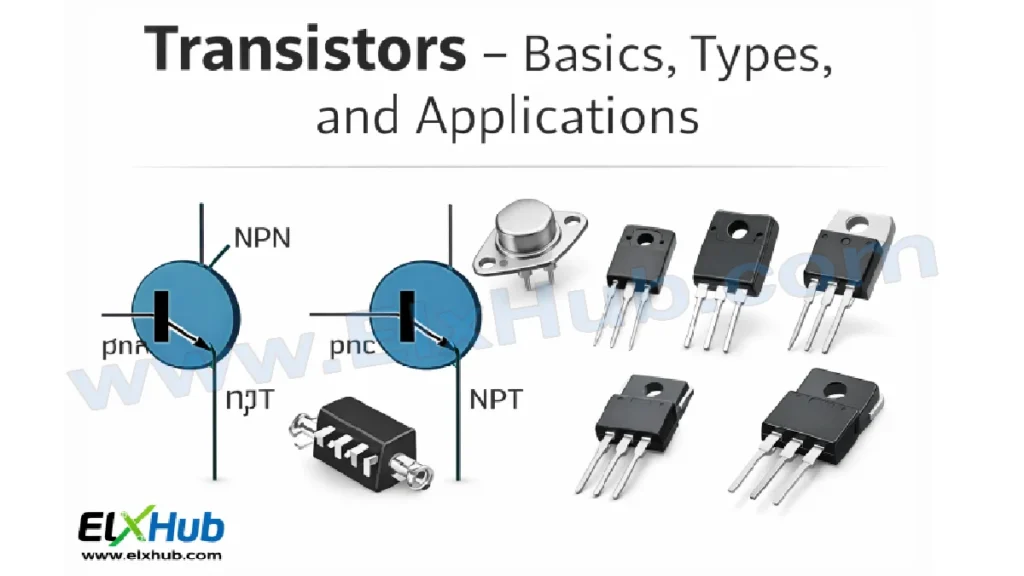
Transistors are the backbone of modern electronics. From the simplest electronic toys to the most advanced computers, smartphones, and communication systems, transistors are everywhere. Often described as one of the greatest inventions of the 20th century, the transistor revolutionized electronics by replacing bulky vacuum tubes with small, efficient, and reliable semiconductor devices.
In basic electronics, understanding transistors is a major milestone. Transistors are primarily used as electronic switches and amplifiers, allowing small electrical signals to control much larger ones. This capability enables signal amplification, digital logic operations, power control, and complex data processing.
In this detailed beginner-friendly guide, we will explore what transistors are, how they work, their internal construction, major types, operating modes, and real-world applications. By the end of this article, you will have a solid conceptual foundation to confidently move forward in electronics.
[Image Placeholder: Overview of different transistors and circuit symbols]
What Is a Transistor?
A transistor is a three-terminal semiconductor device used to amplify or switch electronic signals and electrical power. Unlike passive components such as resistors, capacitors, and inductors, transistors are active components, meaning they can control current flow using an external signal.
The word transistor comes from “transfer resistor,” reflecting its ability to control current transfer from input to output. A small change at the input terminal can result in a large change at the output, which is the fundamental principle behind amplification.
[Image Placeholder: Transistor symbol comparison]
Why Transistors Are Important
Transistors are essential because they:
Enable signal amplification
Act as fast and reliable electronic switches
Consume very little power
Are compact and scalable
Form the building blocks of integrated circuits (ICs)
Without transistors, modern digital electronics, microprocessors, memory chips, and communication systems would not exist.
[Image Placeholder: Evolution from vacuum tubes to transistors]
Basic Construction of a Transistor
A transistor is made using semiconductor materials, typically silicon. By carefully doping silicon with impurities, regions with excess electrons (N-type) and regions with excess holes (P-type) are created.
Depending on how these regions are arranged, different types of transistors are formed. Regardless of type, all transistors have three terminals, each serving a specific function.
[Image Placeholder: Semiconductor doping concept]
Main Types of Transistors
Transistors are broadly classified into two major categories:
Bipolar Junction Transistors (BJTs)
Field Effect Transistors (FETs)
Each category has further subtypes with distinct characteristics and applications.
[Image Placeholder: Classification of transistors]
Bipolar Junction Transistors (BJTs)
BJTs are current-controlled devices where a small base current controls a larger collector current. They are called bipolar because both electrons and holes participate in conduction.
There are two main types of BJTs:
NPN transistor
PNP transistor
[Image Placeholder: NPN and PNP transistor structure]
Structure of a BJT
A BJT consists of three regions:
Emitter
Base
Collector
The base is very thin and lightly doped, while the emitter is heavily doped to supply charge carriers. The collector is moderately doped and designed to collect carriers.
[Image Placeholder: Internal structure of a BJT]
Working Principle of a BJT
In an NPN transistor, when a small current flows into the base-emitter junction, it allows a much larger current to flow from the collector to the emitter. This is how amplification occurs.
In switching applications, the transistor is driven fully ON or fully OFF, controlling current flow like an electronic switch.
[Image Placeholder: BJT working principle]
BJT Operating Modes
BJTs operate in different regions depending on biasing.
| Operating Mode | Description | Application |
|---|---|---|
| Cutoff | No conduction | OFF state (switch) |
| Active | Amplification region | Signal amplification |
| Saturation | Fully ON | ON state (switch) |
[Image Placeholder: BJT operating regions graph]
“Need to amplify a signal or drive a relay? Explore our Ultimate Transistor Selection Guide to compare all our NPN and PNP BJTs and choose the perfect match!”
Field Effect Transistors (FETs)
FETs are voltage-controlled devices where an electric field controls current flow. They have high input impedance and consume very little input power.
FETs are widely used in modern electronics, especially in integrated circuits.
[Image Placeholder: Basic FET symbol]
Types of FETs
The main types of FETs include:
JFET (Junction Field Effect Transistor)
MOSFET (Metal Oxide Semiconductor Field Effect Transistor)
[Image Placeholder: FET classification diagram]
MOSFETs
MOSFETs are the most widely used transistors today. They are fast, efficient, and easy to integrate into ICs.
MOSFETs have three main terminals:
Gate
Drain
Source
[Image Placeholder: MOSFET structure and symbol]
Working Principle of a MOSFET
A voltage applied to the gate creates an electric field that controls the flow of current between the drain and source. The gate is insulated, so almost no current flows into it.
This makes MOSFETs extremely power-efficient.
[Image Placeholder: MOSFET channel formation]
Types of MOSFETs
MOSFETs are classified as:
N-channel MOSFET
P-channel MOSFET
Enhancement mode
Depletion mode
| MOSFET Type | Key Feature | Typical Use |
|---|---|---|
| N-channel | Low resistance | Power switching |
| P-channel | High-side switching | Control circuits |
| Enhancement | Normally OFF | Digital logic |
| Depletion | Normally ON | Specialized circuits |
[Image Placeholder: MOSFET types comparison]
Learn how to switch high-power loads? Check out our Ultimate MOSFET Selection Guide to find the right part for your next project!
Comparison Between BJT and MOSFET
Understanding the differences helps in selecting the right transistor.
| Feature | BJT | MOSFET |
|---|---|---|
| Control | Current-controlled | Voltage-controlled |
| Input Impedance | Low | Very high |
| Switching Speed | Moderate | Very high |
| Power Efficiency | Lower | Higher |
| Applications | Amplifiers | Digital & power circuits |
[Image Placeholder: BJT vs MOSFET comparison]
Transistors as Switches
One of the most common uses of transistors is switching. In digital electronics, transistors act as binary switches, representing logic states 0 and 1.
A small signal from a microcontroller can switch high-power devices like motors, relays, and LEDs using a transistor.
[Image Placeholder: Transistor switching a load]
Transistors as Amplifiers
In amplification, transistors increase the amplitude of weak signals. This is crucial in audio amplifiers, radio receivers, and sensor circuits.
Amplifier configurations include:
Common Emitter
Common Base
Common Collector
[Image Placeholder: Transistor amplifier circuit]
Applications of Transistors
Transistors are used in almost every electronic system.
| Application Area | Role of Transistor |
|---|---|
| Audio systems | Signal amplification |
| Power supplies | Regulation and switching |
| Digital logic | Logic gates and processors |
| Communication | Signal modulation |
| Control systems | Switching and driving loads |
[Image Placeholder: Transistor applications in electronics]
Advantages of Transistors
Small size and lightweight
High reliability and long life
Low power consumption
Fast switching speed
Easy integration into ICs
Limitations of Transistors
Sensitive to heat and overvoltage
Limited power handling (small-signal types)
Requires proper biasing
Can be damaged by static electricity
[Image Placeholder: Transistor damage due to overheating]
Conclusion
Transistors are the heart of modern electronics. Their ability to amplify signals and act as high-speed switches has made possible everything from basic electronic circuits to advanced computing systems. By understanding transistor basics, construction, types, and working principles, beginners gain a critical foundation for learning digital electronics, analog electronics, and power electronics.
As you continue your electronics journey, you will encounter transistors in almost every circuit. Mastering their behavior and applications is essential for designing reliable and efficient electronic systems.
Image Reference Table
| Image Purpose | Filename | Alt Text | Description |
|---|---|---|---|
| Feature Image | transistors-basics-types-working-featured.webp | Transistors basics types and working | Featured image showing BJT and MOSFET transistors with symbols |
| Overview | transistor-overview-electronics.webp | Overview of transistors in electronics | Different transistors used in electronic circuits |
| Symbols | transistor-symbols-comparison.webp | Transistor symbols comparison | Circuit symbols of BJT and MOSFET |
| History | vacuum-tube-to-transistor.webp | Vacuum tubes to transistors evolution | Evolution from vacuum tubes to transistors |
| Doping | semiconductor-doping-transistor.webp | Semiconductor doping for transistors | Doping process in transistor fabrication |
| Classification | transistor-classification-chart.webp | Classification of transistors | Chart showing BJT and FET types |
| BJT Structure | bjt-npn-pnp-structure.webp | NPN and PNP transistor structure | Internal structure of BJTs |
| BJT Working | bjt-working-principle.webp | BJT working principle | Current amplification in BJT |
| Regions | bjt-operating-regions.webp | BJT operating regions | Cutoff, active, and saturation regions |
| FET Basics | fet-basic-symbol.webp | Field effect transistor symbol | Basic FET symbol and terminals |
| MOSFET | mosfet-structure-symbol.webp | MOSFET structure and symbol | MOSFET gate, drain, and source |
| MOSFET Working | mosfet-channel-formation.webp | MOSFET channel formation | Channel creation using gate voltage |
| Comparison | bjt-vs-mosfet-comparison.webp | BJT vs MOSFET comparison | Differences between BJTs and MOSFETs |
| Switching | transistor-switching-load.webp | Transistor used as switch | Transistor controlling a load |
| Amplifier | transistor-amplifier-circuit.webp | Transistor amplifier circuit | Common emitter amplifier |
| Applications | transistor-applications-electronics.webp | Applications of transistors | Use of transistors in electronics |
| Failure | transistor-overheating-damage.webp | Transistor overheating damage | Damaged transistor due to heat |
| Selection | selecting-right-transistor.webp | Selecting the right transistor | Guide to choosing transistors |
| Power | power-transistor-heatsink.webp | Power transistor with heatsink | Power transistor cooling |
| IC Use | transistor-inside-ic.webp | Transistors inside ICs | Millions of transistors in ICs |
| Real World | transistor-real-world-use.webp | Real world transistor applications | Practical uses of transistors |
SEO Title
Transistors Explained – Basics, Types, and Working for Beginners
Meta Description
Learn transistor basics, types, construction, and working principles. A complete beginner-friendly guide to transistors in electronics.