
Introduction
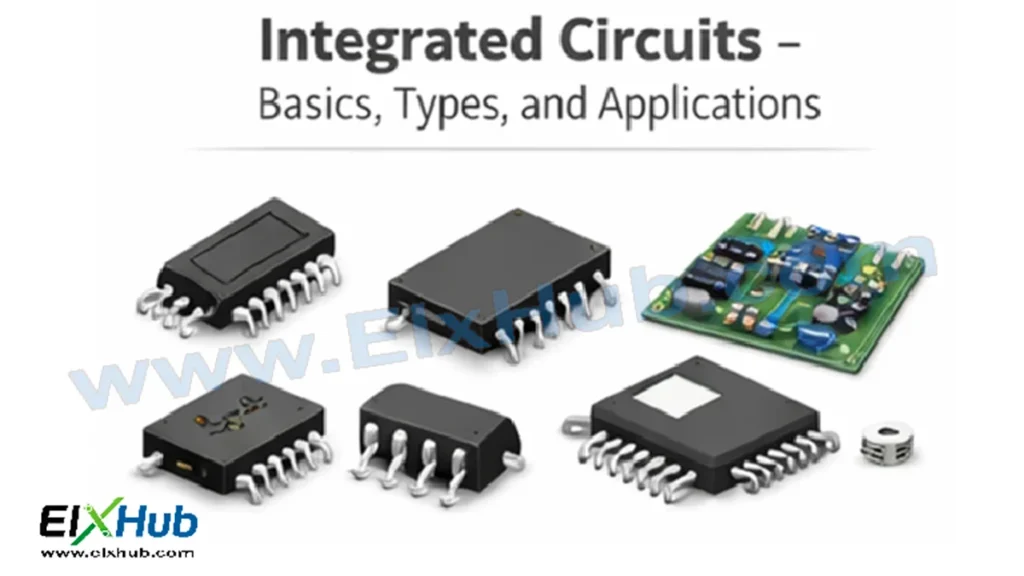
Integrated Circuits (ICs) are one of the most important inventions in the history of electronics. They transformed bulky, complex electronic systems into compact, reliable, and high-performance devices. Today, integrated circuits are found in almost every electronic product, including smartphones, computers, televisions, medical equipment, automobiles, industrial machines, and household appliances.
Before the invention of ICs, electronic circuits were built using discrete components such as resistors, capacitors, diodes, and transistors wired together on circuit boards. These circuits were large, power-hungry, expensive, and prone to failure. Integrated circuits solved these problems by combining thousands, millions, or even billions of electronic components onto a single small semiconductor chip.
In this comprehensive beginner-friendly guide, we will explore what integrated circuits are, how they work, their internal structure, different types, packaging methods, advantages, limitations, and real-world applications. This article is designed to build a strong conceptual foundation in basic electronics.
[Image Placeholder: Overview of integrated circuits on a PCB]
What Is an Integrated Circuit?
An Integrated Circuit (IC) is a miniaturized electronic circuit in which active and passive components such as transistors, resistors, capacitors, and diodes are fabricated onto a single semiconductor substrate, usually silicon. These components are interconnected internally to perform a specific electronic function.
Because all components are integrated into one chip, ICs offer improved performance, lower power consumption, smaller size, and higher reliability compared to discrete circuits.
[Image Placeholder: Integrated circuit chip close-up]
History of Integrated Circuits
The concept of integrated circuits emerged in the late 1950s. Jack Kilby of Texas Instruments and Robert Noyce of Fairchild Semiconductor independently developed the first ICs. Their work laid the foundation for modern microelectronics.
Early ICs contained only a few transistors. Over time, advancements in semiconductor fabrication enabled higher levels of integration, leading to the development of microprocessors, memory chips, and complex system-on-chip designs.
[Image Placeholder: Timeline of IC evolution]
Why Integrated Circuits Are Important
Integrated circuits are essential because they:
Reduce circuit size and weight
Lower manufacturing costs
Improve reliability by reducing wiring
Enable complex electronic functions
Support high-speed operation
Consume less power
Without ICs, modern computing, digital communication, automation, and consumer electronics would not be possible.
[Image Placeholder: Comparison of discrete circuits vs ICs]
Basic Structure of an Integrated Circuit
An integrated circuit is built on a silicon wafer using advanced semiconductor manufacturing processes. The basic elements inside an IC include:
Transistors (as switches or amplifiers)
Resistors (for current control)
Capacitors (for energy storage)
Diodes (for rectification and protection)
Metal interconnections (to connect components)
These elements are fabricated in microscopic dimensions using photolithography and doping techniques.
[Image Placeholder: Internal structure of an IC]
Levels of Integration
Integrated circuits are classified based on the number of components they contain.
| Level of Integration | Description | Examples |
|---|---|---|
| SSI | Small Scale Integration | Logic gates |
| MSI | Medium Scale Integration | Counters, multiplexers |
| LSI | Large Scale Integration | Early microprocessors |
| VLSI | Very Large Scale Integration | Modern CPUs |
| ULSI | Ultra Large Scale Integration | Advanced processors |
[Image Placeholder: IC integration levels chart]
Types of Integrated Circuits
Integrated circuits can be classified in several ways, depending on their function, construction, and application.
Analog Integrated Circuits
Analog ICs process continuous signals. Their output varies smoothly with input.
Examples include:
Operational amplifiers
Voltage regulators
Audio amplifiers
Oscillators
[Image Placeholder: Analog IC examples]
Digital Integrated Circuits
Digital ICs operate using discrete logic levels, typically binary 0 and 1.
Examples include:
Logic gates
Flip-flops
Counters
Microprocessors
Memory ICs
[Image Placeholder: Digital IC logic diagram]
Mixed-Signal Integrated Circuits
Mixed-signal ICs handle both analog and digital signals on the same chip.
Examples include:
Analog-to-digital converters (ADC)
Digital-to-analog converters (DAC)
Phase-locked loops
Communication ICs
[Image Placeholder: Mixed-signal IC block diagram]
Linear vs Non-Linear Integrated Circuits
Linear ICs amplify or process signals without distortion within their operating range, such as operational amplifiers and regulators.
Non-linear ICs perform switching or logic operations, such as digital logic ICs and microcontrollers.
[Image Placeholder: Linear vs non-linear IC comparison]
IC Packaging Types
The package protects the IC and provides electrical connections to external circuits.
| Package Type | Description | Common Use |
|---|---|---|
| DIP | Dual In-line Package | Prototyping |
| SIP | Single In-line Package | Compact boards |
| SOP | Small Outline Package | Surface mount |
| QFP | Quad Flat Package | Microcontrollers |
| BGA | Ball Grid Array | High-performance CPUs |
[Image Placeholder: IC package types]
Pin Configuration and Pinouts
Each IC has a specific pin configuration that defines power supply pins, input pins, output pins, and control pins. Understanding IC pinouts is essential for correct circuit design.
[Image Placeholder: IC pinout diagram]
How Integrated Circuits Work
Integrated circuits work by controlling the flow of electrical signals through microscopic transistors and interconnections. Depending on the design:
Analog ICs amplify or condition signals
Digital ICs perform logic operations
Control ICs manage voltage, current, or timing
All these functions occur at extremely high speeds within a tiny silicon chip.
[Image Placeholder: Signal flow inside an IC]
Applications of Integrated Circuits
Integrated circuits are used across almost every industry.
| Application Area | Role of ICs |
|---|---|
| Consumer electronics | Smartphones, TVs |
| Computing | CPUs, GPUs |
| Communication | Modems, RF ICs |
| Automotive | Engine control units |
| Medical | Diagnostic equipment |
| Industrial | Automation systems |
[Image Placeholder: IC applications in real life]
Advantages of Integrated Circuits
Small size and lightweight
High reliability
Low power consumption
High processing speed
Cost-effective mass production
Reduced noise and interference
Limitations of Integrated Circuits
Difficult to repair or modify
Limited power handling (standard ICs)
Sensitive to static electricity
Heat dissipation challenges
[Image Placeholder: IC overheating example]
Integrated Circuits vs Discrete Circuits
Integrated circuits offer significant advantages over discrete circuits in terms of size, performance, and cost, making them the preferred choice for modern electronics.
[Image Placeholder: Discrete vs IC circuit comparison]
Future of Integrated Circuits
The future of integrated circuits lies in:
Smaller fabrication nodes
3D ICs
System-on-chip designs
AI and machine learning accelerators
Low-power and energy-efficient electronics
[Image Placeholder: Future IC technology]
Looking for the right chip for your circuit? Check out our Ultimate IC Selection Guide to find the perfect timer, op-amp, or regulator for your design!
Conclusion
Integrated circuits are the foundation of modern electronics. By integrating thousands or millions of components onto a single chip, ICs have enabled compact, efficient, and powerful electronic systems. Understanding the basics, types, and applications of integrated circuits is essential for anyone learning electronics.
As you progress further, you will encounter ICs in every field of electronics, from basic analog circuits to advanced digital systems and power electronics.
Image Reference Table
| Image Purpose | Filename | Alt Text | Description |
|---|---|---|---|
| Feature Image | integrated-circuits-basics-types-applications-featured.webp | Integrated circuits basics types applications | Featured image showing different ICs and PCB |
| Overview | integrated-circuits-on-pcb.webp | Integrated circuits on PCB | ICs mounted on a printed circuit board |
| Chip Close-up | ic-chip-close-up.webp | Integrated circuit chip close-up | Detailed view of an IC chip |
| History | ic-evolution-timeline.webp | Integrated circuit evolution timeline | Timeline showing IC development |
| Comparison | discrete-vs-ic-circuits.webp | Discrete vs IC circuits | Comparison between discrete and IC designs |
| Structure | ic-internal-structure.webp | Internal structure of IC | Inside view of an integrated circuit |
| Integration | ic-integration-levels.webp | Levels of IC integration | SSI to VLSI comparison |
| Analog | analog-integrated-circuits.webp | Analog integrated circuits | Examples of analog ICs |
| Digital | digital-integrated-circuits.webp | Digital integrated circuits | Logic-based ICs |
| Mixed | mixed-signal-ic.webp | Mixed-signal integrated circuit | ADC and DAC ICs |
| Packaging | ic-package-types.webp | Integrated circuit package types | DIP, SOP, QFP, BGA packages |
| Pinout | ic-pinout-diagram.webp | IC pin configuration diagram | Typical IC pinout |
| Signal Flow | ic-signal-flow.webp | Signal flow inside IC | Internal operation of IC |
| Applications | ic-applications-electronics.webp | Integrated circuit applications | IC usage across industries |
| Heating | ic-overheating.webp | IC overheating issue | Thermal challenges in ICs |
| Future | future-integrated-circuits.webp | Future of integrated circuits | Advanced IC technologies |
SEO Title
Integrated Circuits Explained – Basics, Types, and Applications for Beginners
Meta Description
Learn integrated circuits basics, types, packaging, working principles, and applications in this complete beginner-friendly electronics guide.


