
Introduction
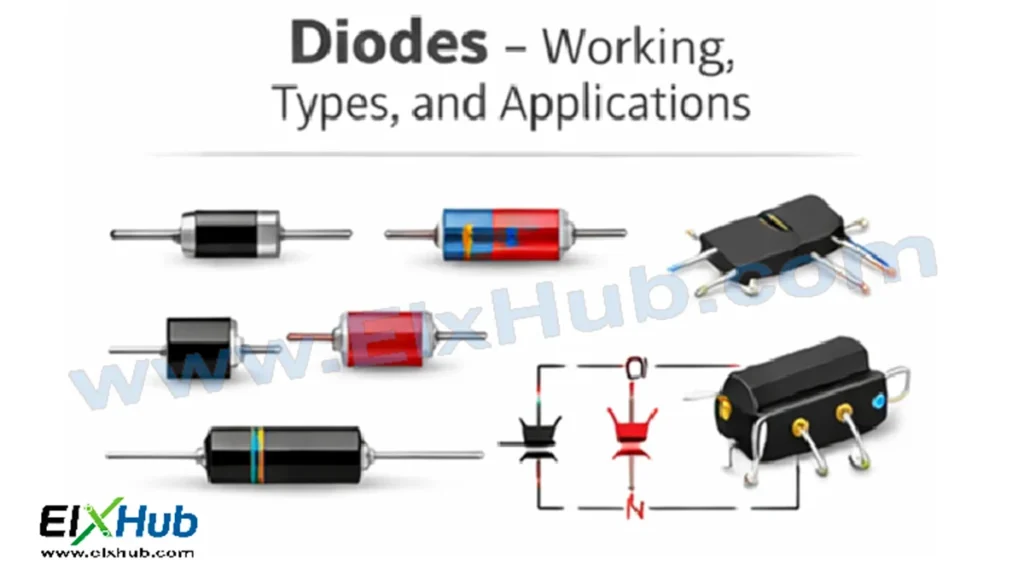
Diodes are one of the most fundamental and widely used components in basic electronics. They play a critical role in controlling the direction of current flow in electronic circuits and act as building blocks for rectifiers, voltage regulators, signal processors, protection circuits, and many other applications. Without diodes, modern power supplies, communication systems, digital logic protection, and signal conditioning circuits would not function properly.
A diode is essentially a semiconductor device that allows electric current to flow easily in one direction while blocking it in the opposite direction. This simple but powerful behavior makes diodes indispensable in both low-power and high-power electronic systems. From converting alternating current (AC) into direct current (DC) to protecting sensitive circuits from voltage spikes, diodes are everywhere.
In this detailed beginner-friendly guide, you will learn what diodes are, how they work internally, their electrical characteristics, different types of diodes, symbols, practical circuits, advantages, limitations, and real-world applications. This article is designed to give you a strong conceptual foundation in basic electronics.
[Image Placeholder: Different types of diodes overview]
What Is a Diode?
A diode is a two-terminal semiconductor device made primarily from silicon or germanium. The two terminals are called the anode and the cathode. Under normal operation, current flows from the anode to the cathode when the diode is forward biased and is blocked when the diode is reverse biased.
This unidirectional current flow behavior is what distinguishes a diode from other electronic components like resistors or capacitors.
[Image Placeholder: Diode symbol and physical form]
Construction of a Diode
Most diodes are made using a PN junction, which is formed by joining P-type and N-type semiconductor materials.
P-type material contains an excess of holes (positive charge carriers)
N-type material contains an excess of electrons (negative charge carriers)
When these two materials are joined, a depletion region is formed at the junction. This region plays a crucial role in the operation of the diode.
[Image Placeholder: PN junction formation]
Working Principle of a Diode
The operation of a diode depends on how it is biased in a circuit.
Forward Bias Condition
When the anode is connected to the positive terminal of a power supply and the cathode to the negative terminal, the diode is said to be forward biased. In this condition:
The depletion region narrows
Charge carriers cross the junction
Current flows through the diode
For silicon diodes, conduction typically begins at around 0.7V.
[Image Placeholder: Forward biased diode]
Reverse Bias Condition
When the anode is connected to the negative terminal and the cathode to the positive terminal, the diode is reverse biased. In this condition:
The depletion region widens
Current flow is blocked
Only a very small leakage current flows
If the reverse voltage exceeds a certain limit, breakdown may occur.
[Image Placeholder: Reverse biased diode]
V-I Characteristics of a Diode
The voltage-current (V-I) characteristic curve of a diode shows how current changes with applied voltage.
| Region | Behavior |
|---|---|
| Forward region | Current increases rapidly after threshold |
| Reverse region | Very small leakage current |
| Breakdown region | Sudden increase in current |
Understanding the V-I characteristics is essential for selecting diodes in practical circuits.
[Image Placeholder: Diode V-I characteristic curve]
Types of Diodes
There are many types of diodes designed for specific applications. Below are the most important ones used in basic and advanced electronics.
PN Junction Diode
This is the most basic diode type used mainly for rectification and switching applications.
Applications include:
Rectifiers
Clipping circuits
Clamping circuits
[Image Placeholder: PN junction diode]
Zener Diode
A Zener diode is designed to operate in reverse breakdown mode and maintain a constant output voltage.
Key features:
Precise voltage regulation
Operates safely in breakdown region
Applications include:
Voltage regulators
Overvoltage protection
[Image Placeholder: Zener diode working]
Schottky Diode
Schottky diodes have a metal-semiconductor junction instead of a PN junction.
Advantages:
Low forward voltage drop
Fast switching speed
Applications include:
High-speed switching
Power supplies
RF circuits
[Image Placeholder: Schottky diode symbol]
Light Emitting Diode (LED)
LEDs emit light when forward biased due to recombination of charge carriers.
Characteristics:
Low power consumption
Long life
Available in many colors
Applications include:
Display indicators
Lighting systems
Optocouplers
[Image Placeholder: LED illumination]
Photodiode
A photodiode converts light into electrical current.
Applications include:
Light sensors
Solar cells
Optical communication systems
[Image Placeholder: Photodiode operation]
Tunnel Diode
Tunnel diodes exploit quantum tunneling and operate at very high speeds.
Applications include:
Microwave oscillators
High-frequency amplifiers
[Image Placeholder: Tunnel diode characteristic]
Varactor Diode
Varactor diodes act as voltage-controlled capacitors.
Applications include:
RF tuning circuits
Frequency modulation
[Image Placeholder: Varactor diode]
Rectifier Diodes
Rectifier diodes are designed to handle high current and voltage.
Applications include:
AC to DC converters
Power supplies
[Image Placeholder: Rectifier diode]
Diode Symbols and Identification
Each diode type has a unique circuit symbol. Physical diodes are often marked with a stripe to indicate the cathode terminal.
[Image Placeholder: Diode symbols chart]
Practical Applications of Diodes
Diodes are used in a wide range of electronic applications.
| Application | Role of Diode |
|---|---|
| Power supplies | AC to DC conversion |
| Signal processing | Clipping and clamping |
| Protection circuits | Reverse polarity protection |
| Communication | Signal detection |
| Lighting | LEDs |
[Image Placeholder: Diode applications]
Diodes in Rectifier Circuits
Rectifier circuits use diodes to convert AC into DC.
Types include:
Half-wave rectifier
Full-wave rectifier
Bridge rectifier
Each configuration uses diodes differently to improve efficiency and output smoothness.
[Image Placeholder: Rectifier circuit using diodes]
Advantages of Diodes
Simple and compact design
Low cost
High reliability
Fast switching capability
Wide range of applications
Limitations of Diodes
Voltage drop in forward bias
Power loss as heat
Reverse breakdown damage if not rated properly
[Image Placeholder: Diode heat dissipation]
Diodes vs Other Components
Unlike resistors or capacitors, diodes provide directional control of current. This makes them unique and essential for many electronic functions.
[Image Placeholder: Diode vs resistor comparison]
Selecting the Right Diode
When choosing a diode, consider:
Maximum current rating
Reverse voltage rating
Switching speed
Power dissipation
Application type
[Image Placeholder: Diode selection guide]
Future Trends in Diode Technology
Modern diodes are becoming faster, more efficient, and capable of handling higher power levels. Wide bandgap materials like silicon carbide and gallium nitride are shaping the future of diode technology.
[Image Placeholder: Advanced diode technology]
Conclusion
Diodes are essential components that enable controlled current flow in electronic circuits. From basic rectification to advanced signal processing and protection, diodes play a critical role in both basic and advanced electronics. Understanding how diodes work, their types, and their applications is a fundamental step for anyone learning electronics.
As you continue exploring electronics, you will encounter diodes in nearly every circuit, making this knowledge invaluable for practical design and troubleshooting.
Image Reference Table
| Image Purpose | Filename | Alt Text | Description |
|---|---|---|---|
| Feature Image | diodes-working-types-applications-featured.webp | Diodes working types applications | Featured image showing different diode types |
| Overview | diode-types-overview.webp | Types of diodes overview | Common diode types used in electronics |
| Symbol | diode-symbol-physical.webp | Diode symbol and package | Circuit symbol and physical diode |
| PN Junction | pn-junction-diode.webp | PN junction diode | Internal PN junction structure |
| Forward Bias | diode-forward-bias.webp | Forward biased diode | Current flow in forward bias |
| Reverse Bias | diode-reverse-bias.webp | Reverse biased diode | Diode blocking current |
| VI Curve | diode-vi-characteristics.webp | Diode V-I characteristics | Voltage-current curve |
| Zener | zener-diode-working.webp | Zener diode working | Voltage regulation using Zener |
| Schottky | schottky-diode.webp | Schottky diode | Low voltage drop diode |
| LED | led-working.webp | Light emitting diode | LED light emission |
| Photo | photodiode-working.webp | Photodiode working | Light sensing diode |
| Rectifier | rectifier-diode.webp | Rectifier diode | High power rectifier |
| Symbols | diode-symbols-chart.webp | Diode symbols chart | Symbols of different diodes |
| Applications | diode-applications.webp | Diode applications | Real-world diode usage |
| Rectifier Circuit | rectifier-circuit-diode.webp | Diode rectifier circuit | AC to DC conversion |
| Heating | diode-heat-dissipation.webp | Diode heat dissipation | Power loss in diode |
| Comparison | diode-vs-resistor.webp | Diode vs resistor | Functional comparison |
| Selection | diode-selection-guide.webp | Selecting a diode | Diode selection parameters |
| Future | advanced-diode-technology.webp | Advanced diode technology | Modern diode materials |
SEO Title
Diodes Explained – Working Principle, Types, and Applications in Electronics
Meta Description
Learn diodes working principle, PN junction operation, types of diodes, characteristics, and real-world applications in this complete beginner electronics guide.


