Introduction
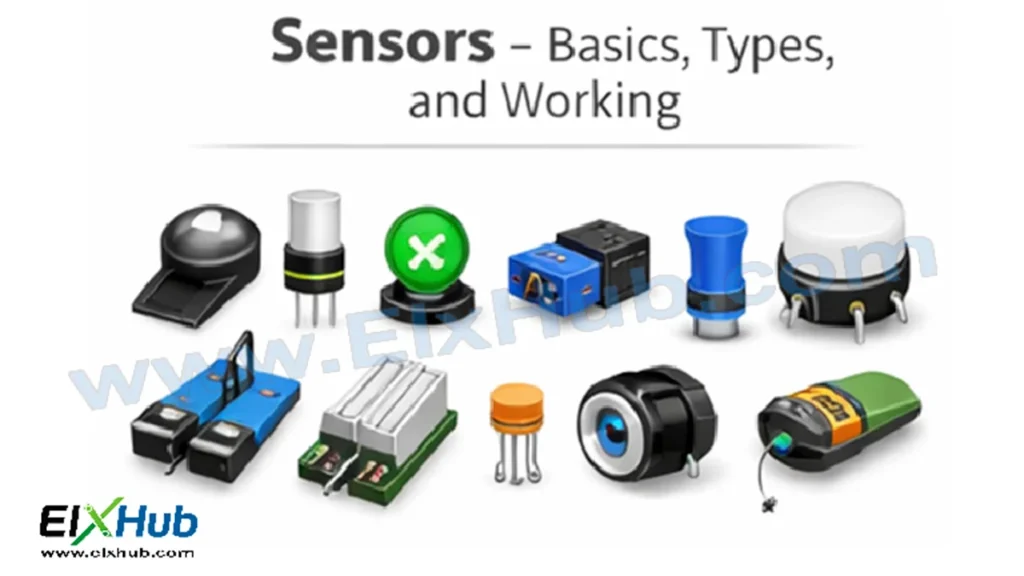
Sensors are fundamental building blocks of modern electronics, acting as the bridge between the physical world and electronic systems. They allow electronic circuits, microcontrollers, and computers to detect, measure, and respond to real-world conditions such as temperature, light, pressure, motion, sound, gas concentration, and many other physical parameters. Without sensors, automation, smart devices, industrial control systems, medical equipment, and Internet of Things (IoT) applications would not be possible.
In basic electronics, understanding sensors is essential because they convert physical quantities (also called measurands) into electrical signals that can be processed, displayed, stored, or used for control. This article provides a complete beginner-friendly yet detailed explanation of sensors, covering their definition, working principle, classification, types, characteristics, interfacing basics, advantages, limitations, and real-world applications. The goal is to give you a strong conceptual foundation before moving to advanced electronics, embedded systems, or automation.
[Image Placeholder: Different types of sensors overview]
What Is a Sensor?
A sensor is an electronic or electromechanical device that detects changes in a physical quantity and converts them into a corresponding electrical signal. This electrical signal can be in the form of voltage, current, resistance, capacitance, frequency, or digital data.
In simple terms, a sensor “senses” something from the environment and translates it into a signal that an electronic system can understand.
Examples of physical quantities sensed include:
Temperature
Light intensity
Pressure
Humidity
Motion
Sound
Gas concentration
[Image Placeholder: Sensor concept block diagram]
Basic Sensor System
A complete sensor-based system typically consists of the following parts:
| Block | Function |
|---|---|
| Sensor element | Detects the physical quantity |
| Transducer | Converts it into an electrical signal |
| Signal conditioning | Amplifies, filters, or linearizes signal |
| Processing unit | Microcontroller or processor |
| Output | Display, control, or data transmission |
[Image Placeholder: Basic sensor system block diagram]
Working Principle of Sensors
The working principle of a sensor depends on the type of physical quantity being measured and the sensing technology used. However, the general concept remains the same.
- A physical stimulus acts on the sensing element
- The sensing element undergoes a change in property
- This change is converted into an electrical signal
- The signal is conditioned and processed
For example, in a temperature sensor, the resistance or voltage of the sensing element changes with temperature.
[Image Placeholder: Sensor working principle diagram]
Active and Passive Sensors
Sensors are broadly classified based on their power requirement.
Active Sensors
Active sensors require an external power source to operate and produce an output signal.
Examples:
Proximity sensors
Ultrasonic sensors
Radar sensors
[Image Placeholder: Active sensor example]
Passive Sensors
Passive sensors do not require an external power source and generate output directly from the sensed energy.
Examples:
Thermocouples
Photodiodes
Piezoelectric sensors
[Image Placeholder: Passive sensor example]
Analog and Digital Sensors
Based on output signal type, sensors are classified as analog or digital.
| Sensor Type | Output |
|---|---|
| Analog sensor | Continuous signal |
| Digital sensor | Discrete or binary signal |
[Image Placeholder: Analog vs digital sensor output]
Classification of Sensors by Measured Quantity
Sensors are also classified based on what they measure.
Temperature Sensors
Temperature sensors detect changes in temperature and convert them into electrical signals.
Common types:
Thermistors
RTDs
Thermocouples
Semiconductor temperature sensors
[Image Placeholder: Temperature sensors]
Light Sensors
Light sensors measure light intensity or illumination level.
Common types:
LDR (Light Dependent Resistor)
Photodiodes
Phototransistors
[Image Placeholder: Light sensor types]
Pressure Sensors
Pressure sensors measure force per unit area.
Applications include:
Industrial automation
Automotive systems
Medical devices
[Image Placeholder: Pressure sensor]
Proximity Sensors
Proximity sensors detect the presence or absence of objects without physical contact.
Types:
Inductive
Capacitive
Infrared
Ultrasonic
[Image Placeholder: Proximity sensor]
Motion Sensors
Motion sensors detect movement or changes in position.
Examples:
PIR sensors
Accelerometers
Gyroscopes
[Image Placeholder: Motion sensors]
Gas Sensors
Gas sensors detect specific gases in the environment.
Applications include:
Gas leakage detection
Air quality monitoring
[Image Placeholder: Gas sensor]
Humidity Sensors
Humidity sensors measure moisture content in the air.
Types:
Capacitive humidity sensors
Resistive humidity sensors
[Image Placeholder: Humidity sensor]
Sound Sensors
Sound sensors convert sound waves into electrical signals.
Commonly used microphones:
Electret microphones
Condenser microphones
[Image Placeholder: Sound sensor]
Transducers and Sensors
Although often used interchangeably, sensors and transducers have a subtle difference.
| Term | Description |
|---|---|
| Sensor | Detects physical quantity |
| Transducer | Converts energy form |
Most sensors include a transducer as part of their structure.
[Image Placeholder: Sensor vs transducer]
Sensor Characteristics
Understanding sensor characteristics is crucial for selecting the right sensor.
| Characteristic | Meaning |
|---|---|
| Sensitivity | Output change per unit input |
| Accuracy | Closeness to true value |
| Resolution | Smallest detectable change |
| Linearity | Output proportionality |
| Response time | Speed of response |
| Range | Minimum and maximum measurable value |
[Image Placeholder: Sensor characteristics graph]
Calibration of Sensors
Calibration ensures that sensor output accurately represents the measured quantity. It involves comparing sensor output with a known reference and adjusting the system if necessary.
Calibration is important in:
Industrial measurements
Medical equipment
Scientific instruments
[Image Placeholder: Sensor calibration]
Interfacing Sensors with Electronic Circuits
Sensors are often interfaced with microcontrollers or analog circuits.
Common interfacing methods:
Voltage divider circuits
Operational amplifiers
ADC (Analog to Digital Converter)
[Image Placeholder: Sensor interfacing circuit]
Sensors in Basic Electronics Projects
In beginner electronics projects, sensors are widely used to create interactive systems.
Examples:
Temperature monitoring
Light-activated switches
Motion-based alarms
Automatic fans
[Image Placeholder: Sensor-based project]
Applications of Sensors
Sensors are used across almost every industry.
| Field | Applications |
|---|---|
| Consumer electronics | Smartphones, wearables |
| Industrial automation | Process control |
| Automotive | Engine control, safety |
| Medical | Patient monitoring |
| Environmental | Weather stations |
| IoT | Smart homes, cities |
[Image Placeholder: Sensor applications]
Advantages of Sensors
Enable automation and control
Improve safety and efficiency
Provide real-time data
Essential for smart systems
Limitations of Sensors
Accuracy affected by environment
Require calibration
Can be sensitive to noise
Limited lifespan for some types
[Image Placeholder: Sensor limitations]
Future Trends in Sensor Technology
Modern sensors are becoming:
Smaller and more efficient
More accurate and reliable
Integrated with wireless communication
Smarter with built-in processing
These advancements are driving growth in IoT, AI, and automation.
[Image Placeholder: Future sensor technology]
Conclusion
Sensors are the foundation of modern electronic systems, enabling machines and devices to sense and interact with the physical world. From simple temperature measurement to complex motion detection and environmental monitoring, sensors play a critical role in basic and advanced electronics alike.
By understanding the basics of sensors, their working principles, types, characteristics, and applications, you gain essential knowledge for electronics, embedded systems, robotics, and automation. As technology evolves, sensors will continue to become smarter, smaller, and more powerful, making them an exciting and indispensable part of electronics.
Image Reference Table
| Image Purpose | Filename | Alt Text | Description |
|---|---|---|---|
| Feature Image | sensors-basics-types-working-featured.webp | Sensors basics types and working | Featured image showing common sensors |
| Overview | types-of-sensors-overview.webp | Types of sensors overview | Various sensor categories |
| Concept | sensor-concept-diagram.webp | Sensor concept diagram | Physical to electrical conversion |
| System | sensor-system-block-diagram.webp | Sensor system block diagram | Complete sensing system |
| Working | sensor-working-principle.webp | Sensor working principle | How sensors operate |
| Active | active-sensor-example.webp | Active sensor example | Powered sensor |
| Passive | passive-sensor-example.webp | Passive sensor example | Self-generating sensor |
| Analog vs Digital | analog-digital-sensor-output.webp | Analog vs digital sensor output | Signal comparison |
| Temperature | temperature-sensors.webp | Temperature sensors | Common temperature sensors |
| Light | light-sensor-types.webp | Light sensor types | LDR and photodiodes |
| Pressure | pressure-sensor.webp | Pressure sensor | Pressure measurement |
| Proximity | proximity-sensor.webp | Proximity sensor | Contactless detection |
| Motion | motion-sensors.webp | Motion sensors | PIR and accelerometer |
| Gas | gas-sensor.webp | Gas sensor | Gas detection |
| Humidity | humidity-sensor.webp | Humidity sensor | Moisture measurement |
| Sound | sound-sensor.webp | Sound sensor | Microphone-based sensor |
| Comparison | sensor-vs-transducer.webp | Sensor vs transducer | Conceptual difference |
| Characteristics | sensor-characteristics.webp | Sensor characteristics graph | Key parameters |
| Calibration | sensor-calibration.webp | Sensor calibration | Accuracy adjustment |
| Interfacing | sensor-interfacing-circuit.webp | Sensor interfacing circuit | Connecting to electronics |
| Projects | sensor-project-example.webp | Sensor-based project | Beginner electronics project |
| Applications | sensor-applications.webp | Applications of sensors | Industry usage |
| Limitations | sensor-limitations.webp | Sensor limitations | Environmental effects |
| Future | future-sensor-technology.webp | Future sensor technology | Advanced sensors |
SEO Title
Sensors Explained – Basics, Types, Working Principles, and Applications
Meta Description
Learn sensors basics, types, working principles, characteristics, and applications in electronics with this complete beginner-friendly guide.