
Introduction
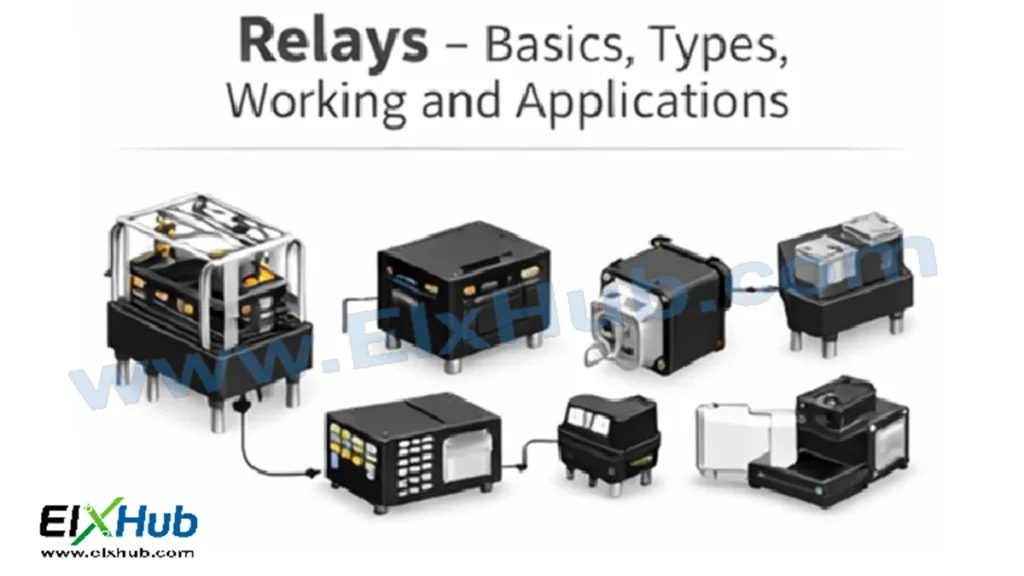
Relays are among the most important and practical components in Basic Electronics. They act as electrically operated switches that allow a low-power electrical signal to control a high-power circuit safely and reliably. Because of this ability, relays are widely used in control systems, automation, protection circuits, automotive electronics, home appliances, and industrial machinery.
For beginners, relays are often the first component that demonstrates how electronics can interact with real-world electrical loads such as motors, lamps, heaters, and solenoids. Even though modern electronics increasingly uses solid-state devices, relays continue to be essential due to their simplicity, strong electrical isolation, and capability to handle high voltages and currents.
This article explains relays in a clear and structured way, covering their definition, construction, working principle, types, specifications, advantages, limitations, and applications. Image placeholders are included throughout the article, and a complete image reference table (with filename, alt text, and description) is provided at the end, strictly following your locked preferences.
[Image Placeholder: Feature image showing different types of relays used in electronics]
What Is a Relay?
A relay is an electrically controlled switch that opens or closes contacts in response to an electrical signal applied to its control terminals. The control circuit and the load circuit are electrically isolated from each other, which makes relays safe and versatile.
In simple terms, a relay allows a small current or voltage to control a much larger current or voltage. This makes it possible to use electronic circuits, microcontrollers, or sensors to control electrical equipment.
Key characteristics of relays:
Electrical isolation between control and load
Ability to switch high current and voltage
Remote and automatic operation
Compatibility with AC and DC systems
[Image Placeholder: Relay symbol and basic definition diagram]
Why Relays Are Important in Electronics
Relays solve several practical problems in electronic and electrical systems. Their importance becomes clear when dealing with power control and safety.
| Reason | Explanation |
|---|---|
| Electrical isolation | Protects sensitive electronics from high voltage |
| Power amplification | Small signal controls large electrical load |
| Safety | Reduces risk of electric shock and damage |
| Automation | Enables automatic and remote switching |
| Versatility | Used in many types of circuits |
[Image Placeholder: Relay isolation between control circuit and load circuit]
Basic Construction of a Relay
A typical electromechanical relay consists of both electrical and mechanical components working together.
| Component | Function |
|---|---|
| Coil | Generates magnetic field when energized |
| Iron core | Strengthens magnetic field |
| Armature | Movable metal lever |
| Contacts | Open or close the load circuit |
| Spring | Returns armature to default position |
| Enclosure | Protects internal parts |
[Image Placeholder: Internal construction of an electromechanical relay]
Working Principle of a Relay
Relays work on the principle of electromagnetism. When electric current flows through the coil, it produces a magnetic field. This magnetic field attracts the armature, causing the contacts to change position.
Step-by-step operation:
- Control voltage is applied to the relay coil
- Coil generates a magnetic field
- Armature moves toward the core
- Contacts switch from their normal state
- Load circuit turns ON or OFF
- When coil is de-energized, the spring resets contacts
This process allows indirect control of high-power circuits.
[Image Placeholder: Relay working principle step-by-step diagram]
Normally Open (NO) and Normally Closed (NC) Contacts
Relay contacts are classified based on their default state when the coil is not energized.
| Contact Type | Description |
|---|---|
| Normally Open (NO) | Open when relay is OFF, closes when ON |
| Normally Closed (NC) | Closed when relay is OFF, opens when ON |
| Changeover (CO) | Switches between NO and NC |
[Image Placeholder: NO and NC relay contact illustration]
Relay Contact Configurations
Relays are also classified using pole and throw terminology.
| Configuration | Description |
|---|---|
| SPST | Single Pole Single Throw |
| SPDT | Single Pole Double Throw |
| DPST | Double Pole Single Throw |
| DPDT | Double Pole Double Throw |
[Image Placeholder: Relay contact configuration symbols]
Types of Relays
Relays are available in many forms depending on their construction and application.
Electromechanical Relays
These are the most common relays, using mechanical contacts.
Features:
Physical contact movement
Audible clicking sound
High current capability
Applications:
Motor control
Power switching
Industrial automation
[Image Placeholder: Electromechanical relay photograph]
Solid State Relays (SSR)
Solid state relays use semiconductor devices instead of mechanical contacts.
Advantages:
No moving parts
Silent operation
Fast switching speed
Applications:
High-speed control
Noise-sensitive environments
[Image Placeholder: Solid state relay module]
Reed Relays
Reed relays use sealed reed switches activated by a magnetic field.
Features:
Compact size
Low contact resistance
Fast response
Applications:
Measurement instruments
Telecommunication systems
[Image Placeholder: Reed relay internal structure]
Latching Relays
Latching relays retain their contact position even after power is removed.
Benefits:
Low power consumption
Memory function
[Image Placeholder: Latching relay operation diagram]
Time Delay Relays
Time delay relays introduce a preset delay before switching.
Types:
On-delay relays
Off-delay relays
Applications:
Motor starting
Sequential control systems
[Image Placeholder: Time delay relay timing diagram]
Thermal Relays
Thermal relays operate based on heat produced by current flow.
Main use:
Motor overload protection
[Image Placeholder: Thermal relay in motor protection]
Automotive Relays
Designed specifically for vehicle electrical systems.
Used in:
Headlights
Fuel pumps
Cooling fans
[Image Placeholder: Automotive relay used in cars]
Relay Specifications
Understanding relay specifications is essential when selecting a relay.
| Parameter | Description |
|---|---|
| Coil voltage | Voltage required to energize coil |
| Coil current | Current drawn by the coil |
| Contact rating | Maximum load voltage and current |
| Switching time | Operate and release time |
| Contact resistance | Resistance when contacts are closed |
| Isolation voltage | Coil-to-contact insulation rating |
[Image Placeholder: Relay specification label example]
Relay Driving and Interfacing
Relays are often driven using electronic circuits rather than directly from logic outputs.
Common methods:
Transistor-based relay driver
Relay modules for microcontrollers
Optocoupler isolation
A flyback diode is always connected across the coil to protect electronic components from voltage spikes.
[Image Placeholder: Relay driver circuit with transistor]
Flyback Diode Protection
When a relay coil is switched OFF, it produces a high-voltage spike. A flyback diode safely absorbs this energy.
Benefits:
Protects ICs and transistors
Improves circuit reliability
[Image Placeholder: Flyback diode across relay coil]
Advantages of Relays
Can control high-power loads
Provide excellent electrical isolation
Simple and reliable operation
Suitable for AC and DC circuits
Limitations of Relays
Mechanical wear over time
Slower switching speed than solid-state devices
Audible noise during operation
Larger size
[Image Placeholder: Relay limitations illustration]
Applications of Relays
Relays are used in almost every electrical and electronic field.
| Field | Applications |
|---|---|
| Industrial systems | Motor control, automation |
| Power systems | Protection and switching |
| Automotive | Lighting and control systems |
| Home appliances | Washing machines, refrigerators |
| Embedded systems | Load control using microcontrollers |
[Image Placeholder: Relay applications in real-world systems]
Relays vs Manual Switches
Relays offer several advantages over manual switches.
| Feature | Relay | Manual Switch |
|—|—|
| Operation | Electrical | Manual |
| Automation | Yes | No |
| Isolation | Yes | No |
| Remote control | Possible | Not possible |
[Image Placeholder: Relay vs manual switch comparison]
Relays in Beginner Projects
Relays are commonly used in beginner electronics projects:
Automatic street lights
Home automation systems
Motor control circuits
Security alarms
[Image Placeholder: Relay-based beginner electronics project]
Future of Relays
Modern relays continue to evolve with hybrid designs that combine mechanical contacts and solid-state control. Despite advancements in electronics, relays remain essential where safety, isolation, and high power handling are required.
[Image Placeholder: Future relay technology concept]
Conclusion
Relays are a cornerstone of basic electronics. They allow safe, efficient, and reliable control of high-power circuits using low-power electrical signals. Understanding relays provides a strong foundation for learning automation, power electronics, and industrial control systems.
From simple school projects to complex industrial applications, relays continue to play a vital role in modern electronics.
Image Reference Table
| Image Purpose | Filename | Alt Text | Description |
|---|---|---|---|
| Feature Image | relays-basics-types-working-featured.webp | Relays basics types working | Featured image showing different relay types |
| Definition | relay-symbol-definition.webp | Relay symbol definition | Basic relay symbol and explanation |
| Isolation | relay-isolation-concept.webp | Relay electrical isolation | Control and load circuit isolation |
| Construction | relay-internal-construction.webp | Relay internal construction | Components inside a relay |
| Working | relay-working-principle.webp | Relay working principle | Step-by-step relay operation |
| Contacts | relay-no-nc-contacts.webp | Relay NO and NC contacts | Normally open and closed contacts |
| Configuration | relay-contact-configurations.webp | Relay contact configurations | SPST, SPDT, DPDT contacts |
| EM Relay | electromechanical-relay.webp | Electromechanical relay | Traditional mechanical relay |
| SSR | solid-state-relay.webp | Solid state relay | Semiconductor-based relay |
| Reed | reed-relay.webp | Reed relay | Compact reed switch relay |
| Latching | latching-relay.webp | Latching relay | Relay with memory function |
| Time Delay | time-delay-relay.webp | Time delay relay | Relay with timing control |
| Thermal | thermal-relay.webp | Thermal relay | Overload protection relay |
| Automotive | automotive-relay.webp | Automotive relay | Relay used in vehicles |
| Specifications | relay-specifications.webp | Relay specifications | Important relay parameters |
| Driver | relay-driver-circuit.webp | Relay driver circuit | Transistor-based relay driver |
| Flyback | flyback-diode-relay.webp | Flyback diode relay | Protection diode across coil |
| Limitations | relay-limitations.webp | Relay limitations | Mechanical relay drawbacks |
| Applications | relay-applications.webp | Relay applications | Industrial and domestic uses |
| Comparison | relay-vs-switch.webp | Relay vs manual switch | Relay and switch comparison |
| Project | relay-project-example.webp | Relay project example | Beginner relay-based project |
| Future | future-relay-technology.webp | Future relay technology | Advanced relay concepts |
SEO Title
Relays Explained – Basics, Types, Working and Applications in Electronics
Meta Description
Learn relays in electronics with this complete beginner guide covering basics, types, working principles, specifications, and real-world applications.


