Introduction
Digital integrated circuits (ICs) are the building blocks of modern electronics. Two of the most common logic families are TTL (Transistor-Transistor Logic) and CMOS (Complementary Metal-Oxide-Semiconductor). These families define how logic gates are implemented, how fast circuits operate, and how much power they consume.
Understanding TTL and CMOS is essential for electronics beginners because the choice of logic family affects circuit design, performance, and compatibility.
This article provides a detailed comparison of TTL and CMOS ICs, including working principles, characteristics, advantages, limitations, and applications.
What Are TTL ICs
TTL (Transistor-Transistor Logic) ICs use bipolar junction transistors (BJTs) to implement logic gates. In TTL circuits, both the logic function and amplification are performed by transistors.
TTL ICs operate at a standard 5V supply and are known for fast switching speed.
Image Placeholder (Horizontal): TTL IC block diagram showing transistor logic
Characteristics of TTL ICs
• Typical supply voltage: 5V
• Propagation delay: 10–20 ns
• Moderate power consumption
• Noise immunity: ~0.4V
• High current driving capability
Advantages of TTL
• Fast switching speed
• Robust operation
• Widely used and available
• Easy to interface with other TTL ICs
Limitations of TTL
• Higher power consumption than CMOS
• Limited voltage range
• Lower input impedance
What Are CMOS ICs
CMOS (Complementary Metal-Oxide-Semiconductor) ICs use complementary pairs of MOSFETs (PMOS and NMOS) to implement logic gates. CMOS technology provides extremely low power consumption and high input impedance.
CMOS ICs can operate at a wide range of supply voltages, from 3V to 15V, depending on the family.
Image Placeholder (Horizontal): CMOS IC structure showing PMOS and NMOS pairs
Characteristics of CMOS ICs
• Supply voltage: 3V–15V
• Very low static power consumption
• High input impedance
• Propagation delay: 10–100 ns (slower than TTL in older CMOS)
• Excellent noise immunity
Advantages of CMOS
• Extremely low power consumption
• Wide supply voltage range
• High noise immunity
• Ideal for battery-operated devices
Limitations of CMOS
• Slower switching speed (older generations)
• Susceptible to static electricity damage
• Limited current driving capability
TTL vs CMOS – Key Differences
| Feature | TTL ICs | CMOS ICs |
|---|---|---|
| Logic Implementation | Bipolar Transistors | CMOS MOSFETs |
| Power Consumption | Moderate | Very Low |
| Voltage Range | Typically 5V | 3–15V |
| Noise Immunity | Moderate (~0.4V) | High (~30% of Vcc) |
| Input Impedance | Low | Very High |
| Switching Speed | Fast | Slower (older), Fast (modern) |
| Current Driving | High | Low |
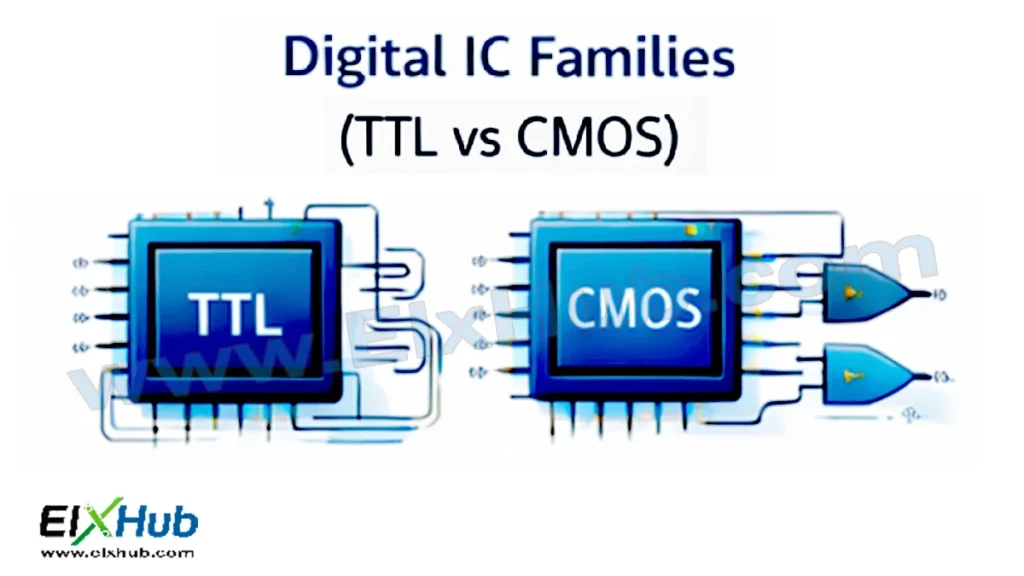
Image Placeholder (Horizontal): TTL vs CMOS IC comparison diagram
Logic Levels
TTL Logic Levels
• Logic HIGH: 2V–5V
• Logic LOW: 0V–0.8V
CMOS Logic Levels
• Logic HIGH: 70–90% of Vcc
• Logic LOW: 0–30% of Vcc
Correct voltage understanding ensures proper interfacing between TTL and CMOS devices.
Interfacing TTL and CMOS
TTL and CMOS ICs can be interfaced with proper voltage matching. Often, a pull-up resistor is used to connect TTL output to CMOS input to ensure reliable HIGH logic levels.
Image Placeholder (Horizontal): TTL-CMOS interfacing diagram
Popular TTL IC Families
• 7400 series (basic logic gates)
• 74LS (low-power Schottky)
• 74HC (high-speed CMOS compatible TTL)
Popular CMOS IC Families
• 4000 series (standard CMOS)
• 74HC (high-speed CMOS)
• 74HCT (TTL-compatible CMOS)
Image Placeholder (Horizontal): TTL and CMOS IC chips image
Applications of TTL ICs
• Microprocessor interfacing
• Logic circuits in computers
• LED and display drivers
• Industrial controllers
Applications of CMOS ICs
• Portable electronics
• Battery-operated devices
• Analog-digital circuits
• Microcontrollers and sensors
Choosing Between TTL and CMOS
The choice depends on:
• Power requirement – battery devices → CMOS
• Speed requirement – high-speed → TTL or modern CMOS
• Voltage compatibility – system voltage level
• Noise immunity – CMOS preferred
Common Beginner Mistakes
• Connecting TTL outputs to CMOS without pull-up resistors
• Overlooking supply voltage differences
• Ignoring propagation delay in high-speed circuits
• Damaging CMOS ICs with static electricity
FAQs About TTL and CMOS
Can TTL and CMOS be used together?
Yes, with proper voltage level matching.
Which is better for low-power devices?
CMOS is ideal due to minimal static power consumption.
Why are TTL ICs still used?
TTL ICs are robust, fast, and widely available.
Conclusion
TTL and CMOS ICs are the backbone of digital electronics. Understanding their differences, advantages, limitations, and applications is crucial for designing reliable and efficient digital systems. Mastery of TTL and CMOS logic families enables learners to work confidently with ICs in microcontrollers, processors, memory systems, and embedded devices.
SEO Title
TTL vs CMOS ICs – Difference, Working, Advantages, and Applications
Meta Description
Learn TTL and CMOS ICs in digital electronics. Complete guide covering characteristics, differences, working, advantages, limitations, and applications.