Introduction
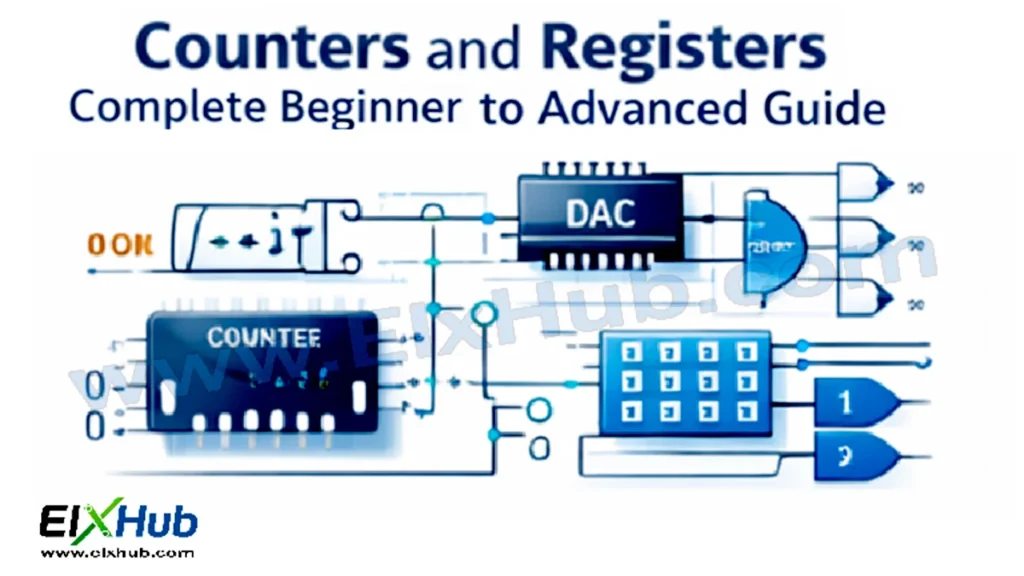
Counters and registers are fundamental building blocks in digital electronics used for data storage, counting events, sequencing operations, and timing control. Almost every digital system—microcontrollers, processors, clocks, communication devices, and automation systems—relies on counters and registers to function correctly. While counters focus on counting pulses or events, registers are designed to store and manipulate binary data. Understanding how counters and registers work is essential for mastering digital electronics and embedded systems.
This article explains counters and registers in detail, covering their types, working principles, truth tables, timing diagrams, applications, and common mistakes, with structured explanations suitable for beginners and intermediate learners.
What Is a Counter
A counter is a sequential digital circuit that counts the number of input pulses applied to it. Each pulse causes the counter to advance its output state according to a defined sequence. Counters are typically built using flip-flops and can count upward, downward, or follow a predefined pattern.
Counters differ from combinational circuits because their output depends not only on the current input but also on the previous state, making them sequential circuits.
Basic Characteristics of Counters
Counters operate using clock pulses and exhibit the following characteristics:
- Output changes on clock transitions
- State progression follows a defined sequence
- Can count up, down, or both
- Often resettable to an initial state
- May include enable and control inputs
Image Placeholder (Horizontal): Basic binary counter block diagram
Types of Counters
Asynchronous Counter (Ripple Counter)
An asynchronous counter is a counter in which each flip-flop is triggered by the output of the previous flip-flop, not directly by the clock. This causes a ripple effect, where changes propagate sequentially through the circuit.
Working Principle
- First flip-flop receives the clock pulse
- Each subsequent flip-flop is triggered by the output of the previous one
- Output changes ripple through the circuit
Advantages
- Simple design
- Fewer components
- Easy to implement
Disadvantages
- Slower due to propagation delay
- Not suitable for high-speed applications
Image Placeholder (Horizontal): 4-bit ripple counter timing diagram
Synchronous Counter
In a synchronous counter, all flip-flops receive the same clock signal simultaneously. This eliminates ripple delays and improves speed.
Working Principle
- Clock applied to all flip-flops at the same time
- Logic gates control when each flip-flop toggles
- Faster and more predictable operation
Advantages
- High speed
- Accurate timing
- Suitable for complex digital systems
Disadvantages
- More complex circuitry
- Requires additional logic gates
Image Placeholder (Horizontal): Synchronous counter logic diagram
Up Counter
An up counter counts in increasing binary order starting from zero.
Binary counting sequence example:
| Clock Pulse | Output (Q3 Q2 Q1 Q0) |
|---|---|
| 0 | 0000 |
| 1 | 0001 |
| 2 | 0010 |
| 3 | 0011 |
| 4 | 0100 |
| 5 | 0101 |
Down Counter
A down counter counts in decreasing binary order.
Binary counting sequence example:
| Clock Pulse | Output (Q3 Q2 Q1 Q0) |
|---|---|
| 0 | 1111 |
| 1 | 1110 |
| 2 | 1101 |
| 3 | 1100 |
| 4 | 1011 |
Up/Down Counter
An up/down counter can count upward or downward depending on a control input. This makes it useful in systems requiring bidirectional counting.
Image Placeholder (Horizontal): Up/down counter control logic
Modulus (MOD) Counter
A MOD-N counter counts from 0 to N–1 and then resets.
Examples:
- MOD-10 counter (Decade counter) counts from 0 to 9
- MOD-60 counter used in digital clocks
Image Placeholder (Horizontal): MOD-10 decade counter diagram
Applications of Counters
Counters are widely used in digital systems for various purposes:
- Digital clocks and watches
- Frequency measurement
- Event counting
- Timers and delays
- Address generation in memory systems
- Sequencing operations in processors
Image Placeholder (Horizontal): Counter applications in digital clock and frequency meter
What Is a Register
A register is a group of flip-flops used to store binary data temporarily. Each flip-flop stores one bit, so an n-bit register stores n bits of data. Registers are essential for data storage, transfer, and manipulation in digital systems.
Characteristics of Registers
- Store binary information
- Controlled by clock signals
- Can load, clear, or shift data
- Used inside CPUs, microcontrollers, and digital circuits
Image Placeholder (Horizontal): 4-bit register block diagram
Types of Registers
Parallel Register
A parallel register loads and outputs all bits simultaneously.
Features
- Fast data transfer
- Requires multiple data lines
- Used in internal CPU data storage
Image Placeholder (Horizontal): Parallel register timing diagram
Serial Register
A serial register loads or outputs data one bit at a time.
Features
- Fewer data lines
- Slower than parallel registers
- Used in communication systems
Image Placeholder (Horizontal): Serial register data flow diagram
Shift Registers
Shift registers move data left or right by one bit per clock pulse. They are extremely important in digital electronics.
Types of Shift Registers
| Type | Description |
|---|---|
| SISO | Serial In Serial Out |
| SIPO | Serial In Parallel Out |
| PISO | Parallel In Serial Out |
| PIPO | Parallel In Parallel Out |
Image Placeholder (Horizontal): Shift register types illustration
Working Example of a Shift Register
Consider a 4-bit right shift register with initial data 1011.
| Clock Pulse | Register Content |
|---|---|
| Initial | 1011 |
| 1 | 0101 |
| 2 | 0010 |
| 3 | 0001 |
Shift registers are widely used for data conversion and storage.
Applications of Registers
Registers play a critical role in:
- Temporary data storage
- Data transfer between components
- Arithmetic and logic operations
- Serial-to-parallel conversion
- Parallel-to-serial conversion
- Microprocessor and microcontroller architecture
Image Placeholder (Horizontal): Register applications in microprocessor data handling
Counters vs Registers Comparison
| Feature | Counter | Register |
|---|---|---|
| Primary Function | Counting events | Storing data |
| Output Change | Sequence-based | Data-based |
| Clock Dependency | Yes | Yes |
| Typical Use | Timers, clocks | CPUs, data transfer |
| Flip-Flops Used | Yes | Yes |
Common Beginner Mistakes
Many learners struggle with counters and registers due to conceptual confusion. Common mistakes include:
- Confusing counters with registers
- Ignoring clock synchronization
- Misunderstanding asynchronous vs synchronous behavior
- Incorrect reset logic design
- Forgetting propagation delays in ripple counters
- Misinterpreting shift direction in shift registers
Understanding timing diagrams and practicing with simulations helps avoid these issues.
FAQs
What is the main difference between a counter and a register?
A counter automatically progresses through states, while a register stores and holds data until changed.
Why are synchronous counters faster than ripple counters?
Because all flip-flops are triggered simultaneously, eliminating propagation delays.
Where are shift registers used in real life?
They are used in serial communication, LED displays, data converters, and microcontroller interfacing.
Can registers be used as counters?
With additional logic, registers can be configured to act as counters, but dedicated counters are more efficient.
Why are counters important in digital clocks?
They keep track of seconds, minutes, and hours by counting clock pulses.
Conclusion
Counters and registers form the backbone of sequential digital electronics. Counters enable accurate event counting, timing, and sequencing, while registers provide essential data storage and transfer capabilities. From simple digital clocks to advanced microprocessors, these components are indispensable. By understanding their types, working principles, truth tables, and applications, you build a strong foundation for advanced topics such as processors, memory systems, and embedded design. Mastery of counters and registers is a critical step toward becoming proficient in digital electronics.
SEO Title
Counters and Registers in Digital Electronics – Types, Working, and Applications
Meta Description
Learn counters and registers in digital electronics. Complete guide covering types, working principles, timing, and real-world applications.