Introduction
Microprocessors and microcontrollers are the heart of modern digital electronic systems. From computers and smartphones to washing machines, drones, and IoT devices, these components control how electronic systems think, process data, and interact with the real world. While the terms microprocessor and microcontroller are often used interchangeably by beginners, they are fundamentally different in structure, functionality, and applications.
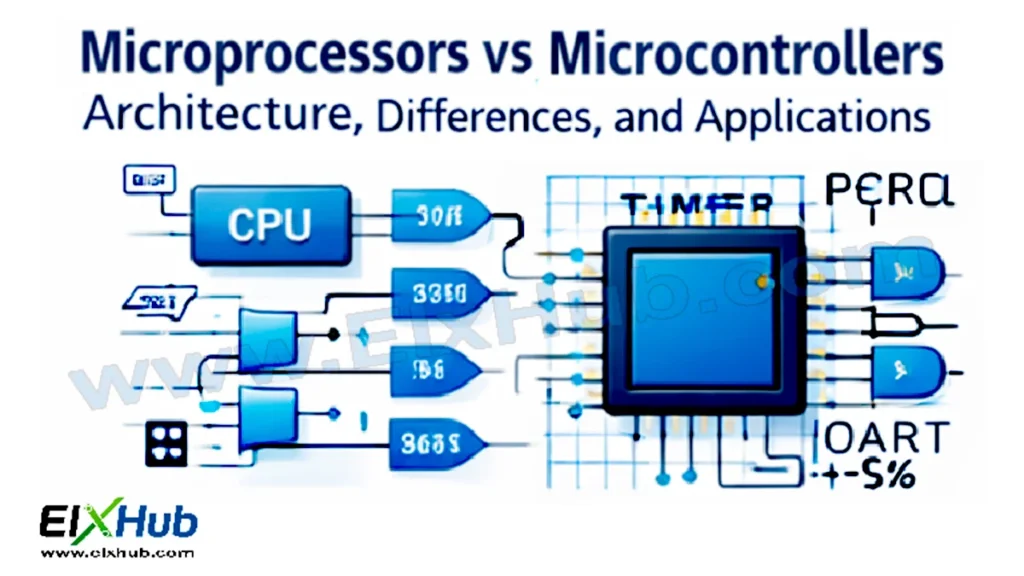
This article provides a complete and in-depth comparison of microprocessors and microcontrollers, covering architecture, internal components, working principles, advantages, limitations, and real-world applications.
What Is a Microprocessor
A microprocessor is a central processing unit (CPU) on a single integrated circuit designed to perform arithmetic, logic, and control operations. It requires external components such as RAM, ROM, input/output ports, and timers to form a complete working system.
Microprocessors are primarily designed for high-performance computing tasks where speed and processing power are critical.
Image Placeholder (Horizontal): Basic microprocessor-based system block diagram
Key Characteristics of a Microprocessor
• Performs arithmetic and logical operations
• Requires external memory and peripherals
• High processing speed
• Suitable for complex computations
• Used in general-purpose systems
What Is a Microcontroller
A microcontroller is a complete computing system on a single chip. It contains a CPU, RAM, ROM (or Flash), input/output ports, timers, and communication interfaces integrated together.
Microcontrollers are designed for dedicated control-oriented applications, where reliability, low power consumption, and cost efficiency are more important than raw processing power.
Image Placeholder (Horizontal): Microcontroller internal architecture diagram
Key Characteristics of a Microcontroller
• CPU, memory, and peripherals on one chip
• Low power consumption
• Cost-effective
• Designed for real-time control tasks
• Used in embedded systems
Internal Architecture Comparison
Microprocessor Architecture
A microprocessor-based system consists of:
• CPU core
• External RAM
• External ROM
• External I/O devices
• External timers and controllers
This architecture allows flexibility and scalability but increases cost, power consumption, and system complexity.
Microcontroller Architecture
A microcontroller integrates:
• CPU core
• Flash or ROM memory
• RAM
• GPIO pins
• Timers and counters
• ADC, UART, SPI, I2C interfaces
This tight integration reduces system size, cost, and power consumption.
| Feature | Microprocessor | Microcontroller |
|---|---|---|
| CPU | Yes | Yes |
| RAM | External | Internal |
| ROM/Flash | External | Internal |
| I/O Ports | External | Internal |
| Timers | External | Internal |
Working Principle
Microprocessor Working
The microprocessor fetches instructions from external memory, processes them using the CPU, and sends output through external I/O devices. Every operation depends on communication between multiple chips, which increases latency.
Microcontroller Working
The microcontroller fetches instructions from internal memory and directly interacts with internal peripherals. This enables faster response time for control-based tasks.
Image Placeholder (Horizontal): Instruction execution flow comparison
Memory Handling
Memory handling is one of the most critical differences between these two devices.
Microprocessors rely on external RAM and ROM, which allows large memory expansion but requires additional circuitry.
Microcontrollers use on-chip memory, which is limited in size but optimized for real-time control tasks.
| Aspect | Microprocessor | Microcontroller |
|---|---|---|
| Memory Type | External | Internal |
| Memory Expansion | Easy | Limited |
| Speed | Slower due to bus | Faster internal access |
Power Consumption
Power consumption is a major deciding factor in embedded system design.
Microprocessors consume high power due to multiple external components and higher clock frequencies.
Microcontrollers are designed for low-power operation, making them ideal for battery-powered and IoT devices.
| Device | Power Usage |
|---|---|
| Microprocessor | High |
| Microcontroller | Low |
Performance and Speed
Microprocessors operate at very high clock speeds and are optimized for complex computations, multitasking, and operating systems.
Microcontrollers operate at lower speeds but provide deterministic real-time performance, which is essential for control systems.
Cost and System Complexity
Microprocessor-based systems are more expensive due to additional components like RAM, ROM, and I/O controllers.
Microcontrollers reduce system cost by integrating everything into a single chip.
| Factor | Microprocessor | Microcontroller |
|---|---|---|
| Cost | High | Low |
| PCB Size | Large | Small |
| Design Complexity | High | Low |
Real-Time Capability
Microcontrollers are specifically designed for real-time applications, where precise timing is critical.
Microprocessors are less suitable for strict real-time tasks unless combined with real-time operating systems.
Applications of Microprocessors
Microprocessors are commonly used in:
• Desktop and laptop computers
• Servers and workstations
• Smartphones and tablets
• High-performance computing systems
• Multimedia processing devices
Image Placeholder (Horizontal): Microprocessor application examples
Applications of Microcontrollers
Microcontrollers are widely used in:
• Embedded systems
• Home appliances
• Automotive control units
• Industrial automation
• IoT devices and sensors
• Robotics and drones
Image Placeholder (Horizontal): Microcontroller application examples
Advantages and Limitations
Advantages of Microprocessors
• High processing power
• Supports complex software
• Flexible memory expansion
Limitations of Microprocessors
• High power consumption
• Higher system cost
• Larger PCB size
Advantages of Microcontrollers
• Low power consumption
• Compact design
• Cost-effective
• Ideal for control tasks
Limitations of Microcontrollers
• Limited processing power
• Limited memory expansion
• Not suitable for heavy multitasking
Common Beginner Confusion
Beginners often assume:
• Microcontrollers are weaker versions of microprocessors
• Microprocessors are always better
• One can replace the other in all applications
In reality, the choice depends entirely on application requirements.
FAQs
Is Arduino a microprocessor or microcontroller?
Arduino boards use microcontrollers, such as ATmega or ESP series chips.
Can a microcontroller run an operating system?
Yes, lightweight operating systems like FreeRTOS can run on microcontrollers.
Why are microcontrollers preferred in embedded systems?
Because they offer low power consumption, compact design, and real-time performance.
Conclusion
Microprocessors and microcontrollers serve different purposes in digital electronics. Microprocessors excel in high-performance computing applications requiring flexibility and complex processing, while microcontrollers dominate embedded and control-based systems due to their efficiency, low power usage, and compact design. Understanding their differences is essential for selecting the right component in electronics projects, industrial designs, and modern embedded systems.
Image Reference Table (For Future Use)
| Filename | Image Description | Alt Text |
|---|---|---|
| microprocessor-system-diagram.png | Block diagram showing microprocessor with external RAM, ROM, and I/O | Microprocessor-based system block diagram |
| microcontroller-architecture.png | Internal architecture of a microcontroller | Microcontroller internal architecture diagram |
| instruction-execution-comparison.png | Comparison of instruction flow in microprocessor vs microcontroller | Microprocessor vs microcontroller instruction flow |
| microprocessor-applications.png | Devices using microprocessors | Applications of microprocessors |
| microcontroller-applications.png | Devices using microcontrollers | Applications of microcontrollers |