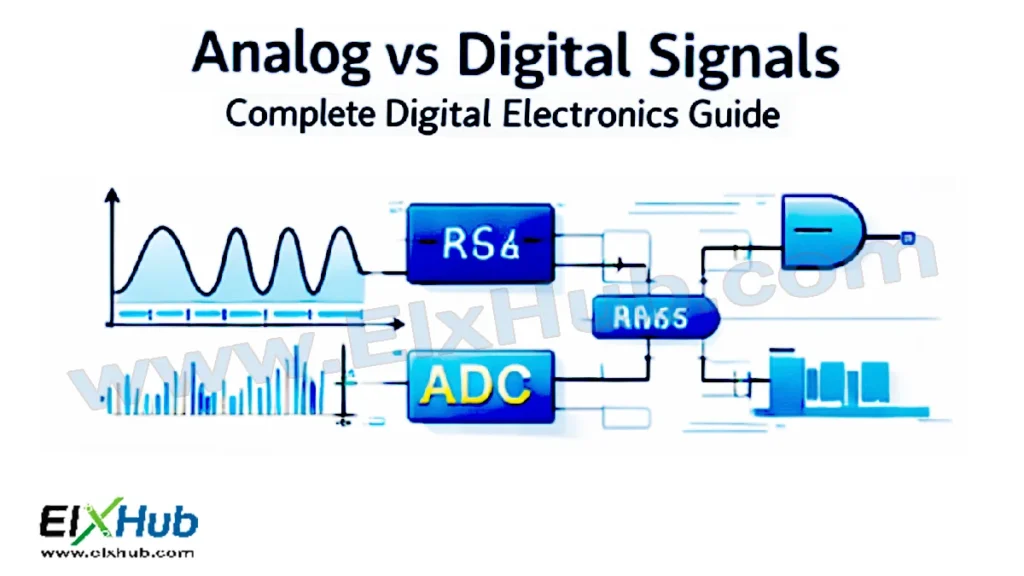
Introduction
In digital electronics, understanding the difference between analog and digital signals is fundamental. Every electronic system communicates using signals, which are either continuous (analog) or discrete (digital). Choosing the correct signal type is crucial for designing circuits, data transmission systems, and electronic devices.
This article explains analog and digital signals in detail, including working principles, characteristics, advantages, limitations, and real-world applications.
What Are Signals in Electronics
A signal is a time-varying electrical quantity used to convey information. Signals can represent voltage, current, or electromagnetic waves. Signals form the basis of all communication, control, and processing systems.
Image Placeholder (Horizontal): Illustration showing generic electrical signals
Analog Signals
Analog signals are continuous signals that vary smoothly over time. They can have an infinite number of values within a range. Examples include sound waves, temperature sensor output, and light intensity.
Characteristics of Analog Signals
• Continuous in time and amplitude
• Can take any value in a range
• Represent real-world phenomena
• Susceptible to noise and distortion
Image Placeholder (Horizontal): Sine wave representing an analog signal
Advantages of Analog Signals
• Accurate representation of real-world quantities
• Simple circuits for signal generation and measurement
• Immediate response without sampling
Disadvantages of Analog Signals
• Noise easily affects signal quality
• Difficult to store and transmit over long distances
• Harder to process with computers and microcontrollers
Digital Signals
Digital signals are discrete signals that take only specific values, typically 0 and 1. These binary signals are the foundation of modern digital electronics and computing.
Characteristics of Digital Signals
• Discrete in time and amplitude
• Represented by logic levels: 0 (LOW) and 1 (HIGH)
• Easier to store, process, and transmit
• Less affected by noise
Image Placeholder (Horizontal): Square wave representing a digital signal
Advantages of Digital Signals
• High noise immunity
• Easy to store in memory
• Simple interfacing with digital circuits
• Easy error detection and correction
Disadvantages of Digital Signals
• Requires conversion for real-world analog signals
• Sampling may introduce quantization error
• Complex circuitry for analog-to-digital conversion
Analog vs Digital – Key Differences
| Feature | Analog Signal | Digital Signal |
|---|---|---|
| Nature | Continuous | Discrete |
| Values | Infinite within range | Finite (0 or 1) |
| Representation | Voltage, current | Logic levels (0 & 1) |
| Noise Immunity | Low | High |
| Storage | Difficult | Easy |
| Processing | Complex | Simple in digital circuits |
| Transmission | Prone to distortion | Reliable over long distances |
Image Placeholder (Horizontal): Analog vs Digital signal comparison chart
Converting Analog to Digital
Microcontrollers and computers require digital input. Analog-to-Digital Converters (ADCs) transform analog signals into digital form for processing.
Steps for Conversion
- Sample the analog signal
- Quantize the amplitude into discrete levels
- Encode into binary format
Image Placeholder (Horizontal): ADC conversion block diagram
Converting Digital to Analog
Digital-to-Analog Converters (DACs) transform digital signals into analog form, enabling digital systems to control real-world devices like speakers or motors.
Image Placeholder (Horizontal): DAC conversion block diagram
Real-World Examples
Analog Signals
• Microphone output
• Thermocouple temperature sensors
• Analog audio signals
Digital Signals
• Computer data processing
• Digital clocks
• Logic circuits in microcontrollers
Mixed Signals
• Smartphones
• Digital audio players
• Communication systems using ADC and DAC
Applications
Analog Signal Applications
• Audio amplifiers
• Analog sensors
• Radio frequency transmission
Digital Signal Applications
• Computers and processors
• Digital communication systems
• Microcontroller-based projects
Why Digital Electronics Dominates Today
Modern electronics rely on digital signals due to their reliability, easy storage, error detection, and compatibility with microcontrollers and processors. While analog signals are important for sensing and measurement, digital electronics enables advanced processing and automation.
Common Beginner Mistakes
• Confusing analog and digital signals
• Ignoring sampling rate in ADCs
• Neglecting quantization error
• Improper interfacing between analog and digital circuits
FAQs
Can analog and digital signals coexist?
Yes, most modern systems use both, with ADC and DAC interfaces.
Which is better for long-distance communication?
Digital signals are preferred due to noise immunity.
Are digital signals always faster than analog?
Not necessarily; speed depends on circuit design and technology.
Conclusion
Analog and digital signals are the foundation of electronics. Analog signals represent real-world phenomena accurately, while digital signals enable reliable processing and storage. Understanding their differences, working, and applications is essential for anyone entering digital electronics and embedded system design.
SEO Title
Analog vs Digital Signals – Differences, Working, and Applications in Electronics
Meta Description
Learn the difference between analog and digital signals in electronics. Complete guide covering characteristics, waveform, advantages, disadvantages, and applications.