
Introduction
Basic electronic components are the building blocks of all electronic circuits, from simple hobby projects to complex industrial systems. Whether you are learning electronics for the first time or planning to move toward advanced topics like digital electronics, analog electronics, or power electronics, understanding these components is absolutely essential.
Every electronic device you see around you—mobile phones, computers, televisions, chargers, control panels, and even household appliances—is made by combining basic electronic components in different ways. Each component has a specific role, such as controlling current, storing energy, amplifying signals, or switching operations.
This beginner-friendly guide provides a clear and practical overview of the most important basic electronic components, explaining what they are, how they work, where they are used, and why they matter. No prior electronics knowledge is required.
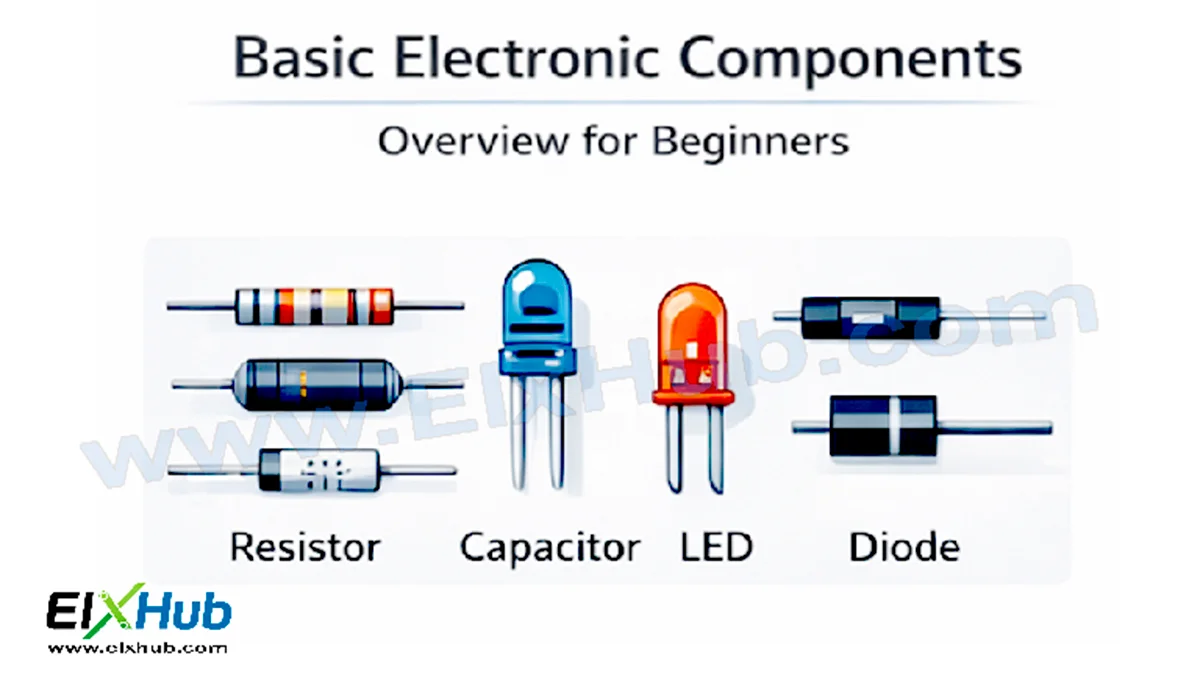
[Image Placeholder: Overview illustration of basic electronic components]
What Are Electronic Components?
Electronic components are physical devices used to control the flow of electricity in electronic circuits. They are usually connected together on breadboards, printed circuit boards (PCBs), or wired systems to perform specific functions.
Electronic components can be broadly classified into:
- Passive components
- Active components
- Electromechanical components
Understanding this classification helps beginners quickly grasp how circuits are designed.
[Image Placeholder: Classification of electronic components diagram]
Passive Electronic Components
Passive components do not generate energy on their own. Instead, they either consume, store, or regulate electrical energy.
Resistors
A resistor is one of the most common electronic components. Its main purpose is to limit the flow of electric current in a circuit.
Resistors are used to:
- Protect components from excessive current
- Divide voltage
- Control signal levels
- Generate heat in some applications
Resistors are identified by color bands or printed values.
[Image Placeholder: Different types of resistors]
| Resistor Type | Common Use |
|---|---|
| Carbon film | General electronics |
| Metal film | Precision circuits |
| Wire-wound | High power applications |
| Variable resistor (potentiometer) | Volume and speed control |
Capacitors
A capacitor stores electrical energy temporarily in the form of an electric field. It consists of two conductive plates separated by an insulating material.
Capacitors are widely used for:
- Energy storage
- Signal coupling and decoupling
- Noise filtering
- Timing circuits
[Image Placeholder: Capacitor types and symbols]
| Capacitor Type | Typical Application |
|---|---|
| Ceramic | High-frequency circuits |
| Electrolytic | Power supply filtering |
| Tantalum | Compact designs |
| Film | Audio and signal circuits |
Inductors
An inductor stores energy in a magnetic field when current flows through it. Inductors resist changes in current.
They are commonly used in:
- Power supplies
- Filters
- Choke circuits
- Energy storage in converters
[Image Placeholder: Inductor and magnetic field illustration]
| Inductor Type | Application |
|---|---|
| Air-core | RF circuits |
| Iron-core | Power electronics |
| Ferrite-core | Noise suppression |
Active Electronic Components
Active components require an external power source to operate and can amplify or control electrical signals.
Diodes
A diode allows current to flow in only one direction. It acts like an electronic one-way valve.
Diodes are used for:
- Rectification
- Voltage regulation
- Signal clipping
- Protection circuits
[Image Placeholder: Diode symbol and real component]
| Diode Type | Purpose |
|---|---|
| Rectifier diode | AC to DC conversion |
| Zener diode | Voltage regulation |
| LED | Light emission |
| Schottky diode | Fast switching |
Transistors
A transistor is one of the most important electronic components ever invented. It can act as a switch or an amplifier.
Transistors are used in:
- Amplifiers
- Digital logic circuits
- Power control systems
- Signal processing
[Image Placeholder: Transistor types comparison]
| Transistor Type | Common Use |
|---|---|
| BJT | Amplification |
| MOSFET | Switching and power control |
| IGBT | High-power applications |
Integrated Circuits (ICs)
An integrated circuit combines thousands or millions of components into a single small chip.
ICs are used for:
- Processing
- Control
- Memory
- Signal conversion
[Image Placeholder: Integrated circuit chip close-up]
| IC Category | Examples |
|---|---|
| Analog ICs | Op-amps |
| Digital ICs | Logic gates |
| Mixed-signal ICs | ADC, DAC |
| Microcontrollers | Embedded control |
Electromechanical Components
Electromechanical components involve both electrical and mechanical actions.
Switches
A switch opens or closes a circuit manually or automatically.
Uses include:
- Power control
- User input
- Mode selection
[Image Placeholder: Different types of switches]
Relays
A relay is an electrically operated switch that allows a low-power signal to control a high-power circuit.
Relays are used in:
- Industrial automation
- Motor control
- Protection systems
[Image Placeholder: Relay internal working diagram]
Connectors and Wires
Wires and connectors provide physical connections between components and circuits.
They are essential for:
- Signal transfer
- Power distribution
- Modular design
[Image Placeholder: Wires and connectors]
Power Sources in Electronics
Every electronic circuit requires a power source.
Common power sources include:
- Batteries
- DC power supplies
- AC adapters
- Solar cells
[Image Placeholder: Different electronic power sources]
| Power Source | Typical Use |
|---|---|
| Battery | Portable devices |
| DC supply | Laboratory testing |
| Adapter | Consumer electronics |
Symbols Used in Circuit Diagrams
Electronic components are represented by standardized symbols in circuit diagrams.
Learning symbols helps you:
- Read schematics
- Design circuits
- Troubleshoot faults
[Image Placeholder: Basic electronic symbols chart]
Breadboards and PCBs
Breadboards
Breadboards are used for temporary circuit building and testing.
Advantages:
- No soldering
- Easy modifications
- Beginner-friendly
[Image Placeholder: Breadboard with components]
Printed Circuit Boards (PCBs)
PCBs provide permanent mounting and connections for electronic components.
Advantages:
- Compact design
- Reliability
- Professional finish
[Image Placeholder: Printed circuit board layout]
How Components Work Together
Electronic circuits are created by combining components:
- Resistors control current
- Capacitors smooth voltage
- Transistors switch or amplify
- ICs process information
Understanding individual components helps you understand entire systems.
[Image Placeholder: Simple electronic circuit combining components]
Common Beginner Mistakes
Beginners often:
- Reverse polarity of components
- Ignore voltage ratings
- Overheat components during soldering
- Misread resistor values
Learning basics carefully prevents damage and frustration.
Safety Tips for Beginners
- Always disconnect power before changes
- Use proper tools
- Avoid short circuits
- Follow component ratings
[Image Placeholder: Electronics safety icons]
Why Learning Basic Electronic Components Matters
Understanding basic electronic components is essential for:
- Electronics education
- DIY projects
- Repair work
- Advanced engineering fields
These components form the foundation of all electronic technologies.
Conclusion
Basic electronic components are the heart of every electronic system. From simple resistors and capacitors to powerful integrated circuits and transistors, each component plays a vital role in controlling electrical energy and signals. By learning what these components are, how they work, and where they are used, beginners gain the confidence needed to explore more advanced topics in electronics.
Mastering these fundamentals opens the door to digital electronics, analog circuit design, power electronics, embedded systems, and countless real-world applications. With practice and curiosity, these small components become powerful tools for innovation and problem-solving.
Image Reference Table (For Future Use)
| Image Filename | Suggested Alt Text | Description |
|---|---|---|
| components-overview.png | Basic electronic components | Overall illustration |
| component-classification.png | Electronic component types | Passive and active |
| resistors.png | Resistor types | Carbon, metal, wire-wound |
| capacitors.png | Capacitor types | Ceramic, electrolytic |
| inductors.png | Inductor basics | Magnetic field |
| diodes.png | Diode types | Rectifier, Zener, LED |
| transistors.png | Transistor comparison | BJT vs MOSFET |
| integrated-circuits.png | IC chip | Integrated electronics |
| breadboard.png | Breadboard usage | Circuit prototyping |
| pcb.png | Printed circuit board | Permanent circuits |
SEO Title: Basic Electronic Components Explained – Beginner-Friendly Guide
Meta Description: Learn basic electronic components explained simply for beginners. Understand resistors, capacitors, diodes, transistors, ICs, uses, and applications.


