
Introduction
Ohm’s Law is one of the most important and fundamental principles in electronics. Every electronic circuit, whether simple or complex, follows Ohm’s Law in some form. If you truly understand Ohm’s Law, you gain the ability to analyze, design, troubleshoot, and safely operate electronic circuits. For beginners, Ohm’s Law is the gateway concept that connects voltage, current, and resistance into a single, easy-to-understand relationship.
This article is written for Basic Electronics learners and explains Ohm’s Law in a simple, practical, and beginner-friendly way. You will learn what Ohm’s Law is, why it is important, how it works, how to apply it in real circuits, common mistakes beginners make, and how Ohm’s Law is used in everyday electronic devices.
[Image Placeholder: Simple diagram showing a battery, resistor, and labeled V, I, and R]
What Is Ohm’s Law?
Ohm’s Law states that the current flowing through a conductor is directly proportional to the voltage applied across it and inversely proportional to its resistance, provided temperature and physical conditions remain constant.
In simple words:
- Higher voltage pushes more current
- Higher resistance restricts current
Ohm’s Law mathematically connects three basic electrical quantities:
- Voltage (V)
- Current (I)
- Resistance (R)
These three quantities form the backbone of all electronic circuit analysis.
Mathematical Expression of Ohm’s Law
Ohm’s Law is expressed using a simple formula:
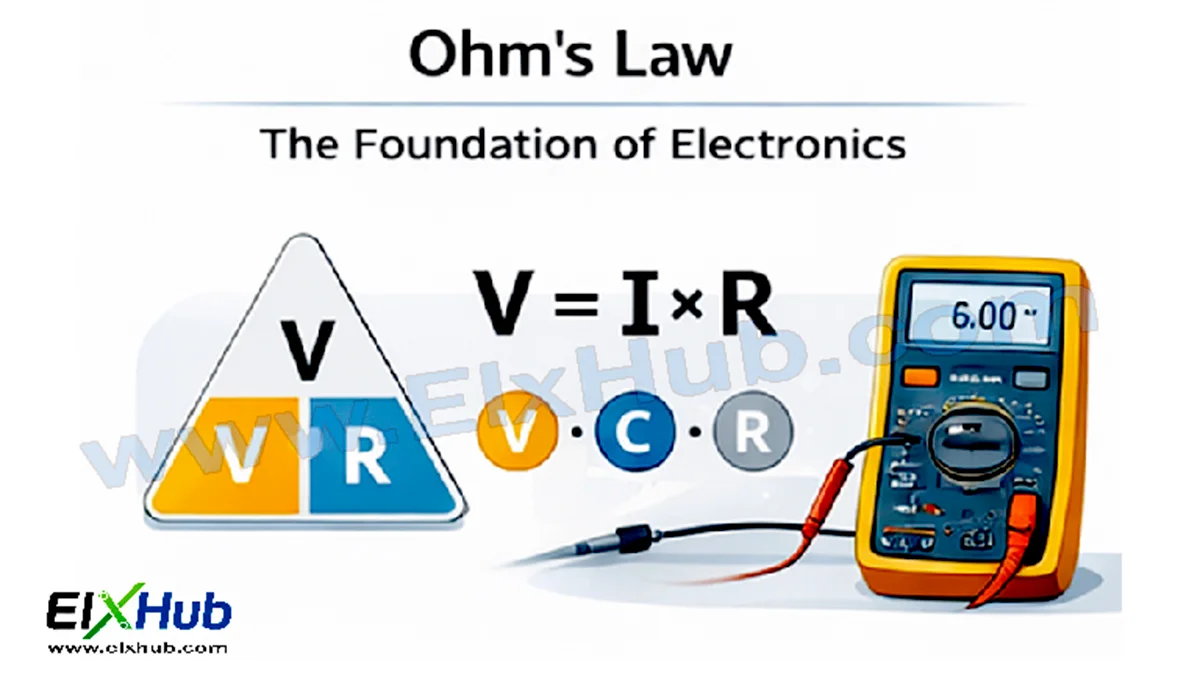
V = I × R
Where:
- V is voltage in volts (V)
- I is current in amperes (A)
- R is resistance in ohms (Ω)
From this single formula, we can derive two more useful equations:
I = V ÷ R
R = V ÷ I
These three equations allow you to calculate any one quantity if the other two are known.
[Image Placeholder: Ohm’s Law triangle showing V on top, I and R at the bottom]
Understanding Ohm’s Law with a Simple Analogy
The easiest way to understand Ohm’s Law is by using a water flow analogy.
| Electrical Quantity | Water Analogy |
|---|---|
| Voltage | Water pressure |
| Current | Flow rate of water |
| Resistance | Narrowness of pipe |
If water pressure (voltage) increases, more water (current) flows.
If the pipe becomes narrower (higher resistance), water flow (current) decreases.
This analogy helps beginners visualize how electrical circuits behave.
[Image Placeholder: Water tank and pipe analogy comparing voltage, current, and resistance]
Why Ohm’s Law Is So Important
Ohm’s Law is important because it allows you to:
- Predict how a circuit will behave
- Calculate safe operating values
- Select proper resistor values
- Prevent component damage
- Analyze faults in circuits
Every electronic designer, technician, or hobbyist uses Ohm’s Law daily, whether consciously or unconsciously.
Without Ohm’s Law, circuit design would be guesswork rather than science.
Units Used in Ohm’s Law
Understanding units is essential when working with Ohm’s Law.
| Quantity | Symbol | Unit |
|---|---|---|
| Voltage | V | Volt (V) |
| Current | I | Ampere (A) |
| Resistance | R | Ohm (Ω) |
Common sub-units are also used:
| Quantity | Sub-unit | Meaning |
|---|---|---|
| Current | mA | milliampere (0.001 A) |
| Resistance | kΩ | kilo-ohm (1000 Ω) |
| Resistance | MΩ | mega-ohm (1,000,000 Ω) |
[Image Placeholder: Table-style visual showing electrical units and prefixes]
Applying Ohm’s Law in Simple Circuits
Let’s see how Ohm’s Law works in practical situations.
Example 1: Calculating Current
If a 9V battery is connected to a 300Ω resistor:
I = V ÷ R
I = 9 ÷ 300
I = 0.03 A or 30 mA
This calculation tells us how much current flows in the circuit.
Example 2: Calculating Resistance
If a circuit operates at 12V and draws 2A current:
R = V ÷ I
R = 12 ÷ 2
R = 6 Ω
Example 3: Calculating Voltage Drop
If a current of 0.5A flows through a 10Ω resistor:
V = I × R
V = 0.5 × 10
V = 5 V
[Image Placeholder: Step-by-step Ohm’s Law calculation illustration]
Ohm’s Law in Series Circuits
In a series circuit, current remains the same throughout the circuit, but voltage divides across components.
| Property | Behavior in Series Circuit |
|---|---|
| Current | Same everywhere |
| Voltage | Divided across resistors |
| Resistance | Adds up |
Total resistance in series:
Rₜ = R₁ + R₂ + R₃
Ohm’s Law helps calculate voltage drops across each resistor.
[Image Placeholder: Series circuit with labeled voltage drops]
Ohm’s Law in Parallel Circuits
In a parallel circuit, voltage remains the same across all branches, but current divides.
| Property | Behavior in Parallel Circuit |
|---|---|
| Voltage | Same across all branches |
| Current | Divides among branches |
| Resistance | Decreases overall |
Total resistance in parallel:
1 / Rₜ = 1 / R₁ + 1 / R₂ + 1 / R₃
Ohm’s Law is used to calculate branch currents and total current.
[Image Placeholder: Parallel circuit showing current division]
Using Ohm’s Law to Protect Components
One of the most common uses of Ohm’s Law is current limiting, especially for LEDs.
Example:
An LED requires 20 mA current and has a forward voltage of 2V. Using a 5V supply:
Resistor value:
R = (5 − 2) ÷ 0.02
R = 150 Ω
This calculation prevents LED damage.
[Image Placeholder: LED current-limiting resistor calculation diagram]
Power and Ohm’s Law
Ohm’s Law is closely related to electrical power.
Power formula:
P = V × I
Using Ohm’s Law, we get:
P = I² × R
P = V² ÷ R
These formulas help in selecting resistor power ratings and preventing overheating.
| Situation | Correct Formula |
|---|---|
| Known I and R | P = I² × R |
| Known V and R | P = V² ÷ R |
[Image Placeholder: Resistor overheating vs correct power rating illustration]
Limitations of Ohm’s Law
Ohm’s Law does not apply to all components under all conditions.
It does not strictly apply to:
- Diodes
- Transistors
- LEDs
- Non-linear components
- High-temperature conditions
These components do not have a constant resistance. However, Ohm’s Law is still used approximately in many practical cases.
Common Beginner Mistakes with Ohm’s Law
Beginners often make mistakes such as:
Using wrong units in calculations
Ignoring milli and kilo prefixes
Applying Ohm’s Law incorrectly in AC circuits
Forgetting internal resistance of power sources
Not considering power dissipation
Understanding Ohm’s Law deeply helps avoid these errors.
Ohm’s Law in Everyday Electronics
Ohm’s Law is used in:
- Mobile chargers to regulate current
- Power supplies to set voltage levels
- Audio amplifiers to control signal levels
- Battery management systems
- Industrial control circuits
Every time you plug in an electronic device, Ohm’s Law is silently at work.
[Image Placeholder: Everyday electronics collage showing chargers, LEDs, and circuits]
How to Practice Ohm’s Law as a Beginner
The best way to learn Ohm’s Law is through hands-on practice.
| Practice Method | Benefit |
|---|---|
| Simple breadboard circuits | Visual understanding |
| Multimeter measurements | Real-world values |
| LED resistor experiments | Safe learning |
| Online simulators | Risk-free testing |
Practical experience reinforces theoretical knowledge.
[Image Placeholder: Beginner practicing Ohm’s Law on breadboard]
Conclusion
Ohm’s Law is rightly called the foundation of electronics. It provides a simple yet powerful relationship between voltage, current, and resistance. By mastering Ohm’s Law, beginners gain the confidence to analyze circuits, select proper components, and design safe electronic systems.
Whether you aim to become an electronics engineer, technician, hobbyist, or student, Ohm’s Law will remain one of the most frequently used tools throughout your journey. A strong understanding of this principle makes learning advanced topics like analog electronics, digital circuits, and power electronics much easier and more intuitive.
Image Reference Table (For Future Use)
| Image Filename | Suggested Alt Text | Description |
|---|---|---|
| ohms-law-basic-diagram.png | Ohm’s Law basic circuit | Battery, resistor, and current |
| ohms-law-triangle.png | Ohm’s Law triangle | Relationship between V, I, and R |
| water-analogy-ohms-law.png | Ohm’s Law water analogy | Pressure and flow comparison |
| series-circuit-ohms-law.png | Series circuit Ohm’s Law | Voltage division |
| parallel-circuit-ohms-law.png | Parallel circuit Ohm’s Law | Current division |
| led-current-limiting.png | LED resistor calculation | Protecting LED |
| power-dissipation-resistor.png | Resistor power rating | Heat and safety |
| everyday-ohms-law.png | Ohm’s Law applications | Real-world electronics |
| breadboard-ohms-law.png | Ohm’s Law practice | Beginner experiment setup |
SEO Title: Ohm’s Law Explained – The Foundation of Electronics for Beginners
Meta Description: Learn Ohm’s Law explained simply with formulas, examples, tables, and real-world applications. A complete beginner guide to electronics fundamentals.


