
Introduction
In basic electronics, two fundamental types of electrical power are used: AC (Alternating Current) and DC (Direct Current). Every electronic device, electrical system, and power source operates using either AC or DC, or a combination of both. Understanding the difference between AC and DC is essential for beginners because it explains how electricity is generated, transmitted, stored, and used in real-life applications.
From household wall sockets to mobile phones, from power plants to small electronic circuits, AC and DC play distinct roles. This article explains AC vs DC in a simple, beginner-friendly way, covering definitions, characteristics, waveforms, advantages, disadvantages, applications, and safety aspects. By the end, you will clearly understand where AC is used, where DC is preferred, and why both are equally important in electronics.
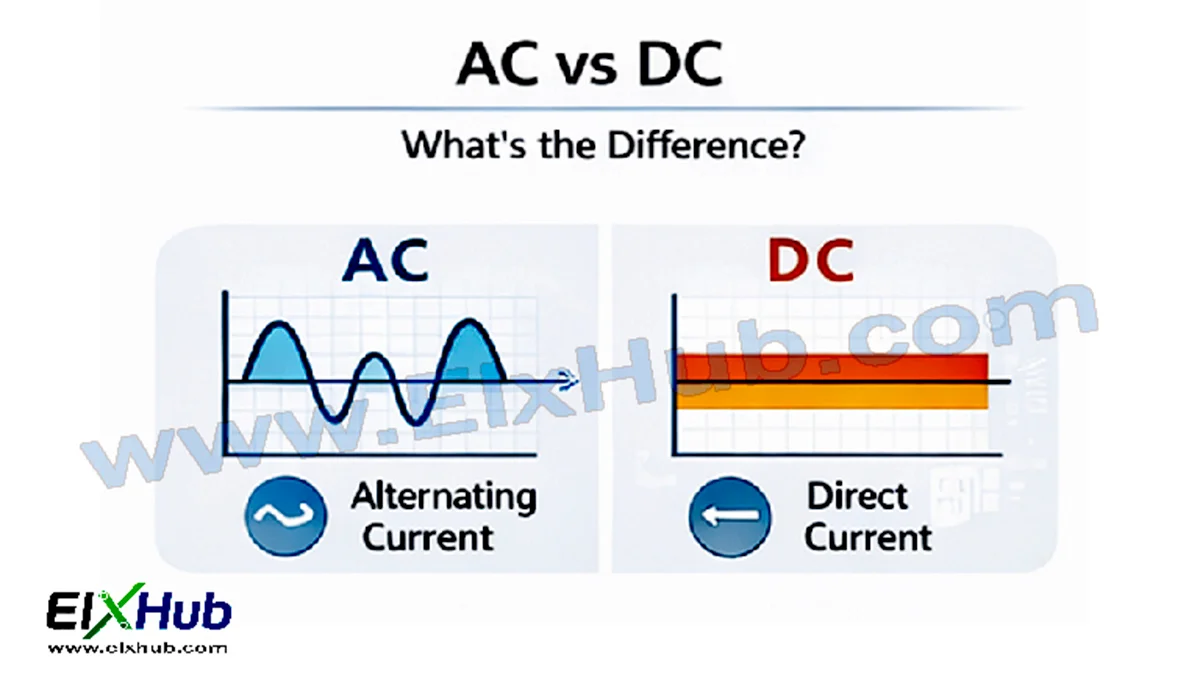
[Image Placeholder: Visual comparison showing AC waveform and DC straight line]
What Is Direct Current (DC)?
Direct Current (DC) is the type of electrical current that flows in one direction only. The voltage level remains constant (or nearly constant), and electrons move steadily from the negative terminal to the positive terminal.
DC is the most basic and easiest form of electricity to understand and analyze, making it ideal for electronic circuits.
Characteristics of DC
| Property | Description |
|---|---|
| Direction of flow | One direction only |
| Voltage polarity | Fixed |
| Frequency | Zero |
| Waveform | Straight horizontal line |
| Storage | Easily stored in batteries |
[Image Placeholder: DC voltage waveform as a straight horizontal line]
Common Sources of DC
DC power is commonly obtained from:
- Batteries
- Cells
- Power banks
- Solar panels
- DC power supplies
- Rectifiers (AC to DC conversion)
Most low-voltage electronic devices operate internally on DC power.
What Is Alternating Current (AC)?
Alternating Current (AC) is the type of electrical current that changes direction periodically. The voltage continuously varies with time, alternating between positive and negative values.
AC is the standard form of electricity used for power generation, transmission, and distribution worldwide.
Characteristics of AC
| Property | Description |
|---|---|
| Direction of flow | Reverses periodically |
| Voltage polarity | Changes with time |
| Frequency | Usually 50 Hz or 60 Hz |
| Waveform | Sinusoidal |
| Storage | Not directly stored |
[Image Placeholder: Sinusoidal AC waveform labeled with positive and negative cycles]
Common Sources of AC
AC power is commonly obtained from:
- Power plants
- Generators
- Alternators
- Wall sockets (mains supply)
Most household and industrial electrical appliances use AC power directly.
Understanding AC and DC Waveforms
The waveform is a visual representation of how voltage or current changes over time.
DC Waveform
A DC waveform is represented as a straight horizontal line, indicating constant voltage.
AC Waveform
An AC waveform is usually a sine wave, showing continuous variation of voltage with time.
| Feature | DC Waveform | AC Waveform |
|---|---|---|
| Shape | Straight line | Sine wave |
| Time variation | Constant | Periodic |
| Polarity | Fixed | Alternating |
[Image Placeholder: Side-by-side DC and AC waveform comparison]
Frequency in AC and DC
Frequency refers to the number of cycles per second and is measured in hertz (Hz).
- DC has zero frequency because it does not change direction.
- AC has a specific frequency:
- 50 Hz in many countries
- 60 Hz in some regions
Frequency affects transformer operation, motor speed, and power transmission efficiency.
[Image Placeholder: AC waveform showing frequency cycles per second]
Why Is AC Used for Power Transmission?
AC is preferred for long-distance power transmission because it can be easily transformed to higher or lower voltages using transformers.
Advantages of AC in Power Systems
| Advantage | Explanation |
|---|---|
| Easy voltage transformation | Using transformers |
| Reduced power loss | High-voltage transmission |
| Efficient generation | Alternators generate AC naturally |
| Cost-effective | Lower infrastructure cost |
High-voltage AC transmission reduces current, which minimizes energy losses in transmission lines.
[Image Placeholder: Power transmission lines carrying AC electricity]
Why Is DC Used in Electronics?
DC is ideal for electronic circuits because components like transistors, ICs, and microcontrollers require stable and fixed voltage levels.
Advantages of DC in Electronics
| Advantage | Explanation |
|---|---|
| Stable voltage | Essential for logic circuits |
| Easy control | Suitable for precision electronics |
| Energy storage | Batteries store DC |
| Low noise | Better for sensitive circuits |
Almost all electronic devices convert incoming AC into DC internally.
[Image Placeholder: AC to DC conversion block diagram]
AC vs DC: Key Differences Table
| Parameter | AC (Alternating Current) | DC (Direct Current) |
|---|---|---|
| Direction | Alternates | One direction |
| Voltage level | Varies with time | Constant |
| Frequency | 50 Hz / 60 Hz | 0 Hz |
| Transmission | Long-distance efficient | Not suitable |
| Storage | Not stored directly | Easily stored |
| Circuit complexity | Higher | Lower |
| Typical use | Power distribution | Electronics |
This table provides a quick and clear comparison for beginners.
Conversion Between AC and DC
In real-world systems, AC and DC are frequently converted into each other.
AC to DC Conversion
AC is converted to DC using:
- Rectifiers
- Power supplies
- Adapters and chargers
This is necessary for powering electronic devices from wall sockets.
DC to AC Conversion
DC is converted to AC using:
- Inverters
- UPS systems
- Solar power systems
This allows batteries or solar panels to supply AC appliances.
[Image Placeholder: Rectifier and inverter block diagrams]
Safety Considerations: AC vs DC
Both AC and DC can be dangerous, but their effects differ.
AC Safety Aspects
- More dangerous at low voltages
- Causes muscle contraction
- Can prevent release from live wires
DC Safety Aspects
- Causes continuous muscle contraction
- Less likely to cause involuntary locking
- High DC voltages are extremely dangerous
| Aspect | AC | DC |
|---|---|---|
| Shock severity | Higher at low voltage | Higher at high voltage |
| Muscle effect | Locking effect | Strong contraction |
| Common exposure | Household wiring | Batteries, EVs |
[Image Placeholder: Electrical safety warning symbols]
AC and DC in Household Appliances
| Appliance | Type of Power |
|---|---|
| Fan | AC |
| Refrigerator | AC |
| LED TV | AC input, DC internal |
| Laptop | DC |
| Mobile phone | DC |
| Washing machine | AC |
Most modern appliances use AC input but operate internally on DC.
AC and DC in Motors
Different motors use different types of power.
| Motor Type | Power Used |
|---|---|
| DC motor | DC |
| AC induction motor | AC |
| BLDC motor | DC with electronic control |
| Universal motor | AC or DC |
Motor control and efficiency depend heavily on the type of current used.
[Image Placeholder: AC motor and DC motor comparison]
Advantages and Disadvantages Summary
Advantages of AC
- Efficient long-distance transmission
- Easy voltage conversion
- Widely available
Disadvantages of AC
- Complex circuitry
- Not suitable for direct storage
- Requires rectification for electronics
Advantages of DC
- Simple and stable
- Ideal for electronics
- Easily stored
Disadvantages of DC
- Transmission losses
- Voltage conversion is complex
- Limited direct distribution
AC vs DC in Renewable Energy Systems
Renewable energy systems use both AC and DC.
- Solar panels produce DC
- Wind turbines generate AC
- Batteries store DC
- Grid supply is AC
Power electronics bridges the gap between AC and DC in modern energy systems.
[Image Placeholder: Solar panel DC and inverter AC output]
Common Beginner Confusions About AC and DC
Beginners often misunderstand:
- AC is not “stronger” than DC
- DC is not always safer
- Frequency matters only in AC
- Devices may use both AC and DC
Clarifying these points helps build a strong foundation in electronics.
How to Identify AC and DC Power Sources
| Source | Power Type |
|---|---|
| Wall socket | AC |
| Battery | DC |
| Power adapter output | DC |
| Generator output | AC |
| Solar panel | DC |
Always check labels and symbols before connecting circuits.
[Image Placeholder: AC and DC symbols on power supplies]
Conclusion
AC and DC are the two fundamental forms of electrical power, each serving a unique purpose in electronics and electrical systems. AC excels in power generation and transmission, while DC is essential for electronic circuits, storage, and control. Rather than competing, AC and DC work together to power modern technology.
For beginners in basic electronics, understanding the difference between AC and DC is a critical step toward learning more advanced topics such as rectifiers, inverters, power supplies, analog electronics, and power electronics. Once this foundation is clear, analyzing real-world systems becomes much easier and more intuitive.
Image Reference Table (For Future Use)
| Image Filename | Suggested Alt Text | Description |
|---|---|---|
| ac-vs-dc-overview.png | AC vs DC overview | Visual comparison |
| dc-waveform.png | DC waveform | Constant voltage |
| ac-waveform.png | AC waveform | Alternating sine wave |
| ac-dc-waveform-comparison.png | AC vs DC waveforms | Side-by-side |
| power-transmission-ac.png | AC power transmission | High-voltage lines |
| ac-to-dc-conversion.png | AC to DC conversion | Rectifier diagram |
| inverter-dc-to-ac.png | DC to AC conversion | Inverter diagram |
| motor-ac-dc.png | AC and DC motors | Motor comparison |
| renewable-ac-dc.png | AC DC renewable energy | Solar and inverter |
| ac-dc-symbols.png | AC DC symbols | Power labels |
SEO Title: AC vs DC Explained – Difference Between Alternating and Direct Current
Meta Description: Learn AC vs DC explained simply for beginners. Understand differences, waveforms, advantages, applications, safety, and real-world examples in electronics.


