Introduction
Thyristor-based converters form one of the most important foundations of classical power electronics. Before the widespread adoption of high-frequency MOSFETs and IGBTs, thyristors such as SCRs, TRIACs, and related devices were the primary means of controlling large amounts of electrical power. Even today, thyristor-based AC-DC and AC-AC converters remain widely used in high-power, medium-frequency, and grid-connected applications due to their ruggedness, high voltage and current ratings, and cost-effectiveness.
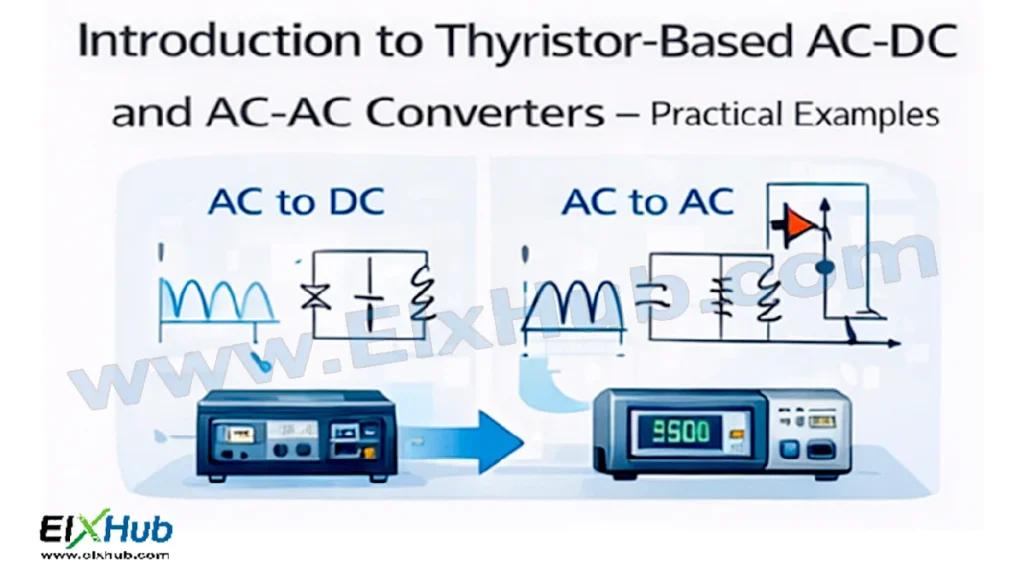
AC-DC converters using thyristors are commonly referred to as controlled rectifiers, while AC-AC converters using thyristors are implemented as AC voltage controllers or cycloconverters. These converters allow controlled regulation of output voltage, current, and power by adjusting the firing angle of the thyristors. This article provides a deep, practical, and structured explanation of thyristor-based AC-DC and AC-AC converters, covering operating principles, circuit configurations, waveforms, control strategies, advantages, limitations, and real-world industrial applications.
[Image Placeholder: Thyristor-based power conversion overview]
Why Thyristor-Based Converters Are Important
Thyristors are latching devices that can handle very high power levels with minimal conduction losses. Their importance in power electronics arises from the following characteristics:
- Ability to control large power levels
- High voltage and current handling capability
- High reliability in harsh industrial environments
- Simple gate control requirements
- Long operational life
Because of these properties, thyristor-based converters are still widely used in:
- High-power DC motor drives
- HVDC transmission systems
- Industrial heating and welding
- Large battery chargers
- AC voltage regulation systems
Basic Working Principle of Thyristors in Converters
A thyristor (SCR) remains in the OFF state until a gate pulse is applied and the anode is positive with respect to the cathode. Once triggered, it conducts until the current falls below the holding current.
In power converters:
- Output power is controlled by delaying the gate pulse
- This delay is defined by the firing angle α
- By changing α, the average output voltage and power are controlled
[Image Placeholder: SCR triggering and firing angle concept]
Thyristor-Based AC-DC Converters (Controlled Rectifiers)
What is an AC-DC Converter?
An AC-DC converter converts alternating current (AC) into direct current (DC). When thyristors are used instead of diodes, the converter becomes a controlled rectifier, allowing adjustable DC output.
Types of Thyristor-Based AC-DC Converters
AC-DC converters using thyristors are classified based on phase and configuration.
| Converter Type | Supply | Number of SCRs |
|---|---|---|
| Single-phase Half-wave | 1-phase | 1 SCR |
| Single-phase Full-wave | 1-phase | 2 or 4 SCRs |
| Three-phase Half-wave | 3-phase | 3 SCRs |
| Three-phase Full-wave | 3-phase | 6 SCRs |
[Image Placeholder: Classification of thyristor rectifiers]
Single-Phase Half-Wave Controlled Rectifier
In a single-phase half-wave controlled rectifier:
- One SCR is connected in series with the load
- SCR conducts only during positive half cycles
- Output DC voltage is controlled by firing angle
Key features:
- Simple circuit
- High ripple content
- Low efficiency
- Used only in low-power applications
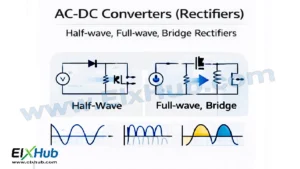
[Image Placeholder: Single-phase half-wave controlled rectifier circuit]
Single-Phase Full-Wave Controlled Rectifier
In this configuration:
- Two or four SCRs are used
- Both positive and negative half cycles are utilized
- Output DC voltage is higher and smoother
Advantages:
- Better transformer utilization
- Lower ripple compared to half-wave
- Suitable for DC motor drives
| Parameter | Half-Wave | Full-Wave |
|---|---|---|
| Ripple | High | Lower |
| Efficiency | Low | Higher |
| Output Power | Low | Medium |
[Image Placeholder: Single-phase full-wave SCR rectifier waveforms]
Three-Phase Controlled Rectifiers
Three-phase controlled rectifiers are used in high-power applications.
Characteristics:
- Six SCRs in bridge configuration
- Lower ripple in output
- Higher average DC voltage
- Improved efficiency
Applications include:
- Steel rolling mills
- Large DC motor drives
- HVDC converter stations
[Image Placeholder: Three-phase full-controlled bridge rectifier]
Control of Output Voltage in AC-DC Converters
The average DC output voltage of a controlled rectifier depends on firing angle α.
- Small α → High DC output
- Large α → Reduced DC output
- α > 90° → Inversion operation (power flows back to AC source)
This principle enables regenerative braking in motor drives.
Practical Applications of Thyristor AC-DC Converters
| Application | Purpose |
|---|---|
| DC Motor Drives | Speed and torque control |
| Battery Chargers | Adjustable charging current |
| Electroplating | Controlled DC supply |
| HVDC Systems | Bulk power transmission |
| Welding Equipment | High current DC |
[Image Placeholder: Industrial use of controlled rectifiers]
Thyristor-Based AC-AC Converters
What is an AC-AC Converter?
An AC-AC converter converts AC power at fixed frequency into AC power with controlled voltage or frequency.
Using thyristors, AC-AC conversion is achieved mainly through:
- AC voltage controllers
- Cycloconverters
AC Voltage Controllers Using Thyristors
Principle of Operation
AC voltage controllers control the RMS value of AC voltage supplied to a load without changing frequency. This is done by phase angle control of SCRs.
Circuit features:
- Two SCRs connected in anti-parallel
- Control of conduction angle
- Suitable for resistive and inductive loads
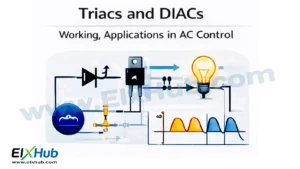
[Image Placeholder: SCR-based AC voltage controller]
Single-Phase AC Voltage Controller
In single-phase controllers:
- SCRs conduct for a controlled portion of each half-cycle
- RMS output voltage is adjusted
- Used for light dimmers and heaters
Advantages:
- Simple circuit
- Low cost
- Compact design
Limitations:
- High harmonic distortion
- Poor power factor at low output voltage
Three-Phase AC Voltage Controllers
Three-phase AC voltage controllers are used for:
- Soft starting of induction motors
- Industrial heating
- Large lighting systems
Benefits:
- Smooth voltage control
- Reduced starting current
- Lower mechanical stress
[Image Placeholder: Three-phase AC voltage controller]
Cycloconverters
What is a Cycloconverter?
A cycloconverter converts AC power at one frequency directly into AC power at a lower frequency using thyristors without an intermediate DC stage.
Key characteristics:
- Output frequency is a fraction of input frequency
- Requires many SCRs
- Used in very high-power applications
[Image Placeholder: Cycloconverter principle]
Applications of Cycloconverters
| Application | Reason |
|---|---|
| Rolling Mills | Low-speed high-torque |
| Cement Kilns | Large power handling |
| Ship Propulsion | Smooth torque control |
Harmonics and Power Quality Issues
Thyristor-based converters introduce significant harmonics due to phase control.
Effects:
- Distorted input current
- Reduced power factor
- Heating in transformers
Mitigation techniques include:
- Passive harmonic filters
- Active filters
- Multi-pulse rectifiers
- Controlled firing strategies
Advantages of Thyristor-Based Converters
- Extremely high power handling
- Rugged and reliable
- Cost-effective for large systems
- Proven and mature technology
Limitations of Thyristor-Based Converters
- Limited switching frequency
- Poor input power factor
- Large harmonic content
- Requires bulky filters
- Less suitable for fast dynamic control
Comparison with Modern PWM Converters
| Feature | Thyristor Converter | PWM Converter |
|---|---|---|
| Power Level | Very High | Medium to High |
| Switching Speed | Low | High |
| Harmonics | High | Low |
| Control Precision | Moderate | High |
| Cost (High Power) | Lower | Higher |
Future Role of Thyristor Converters
Despite the rise of IGBT and MOSFET-based converters, thyristor-based systems remain irreplaceable in:
- Ultra-high voltage systems
- Grid-level power conversion
- Heavy industrial processes
Hybrid systems combining thyristors and modern semiconductor devices are also emerging.
[Image Placeholder: Future hybrid power electronic systems]
Conclusion
Thyristor-based AC-DC and AC-AC converters remain a cornerstone of power electronics, especially in high-power and industrial applications. Controlled rectifiers enable efficient conversion of AC to adjustable DC, while AC voltage controllers and cycloconverters allow flexible control of AC power. Although modern PWM-based converters offer superior performance in many areas, thyristor-based converters continue to dominate where ruggedness, simplicity, and high power capacity are required. Understanding their principles, circuits, and practical applications is essential for any power electronics engineer or student.
Image Reference Table
| Image Filename | Description | Alt Text |
|---|---|---|
| thyristor-overview.png | Thyristor power conversion | Thyristor-based power converters |
| firing-angle.png | SCR firing angle control | SCR firing angle principle |
| rectifier-types.png | Controlled rectifier types | Types of thyristor rectifiers |
| half-wave-scr.png | Half-wave SCR rectifier | Single-phase half-wave controlled rectifier |
| full-wave-scr.png | Full-wave SCR rectifier | Single-phase full-wave controlled rectifier |
| three-phase-scr.png | Three-phase bridge | Three-phase SCR bridge rectifier |
| ac-voltage-controller.png | AC voltage controller | SCR-based AC voltage controller |
| three-phase-ac-control.png | Three-phase AC control | Three-phase AC voltage controller |
| cycloconverter.png | Cycloconverter system | Thyristor-based cycloconverter |
| industrial-applications.png | Industrial power systems | Thyristor converter applications |
SEO Title
Thyristor-Based AC-DC and AC-AC Converters – Working, Circuits, Applications
Meta Description
Learn thyristor-based AC-DC and AC-AC converters with practical examples, covering controlled rectifiers, AC voltage controllers, cycloconverters, circuits, and applications.