Introduction
Power Electronics is a specialized field of electronics that deals with the efficient conversion, control, and conditioning of electrical power using electronic devices and circuits. Unlike low-power signal electronics, power electronics focuses on handling high voltages and currents while maintaining efficiency, reliability, and safety. Modern life depends heavily on power electronics, even if it often operates invisibly in the background. From mobile phone chargers and laptop adapters to solar inverters, electric vehicles, industrial motor drives, and smart grids, power electronics forms the backbone of energy conversion and management.
As energy demands grow and efficiency standards become stricter, the role of power electronics becomes increasingly important. Engineers must design systems that minimize losses, reduce heat, and deliver stable power under varying load conditions. This article introduces the fundamentals of power electronics, explains why it is so important, and explores its wide range of practical applications across consumer, industrial, and renewable energy systems.
What Is Power Electronics?
Power electronics is the application of solid-state electronics to control and convert electrical power. It involves electronic circuits that process significant levels of power rather than just information or signals. These circuits typically convert electrical energy from one form to another, such as AC to DC, DC to AC, or DC to DC, while controlling voltage, current, frequency, and waveform.
At the heart of power electronics are power semiconductor devices that act as high-speed electronic switches. By rapidly turning these devices on and off, power electronic circuits regulate energy flow with high efficiency.
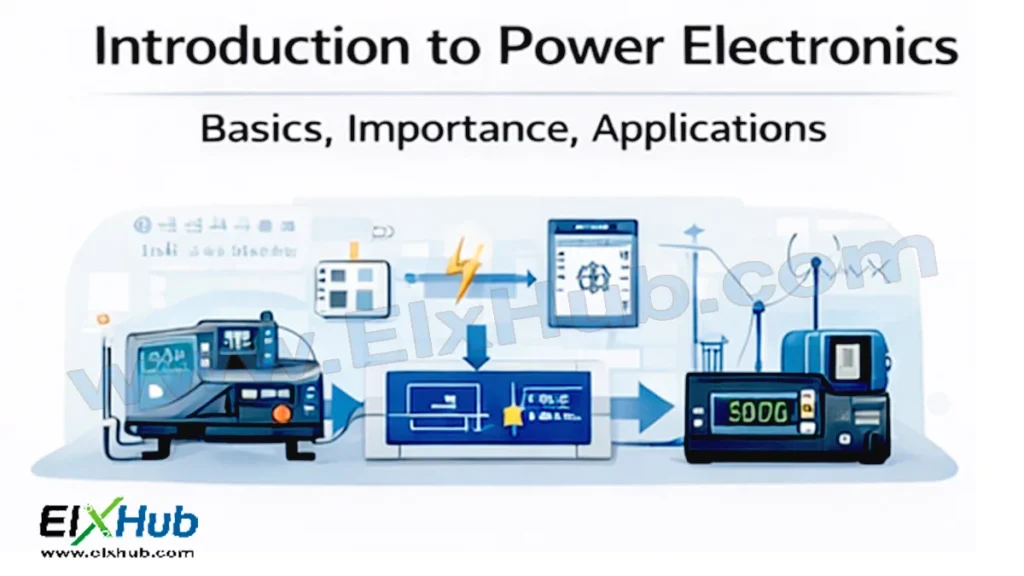
[Image Placeholder: Basic power electronics system showing input source, converter, control unit, and load]
Difference Between Power Electronics and Signal Electronics
Although both fields use electronic components, their goals and design constraints differ significantly.
Power electronics focuses on:
High voltage and current levels
Efficiency and power loss reduction
Thermal management
Robustness and reliability
Signal electronics focuses on:
Low power levels
Signal amplification and processing
Noise reduction and fidelity
This distinction influences component selection, circuit topology, and system design.
Basic Elements of Power Electronics Systems
A typical power electronics system consists of several key building blocks working together.
Power Source
The input source may be AC or DC, depending on the application. Examples include mains supply, batteries, fuel cells, or solar panels.
Power Converter
The power converter is the core of the system. It uses power semiconductor devices to change the form of electrical power.
Common conversion types include:
AC to DC conversion
DC to DC conversion
DC to AC conversion
AC to AC conversion
[Image Placeholder: Classification of power converters diagram]
Control Circuit
The control circuit generates switching signals for the power devices. It ensures the output meets the required voltage, current, or frequency specifications.
Load
The load is the device or system that consumes the processed electrical power, such as a motor, electronic circuit, or battery.
Power Semiconductor Devices
Power electronics relies on special semiconductor devices designed to handle high power levels.
Common power devices include:
Power diodes
Thyristors (SCR)
Triacs
Power MOSFETs
IGBTs
These devices operate mainly as switches, alternating between ON and OFF states to regulate power flow efficiently.
[Image Placeholder: Common power semiconductor devices used in power electronics]
Switching Concept in Power Electronics
Unlike linear regulators, which dissipate excess power as heat, power electronics uses switching techniques. When a device is fully ON, it has low voltage drop and low power loss. When fully OFF, current flow is nearly zero.
This switching approach results in:
High efficiency
Lower heat generation
Compact designs
Pulse Width Modulation (PWM) is a widely used switching technique in power electronics to control output voltage or current.
[Image Placeholder: PWM waveform controlling output voltage]
Importance of Power Electronics
Power electronics plays a critical role in modern electrical and electronic systems. Its importance can be understood from several perspectives.
Energy Efficiency
One of the primary goals of power electronics is efficient energy conversion. High-efficiency converters reduce power losses, saving energy and lowering operating costs.
Renewable Energy Integration
Solar panels, wind turbines, and energy storage systems rely on power electronics to convert and manage energy before feeding it into the grid or storing it in batteries.
Compact and Lightweight Systems
High-frequency switching allows the use of smaller transformers and filters, leading to compact and lightweight power supplies.
Precise Control
Power electronics enables precise control of voltage, current, speed, and torque, which is essential in motor drives and automation systems.
Power Electronics in Electrical Power Conversion
Power electronics enables several fundamental power conversion processes.
AC to DC Conversion
This process is known as rectification. It is used in power supplies, battery chargers, and DC motor drives.
[Image Placeholder: AC to DC rectifier block diagram]
DC to DC Conversion
DC-DC converters adjust DC voltage levels. Common topologies include buck, boost, and buck-boost converters.
Applications include:
Mobile device power management
Battery-powered systems
Embedded electronics
DC to AC Conversion
DC to AC conversion is performed by inverters. Inverters are essential in solar power systems, UPS units, and motor drives.
[Image Placeholder: DC to AC inverter block diagram]
AC to AC Conversion
AC voltage controllers and cycloconverters change AC voltage magnitude or frequency directly from AC input.
Applications of Power Electronics
Power electronics is used across nearly every industry. Below are some of the most important application areas.
Consumer Electronics
Power electronics enables efficient operation of:
Mobile phone chargers
Laptop adapters
Televisions
Home appliances
Industrial Applications
Industries use power electronics for:
Variable frequency drives (VFDs)
Industrial motor control
Welding equipment
Induction heating
[Image Placeholder: Industrial motor drive using power electronics]
Renewable Energy Systems
Renewable energy systems depend heavily on power electronics for:
Solar inverters
Wind turbine converters
Energy storage management
Electric Vehicles
Electric and hybrid vehicles use power electronics for:
Motor control
Battery charging
Regenerative braking
DC-DC voltage regulation
Power Transmission and Smart Grids
Modern power systems use power electronics for:
HVDC transmission
FACTS devices
Smart grid control
Advantages of Power Electronics
Power electronics offers several advantages over traditional electromechanical systems.
High efficiency
Fast response time
Compact size
Low maintenance
High reliability
Challenges in Power Electronics
Despite its advantages, power electronics also presents challenges.
Heat dissipation and thermal management
Electromagnetic interference (EMI)
Complex control algorithms
High initial design cost
Addressing these challenges requires careful circuit design, component selection, and control strategy implementation.
Comparison of Traditional and Power Electronic Systems
| Aspect | Traditional Systems | Power Electronic Systems |
|---|---|---|
| Efficiency | Low to moderate | High |
| Size | Large and bulky | Compact |
| Control | Limited | Precise |
| Maintenance | High | Low |
Future Trends in Power Electronics
Power electronics continues to evolve with advancements such as:
Wide bandgap semiconductors (SiC, GaN)
Higher switching frequencies
Smarter digital control systems
Integration with IoT and AI-based monitoring
These trends will further increase efficiency and expand the application range of power electronics.
Related Tutorials on ElxHub
- Basics: Learn more in Integrated Circuits – Basics, Types and Working
- Selection Guide: Compare power options in our Ultimate IC Selection Guide
- Selection Guide: Compare power options in our Ultimate MOSFET Selection Guide
Conclusion
Power electronics is a vital field that enables efficient energy conversion and control in modern electrical and electronic systems. By using high-speed switching devices and intelligent control techniques, power electronics delivers high efficiency, compact designs, and precise control. Its applications span consumer electronics, industry, renewable energy, electric vehicles, and power transmission systems. A strong understanding of power electronics fundamentals is essential for anyone pursuing studies or careers in electronics, electrical engineering, or energy systems.
Image Reference Table
| Filename | Description | Alt Text |
|---|---|---|
| power-electronics-system.png | Basic power electronics system overview | power electronics system |
| power-converter-types.png | Classification of power converters | power converter types |
| power-semiconductor-devices.png | Common power semiconductor devices | power semiconductor devices |
| pwm-waveform.png | PWM switching waveform | PWM waveform |
| rectifier-block.png | AC to DC rectifier block diagram | AC to DC rectifier |
| inverter-block.png | DC to AC inverter block diagram | DC to AC inverter |
| industrial-drive.png | Industrial motor drive application | power electronics motor drive |
SEO Title
Introduction to Power Electronics – Basics, Importance, and Applications
Meta Description
Learn the fundamentals of power electronics, including basics, importance, power conversion methods, and real-world applications in industry, EVs, and renewable energy.