Introduction
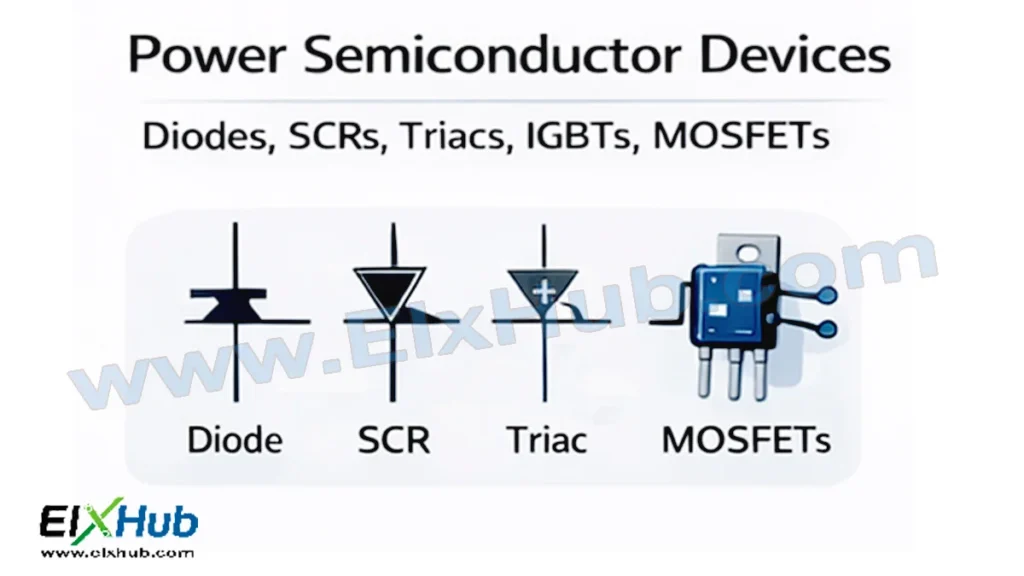
Power semiconductor devices are the foundation of power electronics. They enable the control, conversion, and regulation of electrical power in systems ranging from simple battery chargers to complex industrial drives, renewable energy inverters, and electric vehicles. Unlike small-signal electronic components, power semiconductor devices are designed to handle high voltages, high currents, and significant power dissipation while operating reliably under harsh electrical and thermal conditions.
The evolution of power electronics is closely tied to the development of power semiconductor devices. Early systems relied on bulky electromechanical switches and vacuum tubes, which were inefficient and difficult to control. The introduction of solid-state power devices revolutionized energy conversion by making systems more efficient, compact, and controllable. Today, devices such as power diodes, SCRs, triacs, power MOSFETs, and IGBTs dominate power conversion applications across industries.
This article provides a deep and practical understanding of the major power semiconductor devices used in power electronics. It explains their working principles, characteristics, advantages, limitations, and real-world applications, helping you build a strong conceptual foundation for advanced power electronics topics.
What Are Power Semiconductor Devices?
Power semiconductor devices are solid-state electronic components specifically designed to control and switch electrical power. They typically operate in switching mode rather than linear mode, allowing them to manage large amounts of power with minimal energy loss.
Key goals of power semiconductor devices include:
Efficient power handling
High voltage and current capability
Fast switching performance
Thermal stability and reliability
[Image Placeholder: Classification of power semiconductor devices]
Power semiconductor devices are broadly classified into uncontrolled devices, semi-controlled devices, and fully controlled devices, depending on how their conduction can be controlled.
Power Diodes
Overview
Power diodes are the simplest power semiconductor devices. They allow current to flow in one direction while blocking it in the opposite direction. Unlike small-signal diodes, power diodes are designed to carry large currents and withstand high reverse voltages.
[Image Placeholder: Power diode symbol and structure]
Working Principle
A power diode conducts when it is forward biased and blocks current when reverse biased. When the applied forward voltage exceeds the diode’s threshold, charge carriers cross the junction and current flows. In reverse bias, only a small leakage current exists until breakdown occurs.
Types of Power Diodes
Power diodes are available in different forms based on speed and application.
General-purpose diodes
Fast recovery diodes
Schottky diodes
Each type is optimized for specific voltage, current, and switching speed requirements.
Applications of Power Diodes
Power diodes are widely used in:
Rectifiers
Freewheeling paths in converters
Battery charging circuits
Power supplies
Silicon Controlled Rectifiers (SCR)
Overview
The Silicon Controlled Rectifier (SCR), also known as a thyristor, is a semi-controlled power device. It can be turned ON using a gate signal but cannot be turned OFF by the gate. Turn-off occurs only when current falls below a certain level.
[Image Placeholder: SCR structure and symbol]
Construction and Terminals
An SCR has three terminals:
Anode
Cathode
Gate
It consists of four semiconductor layers arranged in a PNPN structure.
Working Principle
When forward voltage is applied between anode and cathode, the SCR remains OFF until a gate pulse is applied. Once triggered, it latches into the ON state and continues conducting even if the gate signal is removed.
Advantages of SCRs
High voltage capability
High current handling
Robust and reliable operation
Limitations of SCRs
Cannot be turned OFF by gate control
Lower switching speed
Requires commutation circuits
Applications of SCRs
SCRs are commonly used in:
Controlled rectifiers
DC motor speed control
AC voltage regulators
HVDC systems
Triacs
Overview
A triac is a bidirectional thyristor device used mainly in AC power control applications. It can conduct current in both directions when triggered.
[Image Placeholder: Triac symbol and bidirectional conduction]
Working Principle
A triac conducts current in either direction when a gate pulse is applied. Once triggered, it remains ON until the current drops below the holding current.
Advantages of Triacs
Bidirectional conduction
Single device for AC control
Simple gate drive
Limitations of Triacs
Lower power handling compared to SCRs
Sensitive to noise and dv/dt
Not suitable for high-frequency switching
Applications of Triacs
Triacs are widely used in:
Light dimmers
Fan speed regulators
Heater control circuits
Domestic AC appliances
Power MOSFETs
Overview
Power MOSFETs are fully controlled devices widely used in low- to medium-power applications. They offer fast switching speeds and easy gate control.
[Image Placeholder: Power MOSFET internal structure]
Structure and Terminals
A power MOSFET has three terminals:
Gate
Drain
Source
It is a voltage-controlled device, meaning gate voltage controls conduction.
Working Principle
When a sufficient gate-to-source voltage is applied, a conductive channel forms between drain and source, allowing current to flow. Removing the gate voltage turns the device OFF.
Advantages of Power MOSFETs
High switching speed
Simple gate drive
Good efficiency at high frequencies
Limitations of Power MOSFETs
Higher conduction losses at high current
Limited voltage rating compared to IGBTs
Sensitive to static electricity
Applications of Power MOSFETs
Power MOSFETs are used in:
SMPS
DC-DC converters
Battery management systems
Low-voltage motor drives
Insulated Gate Bipolar Transistors (IGBTs)
Overview
IGBTs combine the advantages of MOSFETs and BJTs. They offer easy gate control with high voltage and current capability, making them ideal for medium- to high-power applications.
[Image Placeholder: IGBT symbol and equivalent structure]
Structure and Terminals
An IGBT has three terminals:
Gate
Collector
Emitter
Working Principle
The gate controls the device like a MOSFET, while conduction characteristics resemble a bipolar transistor. This combination results in lower conduction losses at high voltages.
Advantages of IGBTs
High voltage capability
High current handling
Good efficiency in high-power applications
Limitations of IGBTs
Slower switching than MOSFETs
Higher switching losses at high frequency
Applications of IGBTs
IGBTs are commonly used in:
Inverters
Electric vehicle motor drives
Industrial motor control
UPS systems
Comparison of Major Power Semiconductor Devices
| Device | Control Type | Typical Use Case | Switching Speed |
|---|---|---|---|
| Power Diode | Uncontrolled | Rectification | Low |
| SCR | Semi-controlled | High-power AC/DC control | Low |
| Triac | Semi-controlled | AC power control | Low |
| MOSFET | Fully controlled | High-frequency converters | High |
| IGBT | Fully controlled | High-power inverters | Medium |
Thermal Management in Power Devices
Power semiconductor devices generate heat during operation due to conduction and switching losses. Effective thermal management is critical for reliability and lifespan.
Common thermal solutions include:
Heat sinks
Thermal pads and grease
Forced air cooling
Liquid cooling in high-power systems
[Image Placeholder: Heat sink and thermal management for power devices]
Selection Criteria for Power Semiconductor Devices
Choosing the right power device depends on multiple factors:
Voltage and current ratings
Switching frequency
Efficiency requirements
Thermal performance
Cost and availability
Understanding these parameters ensures optimal system performance and reliability.
Role of Power Semiconductor Devices in Modern Power Electronics
Modern power electronics systems depend heavily on advanced power semiconductor devices. From renewable energy integration to electric mobility and smart grids, these devices enable precise and efficient energy control.
Emerging materials such as silicon carbide (SiC) and gallium nitride (GaN) are further improving performance by offering higher efficiency, higher temperature operation, and higher switching speeds.
Conclusion
Power semiconductor devices are the building blocks of power electronics. Each device type—power diodes, SCRs, triacs, MOSFETs, and IGBTs—serves a specific purpose based on power level, switching speed, and control requirements. Understanding their working principles, advantages, limitations, and applications is essential for designing efficient and reliable power electronic systems. As power electronics continues to evolve, advancements in semiconductor technology will further expand the capabilities and applications of these critical devices.
Image Reference Table
| Filename | Description | Alt Text |
|---|---|---|
| power-device-classification.png | Classification of power semiconductor devices | power semiconductor devices |
| power-diode.png | Power diode symbol and structure | power diode |
| scr-device.png | SCR structure and symbol | silicon controlled rectifier |
| triac-device.png | Triac bidirectional conduction | triac AC control |
| power-mosfet.png | Power MOSFET internal structure | power MOSFET |
| igbt-device.png | IGBT symbol and structure | IGBT transistor |
| thermal-management.png | Heat sink and cooling methods | power device cooling |
SEO Title
Power Semiconductor Devices – Diodes, SCRs, Triacs, MOSFETs, and IGBTs Explained
Meta Description
Learn power semiconductor devices in detail, including power diodes, SCRs, triacs, MOSFETs, and IGBTs, with working principles, applications, and comparisons.