Introduction
Memory devices are one of the most critical building blocks of digital electronics. Every digital system, from a simple microcontroller-based project to complex computers and embedded systems, relies heavily on memory to store data, instructions, and intermediate results. Without memory devices, digital circuits would be unable to retain information, making meaningful computation impossible.
Unlike combinational logic, memory devices are sequential in nature, meaning they can store binary information over time. Different types of memory devices are designed to serve different purposes such as high-speed data access, long-term data storage, firmware storage, and configuration retention even when power is removed.
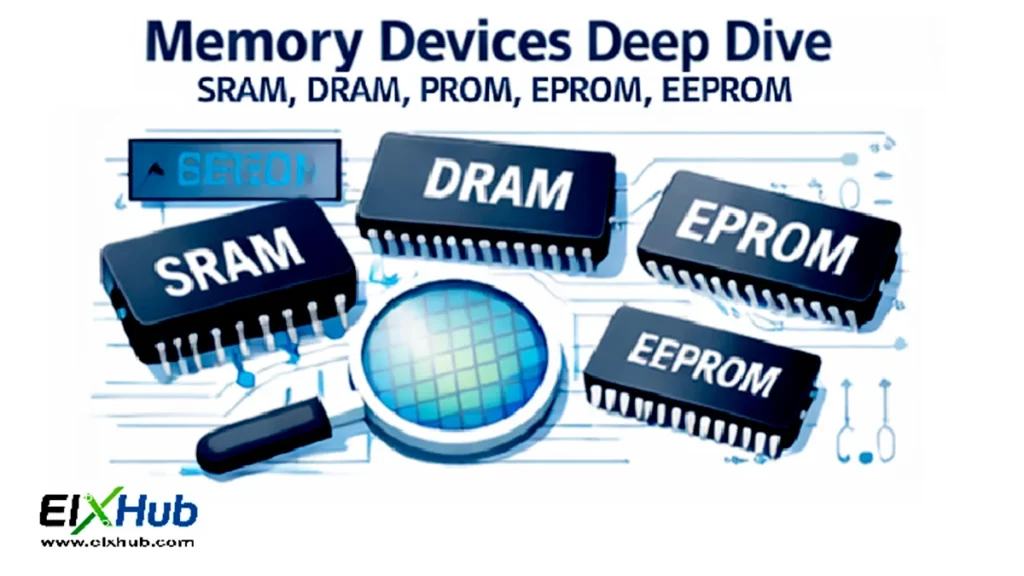
This article provides a full practical deep dive into major memory devices used in digital electronics, including SRAM, DRAM, PROM, EPROM, and EEPROM. The focus is not just on definitions, but on internal working, characteristics, real-world applications, advantages, limitations, and where each type is actually used.
What Are Memory Devices?
Memory devices are electronic components or circuits used to store binary data in the form of logic 0s and 1s. They retain information either temporarily or permanently depending on the type of memory.
Memory devices are broadly classified into:
Volatile memory
Non-volatile memory
Volatile memory loses stored data when power is removed, while non-volatile memory retains data even without power.
[Image Placeholder: Classification diagram of volatile and non-volatile memory]
Volatile Memory Devices
Volatile memory is primarily used for temporary data storage during system operation. These memories are fast and are directly interfaced with processors.
The two most important volatile memory types are:
Static RAM (SRAM)
Dynamic RAM (DRAM)
Static Random Access Memory (SRAM)
SRAM is a high-speed volatile memory that stores data using flip-flop-based memory cells. Unlike DRAM, SRAM does not require refreshing, making it faster and more reliable for certain applications.
Internal Structure of SRAM
Each SRAM cell is typically constructed using six transistors (6T SRAM cell). These transistors form a bistable latch that holds a single bit of data.
[Image Placeholder: Internal 6-transistor SRAM memory cell]
Working Principle of SRAM
Data is written to the SRAM cell by forcing the latch into a desired state. Once stored, the data remains stable as long as power is supplied. No refresh circuitry is required.
Characteristics of SRAM
Very high speed
Low latency
No refresh required
Lower density
Higher cost per bit
Practical Applications of SRAM
CPU cache memory (L1, L2, L3 cache)
High-speed buffers
Registers
Small embedded systems
Advantages of SRAM
Fastest memory access
Simple control logic
Stable data storage
Limitations of SRAM
High power consumption
Low storage density
Expensive compared to DRAM
Dynamic Random Access Memory (DRAM)
DRAM is the most widely used volatile memory for main system memory due to its high density and lower cost.
Internal Structure of DRAM
Each DRAM cell consists of:
One transistor
One capacitor
The capacitor stores charge representing a bit of data.
[Image Placeholder: DRAM cell structure with capacitor and transistor]
Working Principle of DRAM
A charged capacitor represents logic 1, while a discharged capacitor represents logic 0. Over time, the charge leaks, requiring periodic refreshing to maintain data integrity.
Refreshing in DRAM
DRAM must be refreshed thousands of times per second. Refreshing involves reading and rewriting data to restore charge.
Characteristics of DRAM
High storage density
Lower cost per bit
Slower than SRAM
Requires refresh circuitry
Practical Applications of DRAM
Main system memory (RAM) in computers
Graphics memory
Mobile devices
Embedded systems
Advantages of DRAM
Large capacity
Low cost
Efficient for large data storage
Limitations of DRAM
Slower access time
Complex control circuitry
Power consumed during refresh
Comparison of SRAM and DRAM
| Feature | SRAM | DRAM |
|---|---|---|
| Speed | Very high | Moderate |
| Refresh | Not required | Required |
| Density | Low | High |
| Cost | High | Low |
| Applications | Cache, registers | Main memory |
Non-Volatile Memory Devices
Non-volatile memory retains data even when power is removed. These memories are used for firmware storage, configuration data, and long-term information storage.
Key non-volatile memories include:
PROM
EPROM
EEPROM
[Image Placeholder: Non-volatile memory family diagram]
Programmable Read-Only Memory (PROM)
PROM is a type of memory that can be programmed only once after manufacturing.
Working of PROM
PROM contains fusible links. Programming involves blowing specific fuses to store data permanently.
Characteristics of PROM
One-time programmable
Non-volatile
Permanent data storage
Applications of PROM
Firmware storage
Device configuration
Permanent lookup tables
Limitations of PROM
Cannot be erased or reprogrammed
Programming errors are irreversible
Erasable Programmable Read-Only Memory (EPROM)
EPROM allows stored data to be erased and reprogrammed.
Working of EPROM
EPROM stores data using floating-gate transistors. Erasing is done by exposing the chip to ultraviolet (UV) light through a quartz window.
[Image Placeholder: EPROM chip with quartz window]
Characteristics of EPROM
Non-volatile
Reprogrammable
UV-based erasure
Applications of EPROM
Firmware development
Prototyping
Legacy systems
Limitations of EPROM
Requires UV eraser
Chip removal required
Limited erase cycles
Electrically Erasable Programmable Read-Only Memory (EEPROM)
EEPROM allows electrical erasing and programming without removing the chip from the circuit.
Working of EEPROM
EEPROM uses floating-gate transistors similar to EPROM, but erasing and writing are performed electrically.
[Image Placeholder: EEPROM memory cell operation]
Characteristics of EEPROM
Non-volatile
Byte-level erase and write
Electrical reprogramming
Practical Applications of EEPROM
Microcontroller configuration storage
Calibration data
BIOS storage
User settings retention
Advantages of EEPROM
Easy reprogramming
No special equipment needed
Reliable data retention
Limitations of EEPROM
Slower write speed
Limited write cycles
Higher cost than flash memory
Memory Device Selection in Practical Design
Choosing the right memory depends on:
Speed requirements
Storage capacity
Cost constraints
Power consumption
Reprogrammability
For example:
Cache memory uses SRAM
System RAM uses DRAM
Firmware uses EEPROM or flash
Summary Comparison of Memory Types
| Memory Type | Volatile | Speed | Reprogrammable | Typical Use |
|---|---|---|---|---|
| SRAM | Yes | Very High | Yes | Cache |
| DRAM | Yes | Moderate | Yes | Main Memory |
| PROM | No | Moderate | No | Permanent Data |
| EPROM | No | Moderate | Yes (UV) | Development |
| EEPROM | No | Moderate | Yes (Electrical) | Configuration |
Conclusion
Memory devices form the foundation of all digital systems. Understanding the differences between SRAM, DRAM, PROM, EPROM, and EEPROM allows designers and learners to select the correct memory for performance, cost, and reliability requirements. From ultra-fast cache memory to long-term firmware storage, each memory type serves a unique and irreplaceable role in digital electronics.
Image Reference Table
| Filename | Description | Alt Text |
|---|---|---|
| memory-classification.png | Volatile vs non-volatile memory diagram | memory classification diagram |
| sram-cell.png | 6T SRAM memory cell | SRAM memory cell |
| dram-cell.png | DRAM capacitor-based cell | DRAM memory cell |
| eprom-window.png | EPROM with quartz window | EPROM chip |
| eeprom-cell.png | EEPROM floating gate cell | EEPROM memory |
SEO Title
Memory Devices in Digital Electronics – SRAM, DRAM, PROM, EPROM, EEPROM Explained
Meta Description
Learn memory devices in digital electronics with a deep practical guide to SRAM, DRAM, PROM, EPROM, and EEPROM including working and applications.