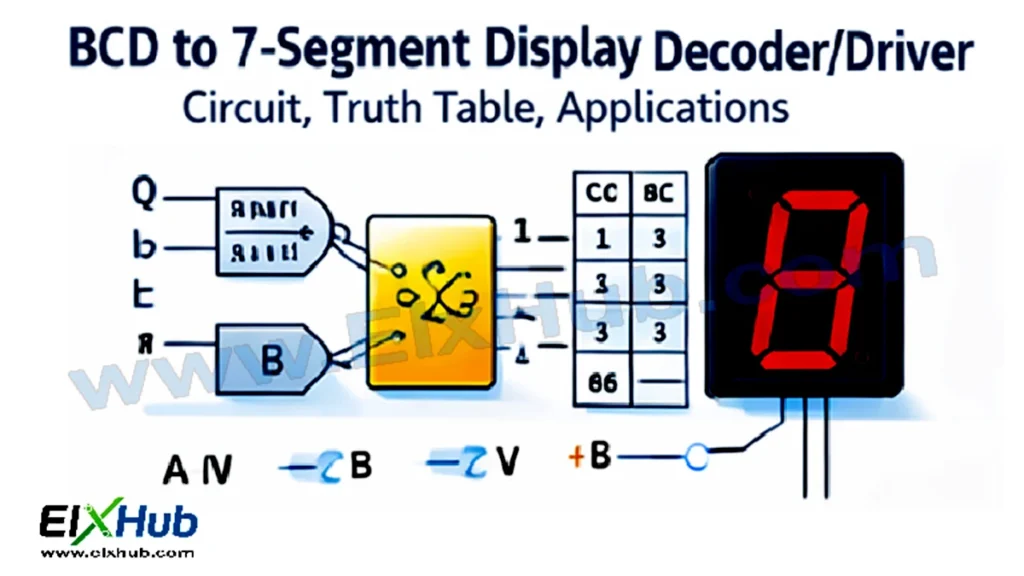
Introduction
A BCD (Binary-Coded Decimal) to 7-segment display decoder/driver is a crucial component in digital electronics used to convert binary input codes into signals that drive 7-segment displays. These devices are widely used in digital clocks, calculators, electronic meters, and any system where numerical data needs to be visually displayed. By converting a 4-bit BCD input into the appropriate 7-segment code, the decoder allows microcontrollers, counters, and digital circuits to present readable numbers on a display with minimal wiring complexity.
BCD to 7-segment decoders simplify circuit design by eliminating the need for separate logic for each segment. They provide standard output codes for all ten decimal digits (0–9) and, in some designs, display blank or error codes for invalid inputs (10–15). Understanding the operation, truth tables, logic circuits, and applications of these decoders is essential for electronics engineers, hobbyists, and students working with digital display systems.
What is a BCD to 7-Segment Display Decoder/Driver?
A BCD to 7-segment decoder takes a 4-bit binary input (representing decimal digits 0–9) and activates the seven segments (labeled a–g) of a display to show the corresponding decimal number. The device can be implemented using logic gates or as an integrated circuit (IC) such as the popular 74LS47 or CD4511.
Each output corresponds to a segment of the display:
- a, b, c, d, e, f, g – Segments that can be turned on/off
- Active HIGH or Active LOW – Depends on the IC; some drivers require common cathode or common anode displays
7-Segment Display Structure
A 7-segment display is composed of seven LEDs arranged in a figure-eight configuration to display numbers 0–9. Each segment is labeled a through g. By turning on specific combinations of these segments, all decimal digits can be represented. Some displays include an additional dot (DP) for decimal points.
Image Placeholder (Horizontal): 7-segment display labeled a–g
Truth Table for BCD to 7-Segment Decoder
| BCD Input | Decimal Digit | a | b | c | d | e | f | g |
|---|---|---|---|---|---|---|---|---|
| 0000 | 0 | 1 | 1 | 1 | 1 | 1 | 1 | 0 |
| 0001 | 1 | 0 | 1 | 1 | 0 | 0 | 0 | 0 |
| 0010 | 2 | 1 | 1 | 0 | 1 | 1 | 0 | 1 |
| 0011 | 3 | 1 | 1 | 1 | 1 | 0 | 0 | 1 |
| 0100 | 4 | 0 | 1 | 1 | 0 | 0 | 1 | 1 |
| 0101 | 5 | 1 | 0 | 1 | 1 | 0 | 1 | 1 |
| 0110 | 6 | 1 | 0 | 1 | 1 | 1 | 1 | 1 |
| 0111 | 7 | 1 | 1 | 1 | 0 | 0 | 0 | 0 |
| 1000 | 8 | 1 | 1 | 1 | 1 | 1 | 1 | 1 |
| 1001 | 9 | 1 | 1 | 1 | 1 | 0 | 1 | 1 |
| 1010–1111 | Invalid | 0 | 0 | 0 | 0 | 0 | 0 | 0 |
This table assumes active HIGH outputs; for active LOW drivers, logic levels are inverted.
Boolean Expressions for Segments
Using the truth table, Boolean expressions for each segment can be derived. For example:
- a = B̅C̅D + B̅CD̅ + BC̅D̅ + BCD
- b = B̅C D̅ + B̅CD + BC̅D̅ + BCD̅
- c = B̅C̅D + B̅CD + BC̅D̅ + BCD̅
- d = B̅C̅D + B̅CD̅ + BC̅D + BCD̅
- e = B̅C̅D + B̅CD̅ + BC̅D̅
- f = B̅C̅D + B̅CD + BC̅D̅
- g = B̅C̅D + B̅CD̅ + BC̅D + BCD
These expressions are then implemented using AND, OR, and NOT gates or programmed into an IC driver.
Implementation Using ICs
Popular ICs for BCD to 7-segment decoding:
| IC | Display Type | Features |
|---|---|---|
| 74LS47 | Common Anode | Active LOW outputs, blanking input, ripple-blanking |
| CD4511 | Common Cathode | Active HIGH outputs, lamp test, blanking input |
| 74HC4511 | Common Cathode | High-speed CMOS, same as CD4511 |
These ICs take a 4-bit BCD input and directly drive the 7-segment display without requiring individual gate implementation.
Image Placeholder (Horizontal): BCD to 7-segment IC connection diagram
Applications of BCD to 7-Segment Decoders
- Digital Clocks – Convert counter outputs to readable time digits
- Calculators – Display arithmetic results
- Counters and Meters – Visualize counts or measurements
- Embedded Systems – Quick numerical display without complex logic
- Digital Electronic Projects – Simple way to show outputs for hobbyist circuits
Advantages
- Reduces wiring complexity
- Easy to interface with microcontrollers
- Standardized ICs simplify design
- Compatible with multiple display types
Limitations
- Only works for decimal digits 0–9
- Extra logic needed for hexadecimal or custom symbols
- IC-based decoders may have propagation delay at high frequencies
Practical Implementation Tips
- Ensure correct common cathode or anode display type
- Check IC power supply ratings (typically 5V)
- Use current-limiting resistors for LEDs
- Cascading multiple decoders for multi-digit displays
- Use blanking input for leading zero suppression
Conclusion
BCD to 7-segment decoders/drivers are fundamental components in digital electronics for converting binary inputs into human-readable numeric displays. By understanding the truth table, Boolean expressions, IC implementations, and applications, designers can create efficient, reliable, and visually accurate digital display systems. From digital clocks to embedded systems, these decoders simplify design and reduce the complexity of numeric display circuits.
Image Reference Table (For Future Use)
| Filename | Description | Alt Text |
|---|---|---|
| bcd-to-7seg-truth-table.png | Truth table of BCD to 7-segment decoder | BCD to 7-segment truth table |
| bcd-to-7seg-ic.png | IC-based BCD to 7-segment driver connection | BCD to 7-segment IC driver circuit |
| bcd-to-7seg-logic.png | Logic gates implementation of BCD to 7-segment | BCD to 7-segment logic gates |
| 7seg-display-diagram.png | 7-segment display labeled a-g | 7-segment display diagram |
| bcd-decoder-applications.png | Applications of BCD to 7-segment decoders | BCD to 7-segment decoder applications |
SEO (Paste in WordPress SEO plugin)
SEO Title
BCD to 7-Segment Display Decoder/Driver | Circuit, Truth Table & Applications
Meta Description
Learn BCD to 7-segment display decoder/driver operation. Includes truth tables, circuits, Boolean expressions, ICs, and applications for digital electronics projects.