Introduction
Logic families are groups of digital ICs that share the same design characteristics and electrical parameters. They define how digital circuits implement logic gates, manage voltage levels, switching speed, power consumption, and compatibility. Understanding logic families is critical for designing reliable digital circuits.
This article provides a detailed explanation of digital logic families, including types, characteristics, working principles, advantages, limitations, and real-world applications.
What Is a Logic Family
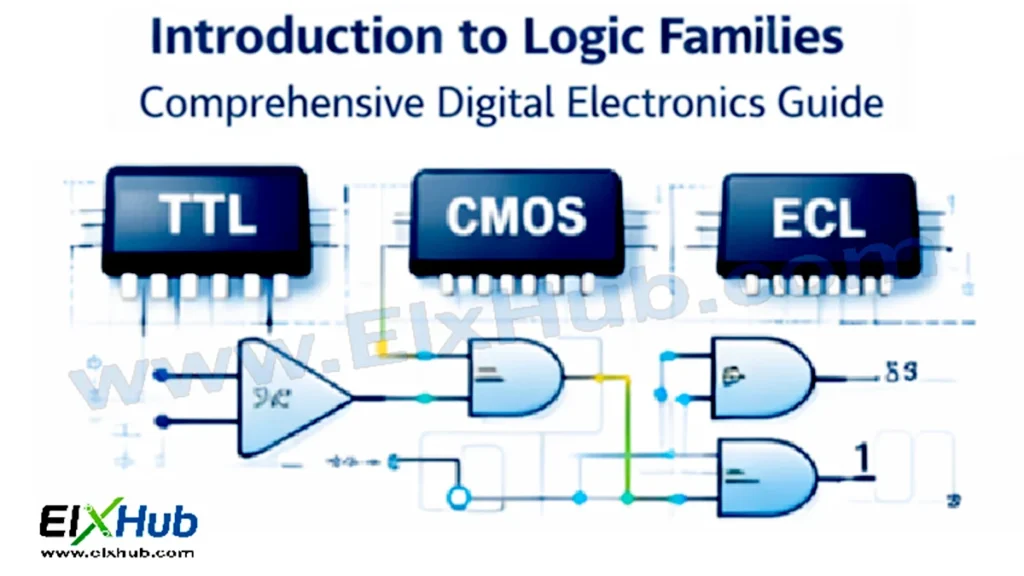
A logic family is a group of electronic logic gates built using the same technology and sharing the same voltage and current specifications. Examples include TTL (Transistor-Transistor Logic), CMOS (Complementary Metal-Oxide-Semiconductor), and ECL (Emitter-Coupled Logic).
Image Placeholder (Horizontal): Logic family overview diagram showing TTL, CMOS, ECL
Why Logic Families Are Important
• Ensure compatibility between ICs
• Determine speed, power, and voltage levels
• Influence noise immunity and performance
• Simplify circuit design by standardizing parameters
Choosing the right logic family is crucial in multi-IC systems to avoid malfunction.
Popular Logic Families
TTL (Transistor-Transistor Logic)
TTL ICs use bipolar junction transistors for logic implementation.
Characteristics:
• Supply voltage: 5V
• High speed
• Moderate power consumption
• Low input impedance
Image Placeholder (Horizontal): TTL IC symbol and pinout
Advantages:
• Fast switching
• Robust operation
• Widely available
Limitations:
• Higher power consumption
• Limited voltage range
CMOS (Complementary Metal-Oxide-Semiconductor)
CMOS uses complementary PMOS and NMOS transistors.
Characteristics:
• Wide supply voltage: 3V–15V
• Very low power consumption
• High input impedance
• Good noise immunity
Image Placeholder (Horizontal): CMOS IC symbol and block diagram
Advantages:
• Extremely low power
• Wide voltage range
• Ideal for battery-operated circuits
Limitations:
• Slower in older CMOS ICs
• Susceptible to static discharge
ECL (Emitter-Coupled Logic)
ECL is a high-speed bipolar logic family. It does not saturate transistors, allowing extremely fast switching.
Characteristics:
• High speed (GHz range)
• Very low voltage swing
• High power consumption
Applications:
• High-speed computers
• Communication systems
• Data servers
RTL (Resistor-Transistor Logic) and DTL (Diode-Transistor Logic)
Older logic families used resistors and diodes with transistors for logic operations. Today, TTL and CMOS dominate, but RTL and DTL are still educationally important.
Key Parameters of Logic Families
| Parameter | TTL | CMOS | ECL |
|---|---|---|---|
| Power Supply | 5V | 3–15V | 5.2V |
| Input Impedance | Low | High | Medium |
| Propagation Delay | 10–20 ns | 10–100 ns | 1–2 ns |
| Noise Immunity | Moderate | High | Low |
| Power Consumption | Moderate | Low | High |
Image Placeholder (Horizontal): Logic family parameter comparison chart
Interfacing Between Logic Families
When designing multi-family circuits:
• TTL to CMOS requires pull-up resistors
• CMOS to TTL works directly if voltage levels are compatible
• ECL requires special level-shifting circuits
Proper interfacing ensures reliable operation.
Image Placeholder (Horizontal): TTL-CMOS interfacing diagram
Applications of Logic Families
• TTL – industrial control, microprocessor interfacing
• CMOS – battery-operated devices, analog-digital converters
• ECL – high-speed communication and computing
• Mixed logic systems in modern electronics
Common Beginner Mistakes
• Mixing incompatible ICs without voltage matching
• Ignoring propagation delay in fast circuits
• Neglecting power supply requirements
• Static electricity damaging CMOS ICs
FAQs About Logic Families
Why are TTL and CMOS most popular?
TTL is fast and robust; CMOS is low-power and versatile, suitable for most modern circuits.
Can ECL be used with TTL?
Directly no; level shifting is required due to different voltage ranges.
What logic family is best for beginners?
CMOS is beginner-friendly due to low power and wide voltage tolerance.
Conclusion
Understanding logic families is essential for designing reliable, compatible, and efficient digital circuits. TTL, CMOS, and ECL each have strengths and weaknesses. Choosing the appropriate logic family ensures that digital systems work correctly in terms of speed, power, and reliability.
SEO Title
Logic Families in Digital Electronics – TTL, CMOS, ECL, and More Explained
Meta Description
Learn digital logic families in electronics. Complete guide covering types, working, advantages, disadvantages, and applications for beginners.