Introduction
Microcontrollers are the brain of modern electronic devices. From home appliances and smartphones to industrial automation and robotics, microcontrollers control and process data efficiently. Unlike general-purpose computers, microcontrollers are small, low-cost, and designed for dedicated applications.
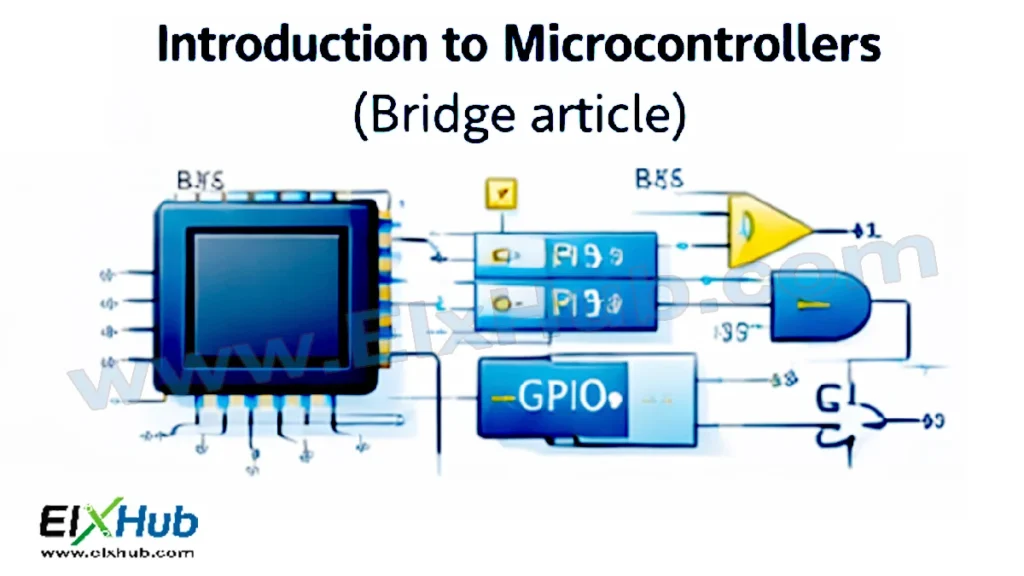
This article provides a detailed explanation of microcontrollers, including architecture, working principles, types, programming basics, and real-world applications. Beginners will gain a solid foundation for electronics projects and embedded systems design.
What Is a Microcontroller
A microcontroller is a compact integrated circuit designed to perform specific tasks. It combines a CPU, memory, and peripherals on a single chip. Microcontrollers are used to control devices and processes based on inputs and programmed logic.
Image Placeholder (Horizontal): Microcontroller internal block diagram showing CPU, memory, and I/O
Difference Between Microcontrollers and Microprocessors
| Feature | Microcontroller | Microprocessor |
|---|---|---|
| Purpose | Dedicated applications | General-purpose computing |
| Peripherals | Built-in I/O and memory | External peripherals needed |
| Cost | Low | Higher |
| Power Consumption | Low | Higher |
| Applications | Embedded systems, gadgets | PCs, servers |
Basic Architecture of a Microcontroller
A typical microcontroller consists of:
• Central Processing Unit (CPU) – executes instructions
• Read-Only Memory (ROM) – stores program code
• Random-Access Memory (RAM) – temporary data storage
• Input/Output Ports – interact with external devices
• Timers and Counters – measure time and events
• Communication Interfaces – UART, SPI, I2C
Image Placeholder (Horizontal): Microcontroller architecture block diagram
How Microcontrollers Work
Microcontrollers work by executing instructions stored in ROM. They read inputs, process data, and control outputs according to the programmed logic. A clock signal synchronizes all operations.
Typical operation:
- Read input data from sensors or switches
- Process data using CPU and program logic
- Update output devices (LEDs, motors, displays)
Common Microcontroller Families
8051 Microcontroller
• 8-bit microcontroller
• Widely used in industrial and educational projects
• Simple instruction set and architecture
PIC Microcontroller
• Manufactured by Microchip
• Popular in embedded systems
• Supports various bit sizes (8-bit, 16-bit, 32-bit)
AVR Microcontroller
• Popular in Arduino boards
• Efficient and versatile
• Strong community support
ARM Cortex-M
• 32-bit high-performance microcontroller
• Used in advanced embedded systems
• Low power consumption
Image Placeholder (Horizontal): Examples of 8051, PIC, AVR, and ARM microcontrollers
Input and Output Interfaces
Microcontrollers interact with the outside world using digital and analog interfaces.
Inputs:
• Sensors (temperature, light, motion)
• Switches and buttons
• Communication lines (UART, SPI, I2C)
Outputs:
• LEDs and displays
• Motors and actuators
• Communication lines to other devices
Image Placeholder (Horizontal): Microcontroller I/O interface diagram
Programming Microcontrollers
Microcontrollers are programmed to perform specific tasks. Programming involves writing code in languages such as:
• Assembly language
• C/C++
• Arduino IDE (simplified C++)
Steps for programming:
- Write code according to logic requirements
- Compile and convert into machine code
- Upload program to microcontroller memory
- Test and debug operation
Image Placeholder (Horizontal): Microcontroller programming workflow diagram
Timers and Interrupts
Timers and interrupts allow microcontrollers to handle time-based tasks and respond to events efficiently.
• Timers generate periodic signals or delays
• Interrupts temporarily pause program execution to handle urgent events
These features make microcontrollers ideal for real-time applications.
Applications of Microcontrollers
Home Automation
Microcontrollers control lights, fans, AC units, and security systems.
Robotics
Robots rely on microcontrollers for sensor processing, motor control, and decision-making.
Industrial Automation
Microcontrollers manage conveyor belts, motors, sensors, and data logging.
Consumer Electronics
Used in washing machines, microwave ovens, cameras, and toys.
Embedded Communication Systems
Microcontrollers enable smart devices to communicate via IoT protocols.
Image Placeholder (Horizontal): Microcontroller applications in home, robotics, and industry
Common Beginner Mistakes
• Forgetting voltage requirements
• Ignoring clock frequency specifications
• Incorrect I/O connections
• Poor program logic or debugging
Avoiding these mistakes ensures reliable microcontroller operation.
FAQs About Microcontrollers
What is the difference between MCU and MPU?
MCU (Microcontroller Unit) integrates CPU, memory, and peripherals on one chip, whereas MPU (Microprocessor Unit) requires external peripherals.
Can microcontrollers run multiple programs at once?
Basic MCUs execute one program at a time but can handle multiple tasks using interrupts.
Which microcontroller is best for beginners?
Arduino (AVR-based) boards are beginner-friendly due to simplicity and strong community support.
Conclusion
Microcontrollers are the heart of modern embedded systems. Understanding their architecture, working principles, programming, and applications is crucial for electronics enthusiasts and engineers. Mastery of microcontrollers opens the door to robotics, automation, IoT, and advanced electronics projects.
SEO Title
Introduction to Microcontrollers – Digital Electronics Complete Beginner Guide
Meta Description
Learn microcontrollers in digital electronics. Complete guide covering working, architecture, types, programming, and real-world applications.