Introduction
AC motors are the backbone of modern industry, consuming a major share of the world’s generated electrical energy. From pumps, fans, compressors, conveyors, elevators, HVAC systems, and machine tools to heavy industrial drives, AC motors dominate due to their rugged construction, low cost, and minimal maintenance. However, without proper control, AC motors operate at fixed speed, draw high starting current, and cause mechanical stress during startup. This is where power electronics plays a critical role.
Power electronics enables efficient, smooth, and flexible control of AC motors by regulating voltage, frequency, and current using semiconductor devices such as diodes, SCRs, MOSFETs, and IGBTs. Two of the most widely used AC motor control technologies are Variable Frequency Drives (VFDs) and Soft Starters. This article provides a comprehensive, practical, and in-depth explanation of AC motor control using power electronics, focusing on operating principles, circuit concepts, control techniques, advantages, limitations, and real-world applications.
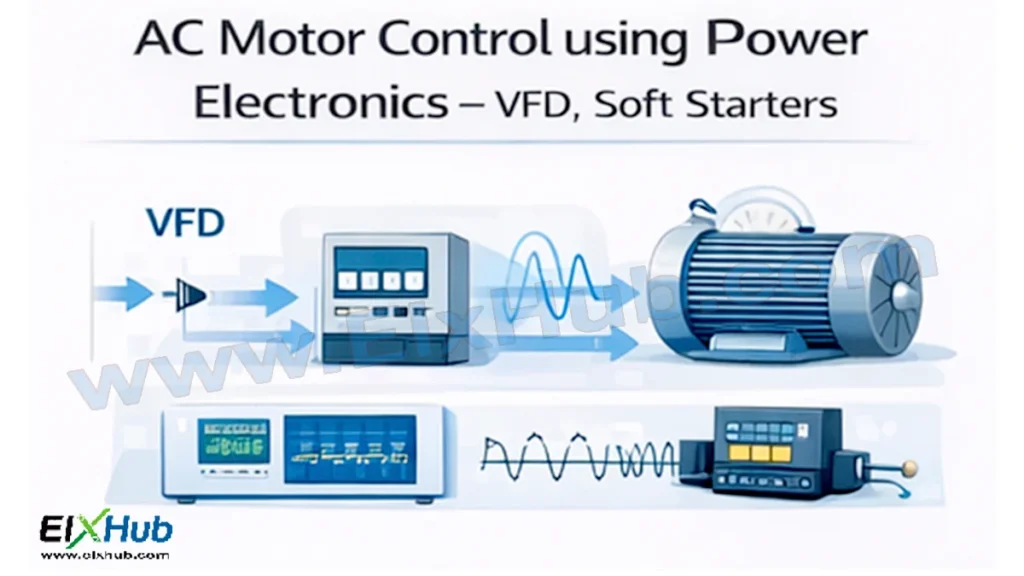
[Image Placeholder: AC motor with power electronic controller]
Why AC Motor Control is Necessary
Traditional AC motor operation involves direct-on-line (DOL) starting, where full rated voltage is applied instantly. This leads to several problems:
- Very high starting current (5 to 7 times rated current)
- Mechanical stress on shafts, couplings, and gears
- Voltage dips affecting other equipment
- No speed control or energy optimization
Power electronic controllers overcome these issues by providing controlled starting, variable speed operation, energy savings, and improved system reliability.
Types of AC Motors Used with Power Electronic Control
The most common AC motors used with power electronic drives are:
| Motor Type | Characteristics | Typical Applications |
|---|---|---|
| Induction Motor (Squirrel Cage) | Rugged, low cost | Pumps, fans, conveyors |
| Induction Motor (Slip Ring) | High starting torque | Cranes, hoists |
| Synchronous Motor | Constant speed, high efficiency | Compressors, mills |
[Image Placeholder: Types of AC motors used in drives]
Among these, three-phase squirrel cage induction motors are the most widely controlled using VFDs.
Fundamentals of AC Motor Speed Control
The speed of an AC motor is primarily determined by the supply frequency.
Synchronous speed is given by:
Ns = (120 × f) / P
Where:
- Ns = Synchronous speed (RPM)
- f = Supply frequency (Hz)
- P = Number of poles
This equation clearly shows that varying frequency directly controls motor speed, which is the fundamental principle behind VFD-based AC motor control.
Power Electronic Building Blocks in AC Motor Control
AC motor control systems are built using several power electronic stages.
| Stage | Function |
|---|---|
| Rectifier | Converts AC to DC |
| DC Link | Filters and stores energy |
| Inverter | Converts DC to variable AC |
| Controller | Controls voltage and frequency |
[Image Placeholder: Power electronic blocks of AC motor drive]
These stages form the heart of Variable Frequency Drives.
Variable Frequency Drives (VFDs)
What is a VFD?
A Variable Frequency Drive (VFD) is a power electronic device that controls the speed and torque of an AC motor by varying the frequency and voltage of the supply.
VFDs provide:
- Smooth starting and stopping
- Wide speed control range
- Energy savings
- Precise torque control
[Image Placeholder: Variable Frequency Drive system overview]
Basic Structure of a VFD
A typical VFD consists of:
- AC-DC Rectifier
- DC Link (Filter)
- DC-AC Inverter
- Control and Protection Circuit
| Section | Description |
|---|---|
| Rectifier | Diode or controlled rectifier |
| DC Link | Capacitors and inductors |
| Inverter | IGBT-based PWM inverter |
| Controller | Microcontroller or DSP |
[Image Placeholder: Internal structure of a VFD]
Rectifier Stage in VFD
The rectifier converts fixed AC input into DC. Common rectifier types include:
| Rectifier Type | Features |
|---|---|
| Diode Bridge | Simple, low cost |
| SCR Rectifier | Controlled DC output |
| Active Rectifier | Low harmonics, regenerative |
DC Link Stage
The DC link smooths rectifier output and stores energy using capacitors and sometimes inductors. A stable DC link voltage is essential for reliable inverter operation.
Inverter Stage
The inverter converts DC into variable-frequency AC using high-speed switching devices.
Modern VFDs use:
- IGBTs for medium and high power
- MOSFETs for low power
[Image Placeholder: PWM inverter waveforms]
V/f Control (Scalar Control)
The simplest and most widely used control method in VFDs is constant V/f control.
Principle:
- Voltage is varied proportionally with frequency
- Magnetic flux remains constant
- Torque remains approximately constant
| Frequency | Voltage | Torque |
|---|---|---|
| Low | Low | Constant |
| Rated | Rated | Rated |
Advantages:
- Simple implementation
- Low cost
- Suitable for fans and pumps
Limitations:
- Poor dynamic response
- Limited low-speed torque
Vector Control and Direct Torque Control
Advanced VFDs use sophisticated control techniques.
Vector Control (Field-Oriented Control)
Vector control independently controls:
- Flux-producing current
- Torque-producing current
Benefits:
- High starting torque
- Precise speed control
- Fast dynamic response
Applications:
- Elevators
- CNC machines
- Robotics
Direct Torque Control (DTC)
DTC directly controls motor torque and flux without PWM modulation.
Advantages:
- Very fast response
- High efficiency
- No current controllers
[Image Placeholder: Vector control concept]
Soft Starters
What is a Soft Starter?
A soft starter is a power electronic device that gradually increases voltage applied to an AC motor during startup, reducing inrush current and mechanical stress.
Unlike VFDs, soft starters do not provide speed control during normal operation.
[Image Placeholder: Soft starter connected to AC motor]
Working Principle of Soft Starters
Soft starters typically use SCRs connected in anti-parallel in each phase.
By controlling the firing angle of SCRs:
- RMS voltage is gradually increased
- Motor accelerates smoothly
- Starting current is reduced
[Image Placeholder: SCR-based soft starter circuit]
Comparison: Soft Starter vs VFD
| Feature | Soft Starter | VFD |
|---|---|---|
| Speed Control | No | Yes |
| Starting Current | Reduced | Very low |
| Energy Saving | Limited | High |
| Cost | Lower | Higher |
| Complexity | Simple | Complex |
Soft starters are ideal where speed control is not required but smooth starting is essential.
Braking of AC Motors Using Power Electronics
Power electronics enables various braking techniques for AC motors.
Types of Braking
| Braking Type | Description |
|---|---|
| DC Injection Braking | DC applied to stator |
| Dynamic Braking | Energy dissipated in resistor |
| Regenerative Braking | Energy returned to supply |
[Image Placeholder: AC motor braking methods]
VFDs commonly support DC injection and regenerative braking.
Harmonics and Power Quality Issues
Power electronic drives introduce harmonics due to switching.
Effects:
- Heating in transformers
- Reduced power factor
- Interference with other equipment
Mitigation techniques:
- Input reactors
- Harmonic filters
- Active front-end converters
Applications of AC Motor Control Using Power Electronics
AC motor drives are used in nearly every industrial sector.
| Application | Benefit |
|---|---|
| Pumps and Fans | Energy saving |
| Conveyors | Smooth speed control |
| Elevators | Precise motion |
| HVAC Systems | Improved efficiency |
| Compressors | Reduced mechanical stress |
| Machine Tools | High precision |
[Image Placeholder: Industrial applications of AC motor drives]
Advantages of Power Electronic AC Motor Control
- Significant energy savings
- Reduced mechanical wear
- Improved process control
- Compact and reliable systems
- Integration with automation systems
Limitations and Challenges
- Higher initial cost
- EMI and harmonic issues
- Complex control algorithms
- Need for skilled maintenance
Despite these challenges, benefits far outweigh limitations in most applications.
Future Trends in AC Motor Control
- Wide bandgap devices (SiC, GaN)
- AI-based predictive control
- Smart drives with IoT integration
- Higher efficiency and power density
- Regenerative and grid-friendly drives
[Image Placeholder: Future smart AC motor drive systems]
Conclusion
AC motor control using power electronics has revolutionized industrial automation and energy management. Technologies such as Variable Frequency Drives and Soft Starters provide smooth starting, precise speed control, reduced losses, and extended motor life. While soft starters address controlled starting requirements, VFDs offer complete speed and torque control with significant energy savings. As power semiconductor devices and control algorithms continue to advance, AC motor drives will become even more efficient, intelligent, and indispensable in modern power electronic systems.
Image Reference Table
| Image Filename | Description | Alt Text |
|---|---|---|
| ac-motor-controller.png | AC motor with controller | AC motor control using power electronics |
| ac-motor-types.png | Types of AC motors | Types of AC motors in drives |
| drive-blocks.png | Power electronic blocks | AC motor drive power blocks |
| vfd-overview.png | VFD system | Variable frequency drive |
| vfd-structure.png | VFD internal structure | VFD internal components |
| inverter-waveform.png | PWM inverter output | PWM inverter waveform |
| vector-control.png | Vector control concept | Vector control of AC motor |
| soft-starter.png | Soft starter circuit | Soft starter for AC motor |
| braking-ac.png | AC motor braking | AC motor braking methods |
| applications-ac.png | Industrial drive uses | AC motor drive applications |
| future-drives.png | Smart AC drives | Future AC motor drives |
SEO Title
AC Motor Control Using Power Electronics – VFD and Soft Starter Explained
Meta Description
Learn AC motor control using power electronics, covering VFDs, soft starters, speed control methods, braking techniques, and industrial applications in detail.