Introduction
Power electronics has become the backbone of modern industrial systems, enabling efficient energy conversion, precise control of electrical machines, and reliable operation of electronic equipment. Industrial applications demand high power density, robust performance, energy efficiency, and fault tolerance. With the rapid growth of automation, renewable energy integration, and smart factories, power electronic devices and circuits have become indispensable across multiple sectors.
This article provides a comprehensive overview of the applications of power electronics in industry, focusing on three major areas: motor drives, uninterruptible power supplies (UPS), and switched-mode power supplies (SMPS). It covers operating principles, circuit topologies, practical implementations, advantages, limitations, and real-world applications. Image placeholders are included for visual illustrations, and an image reference table is provided at the end for structured WordPress insertion. SEO title and meta description are included at the end.
Importance of Power Electronics in Industrial Applications
Industrial operations require reliable and efficient power conversion and control systems. Power electronics enables:
- Efficient AC-DC and DC-AC conversion
- Precise control of motors and actuators
- Voltage and current regulation
- Energy savings through optimized operation
- Integration with automation and control systems
- Protection against faults and disturbances
Industrial power electronics systems typically operate at high power levels and must handle significant stresses, making protection, thermal management, and robust design crucial.
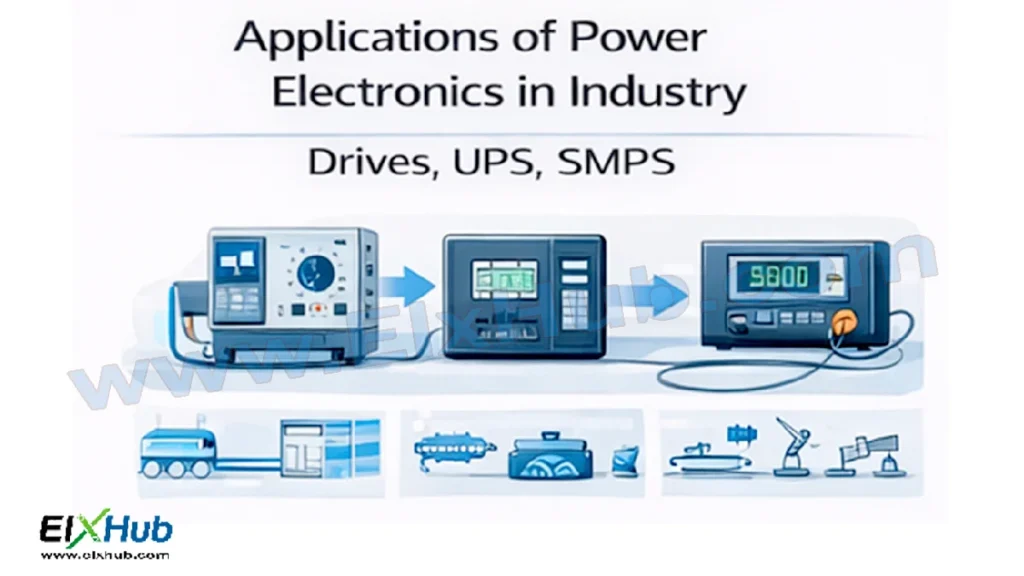
[Image Placeholder: Industrial power electronics applications overview]
Industrial Motor Drives
Motor drives are one of the largest consumers of power electronics in industry. They convert electrical energy into controlled mechanical motion with high efficiency and precision.
Types of Motor Drives
| Motor Type | Drive Type | Power Electronics Device | Applications |
|---|---|---|---|
| AC Induction Motors | VFD (Variable Frequency Drive) | IGBTs, MOSFETs | Pumps, conveyors, fans |
| Synchronous Motors | PWM Drives | IGBTs | Robotics, precision machinery |
| DC Motors | DC Choppers | SCRs, MOSFETs | Lifts, electric vehicles |
| Stepper Motors | Microstepping Drives | MOSFETs | CNC machines, 3D printers |
Variable Frequency Drives (VFDs)
VFDs control the speed and torque of AC motors by varying the supply frequency and voltage. Power electronics devices such as IGBTs or MOSFETs are used in inverter stages to generate variable-frequency output from fixed-frequency AC or DC input.
Advantages:
- Energy savings by matching motor speed to load
- Soft-start reduces mechanical stress
- Precision control of speed and torque
[Image Placeholder: VFD block diagram with AC input, rectifier, DC link, inverter, motor output]
Motor Drive Control Techniques
- Scalar control (V/f control) – simple, cost-effective
- Vector control (field-oriented control) – precise torque and speed regulation
- Direct torque control (DTC) – high dynamic response
[Image Placeholder: Control diagram for vector-controlled AC drive]
Uninterruptible Power Supplies (UPS)
UPS systems ensure continuous power delivery to critical industrial loads during power interruptions or voltage fluctuations. They are essential for sensitive equipment such as servers, data centers, medical devices, and process control systems.
UPS Topologies
| UPS Type | Description | Power Electronics Devices |
|---|---|---|
| Offline (Standby) | Switches to battery during outage | SCRs, MOSFETs |
| Line-interactive | Includes voltage regulation | IGBTs, MOSFETs |
| Online (Double Conversion) | AC → DC → AC conversion for continuous supply | IGBTs, Diodes |
Online UPS Operation
- AC input is rectified to DC
- DC charges batteries and supplies inverter
- Inverter generates regulated AC output
- Load remains continuously powered even during mains failure
Advantages:
- Zero transfer time
- Clean, regulated output
- Suitable for high-reliability applications
[Image Placeholder: Online UPS block diagram showing rectifier, battery, inverter, load]
Applications of UPS in Industry
- Data centers and server farms
- Industrial automation and robotics
- Healthcare equipment
- Telecom systems
- Critical control systems in factories
Switched-Mode Power Supplies (SMPS)
SMPS are widely used in industrial electronics for efficient DC power conversion from AC mains or other DC sources. They replace bulky linear power supplies, offering high efficiency, compact size, and precise voltage regulation.
SMPS Topologies
| Topology | Characteristics | Applications |
|---|---|---|
| Flyback | Isolated, low-power | Sensors, small drives |
| Forward | Isolated, medium-power | Industrial control circuits |
| Half-bridge | Medium to high power | Inverters, motor drives |
| Full-bridge | High power, efficient | Industrial UPS, EV chargers |
| Buck / Boost / Buck-Boost | Non-isolated, voltage conversion | DC-DC conversion, LED drivers |
[Image Placeholder: SMPS block diagram showing rectifier, filter, switching stage, transformer, output]
Key Advantages of SMPS
- High efficiency (85–95%)
- Compact and lightweight
- Wide input voltage range
- Overcurrent and overvoltage protection
- Fast transient response
Applications of SMPS in Industry
- Industrial controllers and PLCs
- Sensors and actuators
- Robotics and automation systems
- Communication equipment
- Battery chargers
Integration of Drives, UPS, and SMPS
In many industrial systems, motor drives, UPS, and SMPS are integrated to provide reliable operation:
- Drives may include internal SMPS to power control circuits
- UPS uses SMPS for battery charging and DC-AC inversion
- SMPS may feed auxiliary control systems in motor-driven processes
This integration improves system efficiency, reduces downtime, and ensures protection against voltage fluctuations.
[Image Placeholder: Industrial power electronics system showing integrated drives, UPS, and SMPS]
Industrial Applications Across Sectors
Power electronics applications span multiple industrial sectors:
| Sector | Application | Key Power Electronics Components |
|---|---|---|
| Manufacturing | CNC machines, robotic arms | VFDs, IGBTs, SMPS |
| Renewable Energy | Solar inverters, wind converters | IGBTs, MOSFETs, DC-DC converters |
| Transportation | EV drives, traction systems | IGBTs, PWM inverters |
| Telecom | Base stations, servers | SMPS, UPS |
| Process Control | Pumps, conveyors, compressors | Drives, UPS, PFC circuits |
Challenges in Industrial Power Electronics
While power electronics enhances industrial efficiency, challenges exist:
- High thermal stresses on power devices
- Electromagnetic interference (EMI) management
- Reliability and maintenance of high-power converters
- Meeting stringent regulatory standards
- Balancing cost, efficiency, and performance
Advanced devices such as SiC and GaN transistors provide higher switching speeds, lower losses, and better thermal handling, but design complexity increases.
[Image Placeholder: High-power industrial converter with cooling and EMI filters]
Need to control a motor or a bank of relays? Check out our Ultimate IC Selection Guide to find the right driver chip for your robotics project!
Conclusion
Power electronics has transformed industrial systems by enabling energy-efficient, reliable, and flexible control of electrical machines and processes. Motor drives, UPS systems, and SMPS are core applications that demonstrate the wide-ranging benefits of power electronic devices. Through precise voltage and current control, fast switching, and integrated protection, these systems improve productivity, reduce energy consumption, and enhance operational safety.
Understanding the applications, circuit topologies, and control strategies of industrial power electronics equips engineers and students to design robust, high-performance systems capable of meeting the demands of modern automated industries. With ongoing innovations in wide-bandgap devices and digital control, the future of industrial power electronics promises even greater efficiency, compactness, and reliability.
Image Reference Table
| Filename | Description | Alt Text |
|---|---|---|
| industrial-overview.png | Overview of industrial power electronics applications | Industrial power electronics |
| vfd-block.png | Variable Frequency Drive block diagram | VFD diagram |
| vector-control.png | Vector control diagram for AC drive | AC motor vector control |
| ups-online.png | Online UPS block diagram | Online UPS system |
| smps-block.png | SMPS block diagram | SMPS structure and components |
| integrated-system.png | Integrated industrial system | Drives, UPS, SMPS in factory |
| high-power-converter.png | High-power converter with cooling | Industrial high-power converter |
SEO Title
Applications of Power Electronics in Industry – Drives, UPS, and SMPS Explained
Meta Description
Learn the industrial applications of power electronics including motor drives, UPS systems, and SMPS. Explore circuits, control methods, and real-world use cases.