Introduction
A microprocessor is the central processing unit of a digital system, responsible for executing instructions, processing data, and controlling overall system operation. At the heart of every computer, embedded system, and digital controller lies a microprocessor designed with a specific internal architecture that determines its performance, capabilities, and applications.
Understanding microprocessor architecture is essential for anyone studying digital electronics, computer engineering, or embedded systems. Architecture defines how data flows inside the processor, how instructions are executed, how memory is accessed, and how input/output operations are managed.
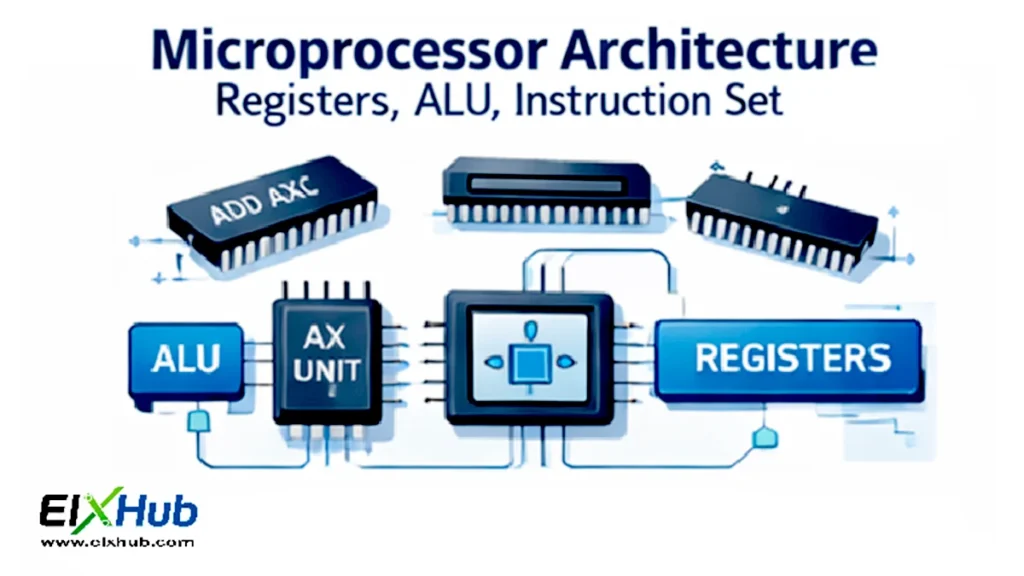
This article provides a deep, practical exploration of microprocessor architecture, focusing on its three most critical components: registers, the arithmetic logic unit (ALU), and the instruction set. Rather than a surface-level overview, this guide explains how these blocks work together internally and how they affect real-world performance.
What Is Microprocessor Architecture?
Microprocessor architecture refers to the internal organization and design of a processor, including its functional units, data paths, control mechanisms, and instruction execution model.
It defines:
How instructions are fetched, decoded, and executed
How data is stored and manipulated
How the processor communicates with memory and peripherals
[Image Placeholder: Block diagram of basic microprocessor architecture]
Major Functional Blocks of a Microprocessor
A typical microprocessor consists of:
Registers
Arithmetic Logic Unit (ALU)
Control Unit
Instruction Decoder
Internal buses
This article focuses deeply on registers, ALU, and instruction set architecture.
Registers in a Microprocessor
Registers are small, high-speed memory locations located inside the microprocessor. They store data, addresses, instructions, and intermediate results during program execution.
Registers are much faster than external memory, allowing rapid access during instruction execution.
Types of Registers
Microprocessors contain multiple types of registers, each serving a specific function.
General Purpose Registers
These registers store data temporarily during computation. They are used by the programmer or compiler for arithmetic, logic, and data movement operations.
Examples include:
Accumulator
Data registers
[Image Placeholder: Register file inside microprocessor]
Special Purpose Registers
These registers perform dedicated control and sequencing tasks.
Key special-purpose registers include:
Program Counter (PC)
The program counter holds the address of the next instruction to be executed. After each instruction fetch, the PC is incremented automatically.
Instruction Register (IR)
The instruction register holds the current instruction being decoded and executed.
Stack Pointer (SP)
The stack pointer points to the top of the stack in memory. It is used for function calls, interrupts, and local variable storage.
Status Register (Flag Register)
The status register contains condition flags that indicate the outcome of operations.
Common flags include:
Zero flag
Carry flag
Sign flag
Overflow flag
[Image Placeholder: Status register with flags]
Register Characteristics
Registers are characterized by:
Bit width (8-bit, 16-bit, 32-bit, 64-bit)
Access speed
Read/write capability
Arithmetic Logic Unit (ALU)
The ALU is the computational core of the microprocessor. It performs all arithmetic and logical operations required by program instructions.
Functions of the ALU
Arithmetic operations:
Addition
Subtraction
Increment
Decrement
Logical operations:
AND
OR
XOR
NOT
Comparison operations:
Greater than
Less than
Equal to
[Image Placeholder: Internal ALU block diagram]
Working of the ALU
The ALU receives operands from registers or memory, performs the selected operation, and stores the result back into a register. Control signals from the control unit determine which operation is executed.
ALU and Flags
After each operation, the ALU updates the status flags, which influence program flow decisions such as branching and looping.
Example:
If result is zero → Zero flag set
If carry occurs → Carry flag set
Control Unit and Instruction Execution
Although not the main focus, the control unit plays a crucial role by coordinating register access, ALU operation, and data movement.
It performs:
Instruction fetch
Instruction decode
Instruction execution
This sequence is known as the instruction cycle.
[Image Placeholder: Instruction fetch-decode-execute cycle]
Instruction Set Architecture (ISA)
The instruction set defines the commands that a microprocessor can execute. It acts as an interface between hardware and software.
Types of Instructions
Instruction sets typically include the following categories:
Data Transfer Instructions
Move data between registers and memory.
Examples:
MOV
LOAD
STORE
Arithmetic Instructions
Perform mathematical operations.
Examples:
ADD
SUB
MUL
DIV
Logical Instructions
Perform bitwise operations.
Examples:
AND
OR
XOR
Control Flow Instructions
Change program execution order.
Examples:
JUMP
CALL
RETURN
Input/Output Instructions
Communicate with external devices.
Examples:
IN
OUT
[Image Placeholder: Instruction categories diagram]
Instruction Format
An instruction consists of multiple fields, including:
Opcode
Operand fields
Addressing mode
Opcode
The opcode specifies the operation to be performed.
Operands
Operands specify data or memory locations used in the operation.
Addressing Modes
Addressing modes define how operands are accessed.
Common addressing modes include:
Immediate
Direct
Indirect
Register
Indexed
Instruction Execution Pipeline
Modern microprocessors use pipelining to improve performance by overlapping instruction execution stages.
Typical pipeline stages:
Fetch
Decode
Execute
Memory access
Write back
[Image Placeholder: Instruction pipeline stages diagram]
Performance Impact of Architecture
Microprocessor architecture directly affects:
Execution speed
Power consumption
Instruction throughput
Scalability
Efficient register usage and ALU design significantly improve performance.
Practical Applications of Microprocessor Architecture Knowledge
Understanding architecture is essential for:
Embedded system programming
Assembly language programming
Compiler optimization
Hardware debugging
Comparison Table of Key Architectural Components
| Component | Function | Importance |
|---|---|---|
| Registers | Fast data storage | Very High |
| ALU | Computation | Very High |
| Instruction Set | Defines operations | Critical |
| Control Unit | Coordination | High |
Conclusion
Microprocessor architecture forms the foundation of digital computing systems. Registers enable high-speed data access, the ALU performs all computations, and the instruction set defines what operations the processor can execute. A deep understanding of these components allows engineers and learners to design efficient systems, write optimized code, and troubleshoot hardware-software interactions effectively.
Image Reference Table
| Filename | Description | Alt Text |
|---|---|---|
| microprocessor-block.png | Microprocessor architecture block diagram | microprocessor architecture |
| register-file.png | Internal processor registers | processor registers |
| alu-block.png | Arithmetic logic unit | ALU block diagram |
| instruction-cycle.png | Fetch-decode-execute cycle | instruction cycle |
| pipeline-stages.png | Instruction pipeline stages | instruction pipeline |
SEO Title
Microprocessor Architecture Explained – Registers, ALU, and Instruction Set Deep Dive
Meta Description
Learn microprocessor architecture in detail including registers, ALU, instruction sets, and execution flow with practical explanations.