Introduction
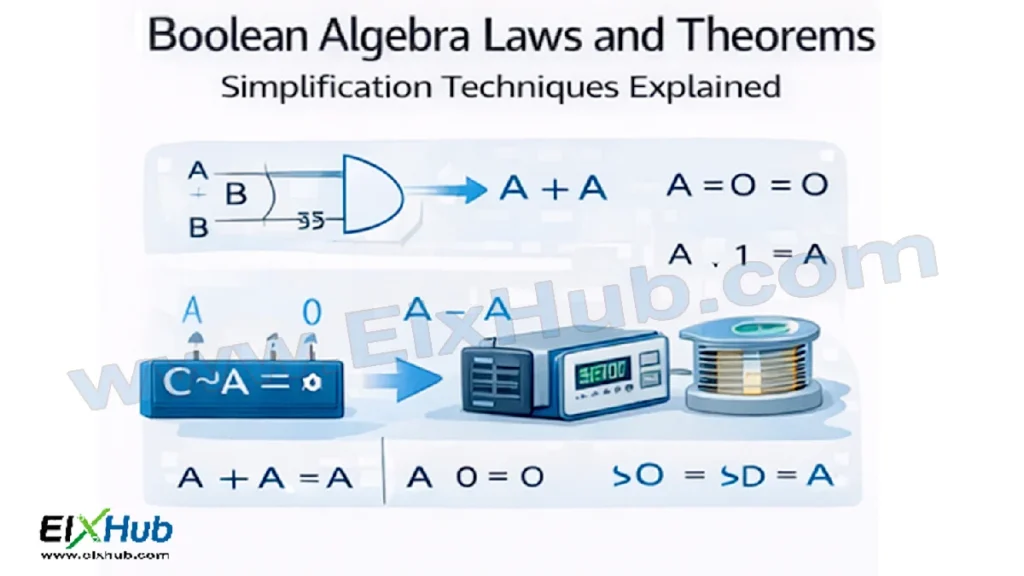
Boolean Algebra is the mathematical language used to describe the operation of digital logic circuits. Every digital system, from simple logic gates to complex microprocessors, is designed and analyzed using Boolean expressions. Understanding Boolean algebra allows engineers and students to simplify logic circuits, reduce hardware complexity, minimize power consumption, and improve system performance.
This article provides a complete, in-depth explanation of Boolean algebra, its laws, theorems, simplification techniques, and real-world applications in digital electronics.
What Is Boolean Algebra
Boolean Algebra is a branch of mathematics that deals with variables having only two possible values:
0 and 1
These values correspond to:
• 0 → LOW, FALSE, OFF
• 1 → HIGH, TRUE, ON
Boolean algebra was introduced by George Boole and later adapted for electronic circuits.
Boolean Variables and Constants
Boolean expressions use:
• Variables (A, B, C, X, Y, etc.)
• Constants (0 and 1)
A Boolean function describes the relationship between inputs and output using logical operations.
Basic Boolean Operations
There are three basic Boolean operations.
AND Operation
Symbol: ·
Expression: A · B
Output is 1 only if all inputs are 1.
OR Operation
Symbol: +
Expression: A + B
Output is 1 if any input is 1.
NOT Operation
Symbol: ¯
Expression: A̅
Inverts the input.
These operations directly correspond to AND, OR, and NOT logic gates.
Boolean Expressions
A Boolean expression is a combination of variables, constants, and operators.
Example:
F = A + B·C
This expression means:
Output is HIGH when A is HIGH or when both B and C are HIGH.
Laws of Boolean Algebra
Boolean laws are rules that help manipulate and simplify expressions without changing their meaning.
Commutative Law
The order of variables does not affect the result.
| Operation | Law |
|---|---|
| AND | A·B = B·A |
| OR | A + B = B + A |
Associative Law
Grouping of variables does not affect the result.
| Operation | Law |
|---|---|
| AND | A·(B·C) = (A·B)·C |
| OR | A + (B + C) = (A + B) + C |
Distributive Law
One operation can be distributed over another.
| Law | Expression |
|---|---|
| AND over OR | A·(B + C) = A·B + A·C |
| OR over AND | A + (B·C) = (A + B)·(A + C) |
Identity Laws
Identity laws define how variables behave with constants.
| Law | Result |
|---|---|
| A + 0 | A |
| A · 1 | A |
Null (Dominance) Laws
These laws show the dominating effect of constants.
| Law | Result |
|---|---|
| A + 1 | 1 |
| A · 0 | 0 |
Idempotent Law
Repeating a variable does not change the result.
| Law | Result |
|---|---|
| A + A | A |
| A · A | A |
Complement Law
A variable combined with its complement gives a fixed output.
| Law | Result |
|---|---|
| A + A̅ | 1 |
| A · A̅ | 0 |
Involution Law
Double complement returns the original variable.
A̿ = A
De Morgan’s Theorems
De Morgan’s theorems are extremely important for converting logic expressions and designing NAND/NOR-only circuits.
First Theorem
(A + B)̅ = A̅ · B̅
Second Theorem
(A · B)̅ = A̅ + B̅
Image Placeholder (Horizontal): De Morgan’s theorem logic diagram
Duality Principle
Every Boolean expression has a dual.
To find the dual:
• Replace + with ·
• Replace · with +
• Replace 0 with 1
• Replace 1 with 0
Example:
Original: A + 0 = A
Dual: A · 1 = A
Boolean Function Simplification
Simplification reduces:
• Number of gates
• Power consumption
• Circuit cost
• Propagation delay
Simplification Using Boolean Laws
Example:
F = A + A·B
Using absorption law:
F = A
Absorption Law
| Law | Result |
|---|---|
| A + A·B | A |
| A·(A + B) | A |
Canonical Forms
Boolean expressions can be written in standard forms.
Sum of Products (SOP)
Expression is a sum (OR) of product (AND) terms.
Example:
F = A̅B + AB̅
Product of Sums (POS)
Expression is a product (AND) of sum (OR) terms.
Example:
F = (A + B)(A̅ + B̅)
Truth Table Method
Truth tables show output for all possible input combinations.
| A | B | Output |
|---|---|---|
| 0 | 0 | 0 |
| 0 | 1 | 1 |
| 1 | 0 | 1 |
| 1 | 1 | 0 |
Truth tables help verify Boolean expressions.
Boolean Algebra vs Karnaugh Map
Boolean algebra is algebraic and rule-based, while Karnaugh maps provide a visual method.
| Feature | Boolean Algebra | K-Map |
|---|---|---|
| Method | Algebraic | Graphical |
| Best for | Small expressions | Medium variables |
| Error chance | Moderate | Low |
Applications of Boolean Algebra
Boolean algebra is used in:
• Logic gate design
• Digital circuit simplification
• Microprocessor architecture
• Control systems
• Communication systems
• Embedded systems
Image Placeholder (Horizontal): Boolean algebra used in digital circuits
Common Mistakes by Beginners
• Forgetting complement rules
• Incorrect application of De Morgan’s laws
• Mixing SOP and POS forms
• Skipping simplification steps
Practical Tips
• Memorize basic laws
• Practice simplification daily
• Verify results with truth tables
• Learn NAND/NOR conversions
Conclusion
Boolean algebra is the backbone of digital electronics. It allows engineers to design efficient, reliable, and cost-effective digital circuits. Mastering Boolean laws and theorems is essential before moving to advanced topics such as Karnaugh maps, sequential circuits, and microprocessor design.
Image Reference Table (For Future Use)
| Filename | Image Description | Alt Text |
|---|---|---|
| boolean-operations.png | Basic Boolean AND, OR, NOT operations | Boolean algebra basic operations |
| boolean-laws-table.png | Summary of Boolean laws | Boolean algebra laws and theorems |
| demorgan-theorem.png | De Morgan’s theorem logic diagram | De Morgan’s theorem in digital electronics |
| boolean-simplification.png | Simplification of Boolean expressions | Boolean expression simplification |
| boolean-applications.png | Boolean algebra in digital circuits | Applications of Boolean algebra |