Introduction
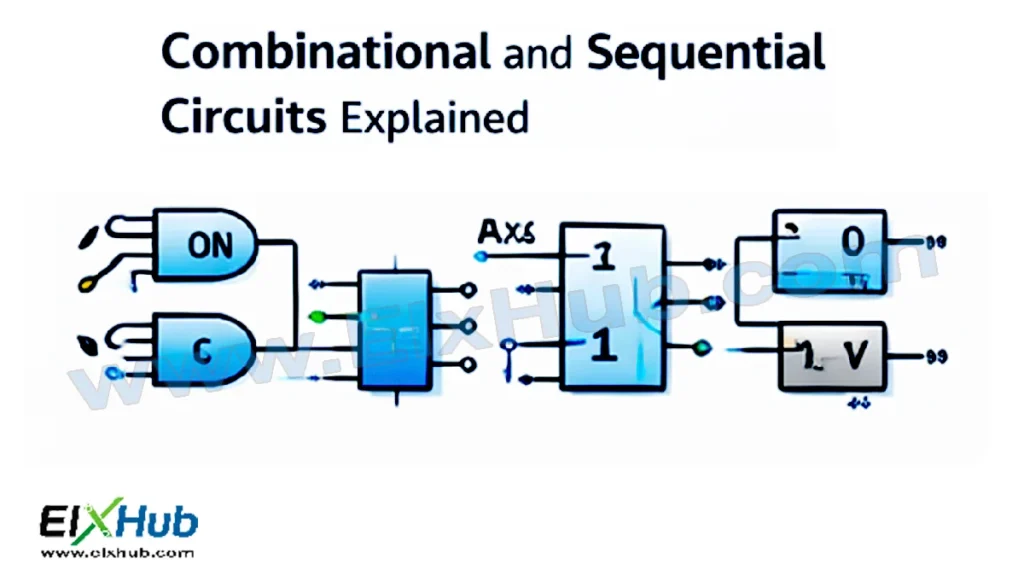
Digital electronics circuits are broadly classified into two main categories: combinational circuits and sequential circuits. This classification is based on how the output of a circuit depends on its inputs and whether the circuit has memory.
Understanding the difference between combinational and sequential circuits is a major milestone for beginners. These concepts form the foundation of advanced topics such as counters, registers, processors, and microcontrollers. This guide explains both types in detail, from basic principles to real-world applications.
What Are Digital Circuits
Digital circuits are electronic circuits that operate using binary logic. They process discrete signals represented by logic 0 and logic 1. These circuits are built using logic gates, flip-flops, and memory elements.
Based on their behavior and dependency on inputs, digital circuits are divided into combinational and sequential circuits.
Combinational Circuits
A combinational circuit is a type of digital circuit whose output depends only on the present inputs. It does not store any previous data or state. Once the input changes, the output changes immediately according to the logic design.
Combinational circuits do not require memory elements or clock signals. Their behavior is entirely defined by Boolean expressions and logic gate combinations.
Characteristics of Combinational Circuits
• Output depends only on current inputs
• No memory or storage elements
• No feedback paths
• Faster operation due to simple logic
• Easy to design and analyze
Image Placeholder (Horizontal): Block diagram of combinational circuit
Examples of Combinational Circuits
Logic Gate Circuits
Simple logic gate combinations such as AND-OR networks are basic combinational circuits used in decision-making systems.
Adders
Adders perform arithmetic operations. A half adder adds two binary bits, while a full adder adds three bits including carry input.
Image Placeholder (Horizontal): Half adder and full adder block diagram
Multiplexers
A multiplexer selects one input from multiple inputs based on control signals. It is widely used in data routing and communication systems.
Decoders and Encoders
Decoders convert binary inputs into specific outputs, while encoders perform the reverse operation. These circuits are used in memory selection and keyboard interfaces.
Advantages of Combinational Circuits
Combinational circuits are simple, fast, and cost-effective. They are ideal for applications where memory is not required and output must respond immediately to input changes.
Limitations of Combinational Circuits
Since combinational circuits have no memory, they cannot store information or remember previous events. This makes them unsuitable for tasks requiring data storage or timing control.
Sequential Circuits
Sequential circuits are digital circuits whose output depends on both current inputs and previous states. Unlike combinational circuits, sequential circuits have memory elements that store data.
These circuits use feedback paths and are usually controlled by clock signals to synchronize operations.
Characteristics of Sequential Circuits
• Output depends on present inputs and past states
• Contains memory elements
• Uses clock signals
• More complex design
• Essential for data storage and timing
Image Placeholder (Horizontal): Sequential circuit block diagram with feedback
Memory Elements in Sequential Circuits
Memory elements store binary information. The most common memory elements are flip-flops and latches.
Flip-flops store a single bit of data and change state based on clock signals. Latches are level-sensitive devices used for temporary storage.
Types of Sequential Circuits
Synchronous Sequential Circuits
In synchronous circuits, all memory elements are triggered by a common clock signal. This ensures predictable and reliable operation.
Examples include counters, registers, and processors.
Asynchronous Sequential Circuits
Asynchronous circuits do not use a global clock. Output changes occur immediately when inputs change. These circuits are faster but harder to design and debug.
Examples of Sequential Circuits
Counters
Counters count clock pulses and are used in digital clocks, timers, and frequency measurement systems.
Image Placeholder (Horizontal): Binary counter timing diagram
Registers
Registers store multiple bits of data and are used in processors and microcontrollers for temporary data storage.
Shift Registers
Shift registers move data left or right with each clock pulse. They are used in data transmission and serial communication.
Difference Between Combinational and Sequential Circuits
Combinational circuits:
• No memory
• Output depends only on inputs
• No clock required
• Faster response
Sequential circuits:
• Contains memory
• Output depends on inputs and previous state
• Requires clock
• Used for data storage and control
Image Placeholder (Horizontal): Comparison table of combinational vs sequential circuits
Applications of Combinational Circuits
• Arithmetic logic units
• Data selection circuits
• Signal processing
• Error detection circuits
Applications of Sequential Circuits
• Digital clocks
• Microcontrollers
• Computer processors
• Communication systems
• Control units
Common Beginner Mistakes
• Expecting combinational circuits to store data
• Ignoring clock timing in sequential circuits
• Incorrect feedback connections
• Confusing latches and flip-flops
Avoiding these mistakes improves circuit reliability and understanding.
FAQs About Digital Circuits
Do all digital circuits need clocks?
No. Only sequential circuits require clocks.
Can a circuit be both combinational and sequential?
Yes. Many complex systems combine both types.
Which circuit type is easier for beginners?
Combinational circuits are easier to start with.
Conclusion
Combinational and sequential circuits are the core building blocks of digital electronics. Combinational circuits provide immediate logic processing, while sequential circuits enable memory and control. Understanding both types prepares beginners for advanced topics like microprocessors, embedded systems, and digital system design.
SEO Title
Combinational and Sequential Circuits Explained – Digital Electronics Complete Guide
Meta Description
Learn combinational and sequential circuits in digital electronics. Understand differences, examples, memory elements, and real applications.