

Introduction
Multimeters are among the most essential tools in electronics, electrical engineering, and troubleshooting work. Whether you are a beginner learning basic electronics or a professional technician diagnosing complex systems, a multimeter is often the first instrument you reach for. It combines multiple measurement functions into a single compact device, making it indispensable in laboratories, workshops, and field applications.
This guide explains what multimeters are, how they work, their types, features, measurement techniques, safety practices, and selection tips. By the end, you will have a clear understanding of how to use a multimeter effectively and safely in real-world electronics tasks.
What Is a Multimeter?
A multimeter is an electronic measuring instrument used to measure electrical quantities such as voltage, current, and resistance. Most modern multimeters can also measure continuity, capacitance, frequency, diode behavior, and sometimes temperature.
The name “multimeter” comes from its ability to perform multiple measurements using a single device. Older instruments measured only one parameter at a time, but multimeters simplified testing and troubleshooting by combining several functions.
Why Multimeters Are Essential in Electronics
Multimeters play a critical role in electronics for several reasons:
- They help verify power supply voltages before connecting circuits
- They assist in fault detection and troubleshooting
- They ensure components are functioning within safe limits
- They reduce guesswork by providing accurate numerical readings
Without a multimeter, diagnosing electronic circuits would rely heavily on assumptions rather than measurements.
Basic Working Principle of a Multimeter
At its core, a multimeter works by converting electrical signals into readable values. Depending on the mode selected, the internal circuitry routes the input signal through appropriate measurement circuits.
- Voltage measurement uses high internal resistance to avoid loading the circuit
- Current measurement uses a low-resistance shunt to measure flowing current
- Resistance measurement applies a small internal voltage and measures current flow
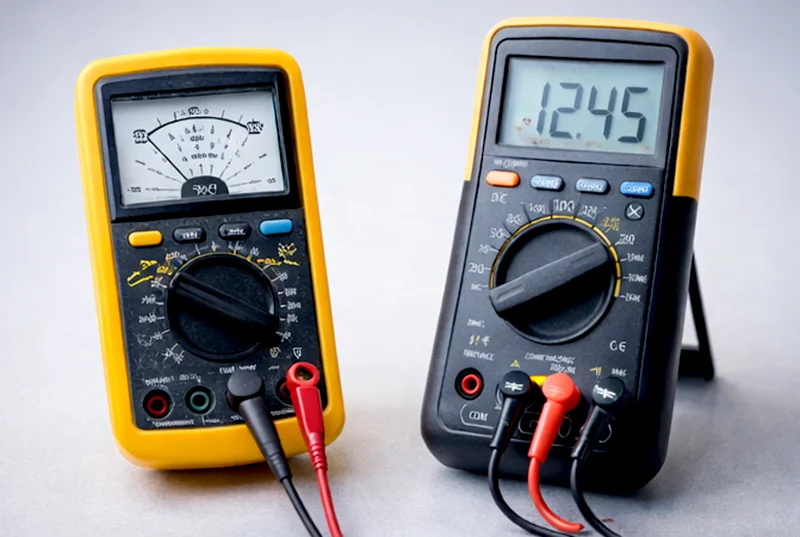
Digital multimeters use analog-to-digital converters (ADC) to display values numerically, while analog multimeters rely on a moving coil and pointer.
Main Types of Multimeters
Analog Multimeters
Analog multimeters display readings using a moving needle over a printed scale. They are simple, robust, and useful for observing changing signals.
Advantages
- Good for observing trends and fluctuations
- No need for batteries for some measurements
Limitations
- Lower accuracy
- Parallax errors when reading scales
Digital Multimeters (DMM)
Digital multimeters display readings on an LCD or LED screen. They are the most commonly used type today.
Advantages
- High accuracy and resolution
- Easy to read
- Additional advanced features
Limitations
- Requires battery power
- Slightly slower response for rapidly changing signals
Auto-Ranging vs Manual-Ranging Multimeters
- Manual-ranging multimeters require the user to select the appropriate measurement range.
- Auto-ranging multimeters automatically choose the best range for the measured value.
Auto-ranging models are more beginner-friendly and reduce the risk of incorrect readings.
Parts of a Multimeter
Display Unit
Shows measured values numerically or graphically.
Selection Dial / Buttons
Used to select measurement type and range.
Input Terminals
Common terminals include:
- COM (Common / Ground)
- VΩ (Voltage & Resistance)
- A or mA (Current)
Test Leads
Probes used to connect the multimeter to the circuit under test.

Common Measurements Performed Using a Multimeter
Measuring Voltage
Multimeters can measure both AC and DC voltage. Voltage measurement is performed by connecting probes in parallel with the circuit element.
Typical uses
- Checking battery voltage
- Verifying power supply output
- Testing wall outlets

Measuring Current
Current measurement requires the multimeter to be placed in series with the circuit.
Important: Incorrect current measurement connections can damage the multimeter or the circuit.

Measuring Resistance
Resistance measurement is performed on powered-off circuits. Applying voltage during resistance measurement can damage the meter.
Uses
- Checking resistor values
- Testing broken wires
- Identifying faulty components
Continuity Testing
Continuity mode checks whether a circuit path is complete. Most multimeters emit a beep when continuity exists.
Applications
- Wire testing
- PCB track verification
- Switch testing

Diode Testing
Diode mode applies a small voltage to test diode polarity and forward voltage drop.
Advanced Multimeter Functions
Some modern multimeters include:
- Capacitance measurement
- Frequency measurement
- Duty cycle testing
- Temperature sensing (with probe)
- True RMS measurement
These features are especially useful in power electronics and signal analysis.
Safety Considerations When Using Multimeters
Safety is critical when working with electrical measurements.
Key precautions
- Always start with the highest range
- Never measure current across a voltage source
- Use proper category-rated meters (CAT II, CAT III, CAT IV)
- Inspect test leads for damage
- Avoid touching exposed metal probes

Multimeter Safety Categories (CAT Ratings)
| Category | Typical Application |
|---|---|
| CAT I | Low-energy electronics |
| CAT II | Household appliances |
| CAT III | Distribution panels |
| CAT IV | Utility connections |
Choosing the correct category ensures user safety during high-energy measurements.
How to Choose the Right Multimeter
When selecting a multimeter, consider:
- Measurement accuracy
- Auto-ranging capability
- Safety rating
- Build quality
- Additional functions needed
- Budget
Beginners can start with a basic digital multimeter, while professionals may require True RMS and advanced measurement options.
Common Multimeter Applications
- Electronics labs
- Power supply testing
- Automotive diagnostics
- Solar system installation
- Home electrical maintenance
Multimeters are truly universal diagnostic tools.
Common Mistakes to Avoid
- Measuring current in voltage mode
- Forgetting to move probe leads
- Measuring resistance on live circuits
- Ignoring safety ratings
Avoiding these mistakes improves both safety and measurement accuracy.
Future of Multimeters
Modern multimeters are evolving with features such as:
- Bluetooth connectivity
- Smartphone integration
- Data logging
- Cloud-based monitoring
These advancements make multimeters smarter and more versatile.
Conclusion
Multimeters are the backbone of electronics testing and troubleshooting. Understanding their types, functions, and safe usage enables engineers, students, and hobbyists to work confidently and accurately. Whether measuring voltage, diagnosing faults, or verifying components, a multimeter remains an essential companion in every electronics lab.


