Introduction
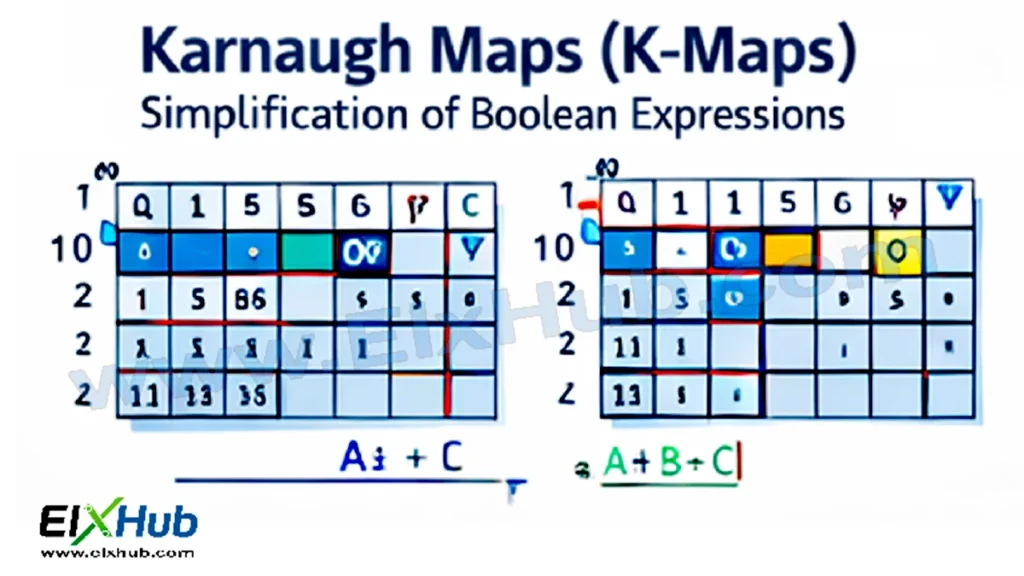
Karnaugh Maps, commonly known as K-Maps, are a powerful graphical technique used to simplify Boolean expressions. While Boolean algebra provides algebraic rules for simplification, K-Maps offer a visual and systematic method that reduces the chance of errors, especially when dealing with multiple variables.
K-Maps are widely used in digital electronics to design efficient combinational circuits with fewer logic gates, lower power consumption, and reduced hardware complexity.
What Is a Karnaugh Map
A Karnaugh Map is a graphical representation of a truth table arranged in a way that allows easy identification of common Boolean terms. It helps simplify Boolean expressions by grouping adjacent 1s (or 0s) according to specific rules.
K-Maps are most effective for simplifying expressions with:
• 2 variables
• 3 variables
• 4 variables
Beyond four variables, simplification becomes complex and is usually handled by software tools.
Why Karnaugh Maps Are Used
K-Maps are preferred over pure Boolean algebra because:
• They reduce human calculation errors
• They provide a visual simplification method
• They result in minimal logic expressions
• They reduce the number of logic gates
• They lower circuit cost and power consumption
Relationship Between K-Maps and Truth Tables
A K-Map is derived directly from a truth table. Each cell in a K-Map represents one row of the truth table.
The difference lies in the arrangement:
• Truth tables list combinations sequentially
• K-Maps arrange combinations using Gray code so that only one variable changes between adjacent cells
Image Placeholder (Horizontal): Truth table to Karnaugh map conversion
Gray Code Arrangement
Gray code is used in K-Maps because it ensures that adjacent cells differ by only one variable. This allows valid grouping of terms.
Example Gray code sequence:
00, 01, 11, 10
This arrangement is critical for correct simplification.
2-Variable Karnaugh Map
A 2-variable K-Map contains 4 cells.
Variables: A and B
| A\B | 0 | 1 |
|---|---|---|
| 0 | 0 | 1 |
| 1 | 1 | 0 |
Each cell represents one minterm.
Simplification Using 2-Variable K-Map
Adjacent 1s can be grouped to eliminate one variable from the expression.
3-Variable Karnaugh Map
A 3-variable K-Map contains 8 cells.
Variables: A, B, and C
| AB\C | 0 | 1 |
|---|---|---|
| 00 | ||
| 01 | ||
| 11 | ||
| 10 |
This map allows grouping of 1, 2, 4, or 8 adjacent cells.
Image Placeholder (Horizontal): 3-variable Karnaugh map example
4-Variable Karnaugh Map
A 4-variable K-Map contains 16 cells.
Variables: A, B, C, and D
| AB\CD | 00 | 01 | 11 | 10 |
|---|---|---|---|---|
| 00 | ||||
| 01 | ||||
| 11 | ||||
| 10 |
This is the most commonly used K-Map in practical digital design.
Rules for Grouping in K-Maps
To simplify correctly, the following rules must be followed:
• Groups must contain powers of 2 (1, 2, 4, 8, 16)
• Groups must be rectangular
• Groups can wrap around edges
• Diagonal grouping is not allowed
• Larger groups are preferred
• Every 1 must be included in at least one group
Image Placeholder (Horizontal): Valid and invalid K-Map groupings
Wrap-Around Grouping
K-Maps are cyclic in nature. The leftmost and rightmost columns are adjacent, as are the top and bottom rows.
This allows grouping across edges, which often leads to further simplification.
Don’t Care Conditions
Don’t care conditions are input combinations that never occur or whose output does not matter.
They are represented by X and can be treated as either 0 or 1 to achieve maximum simplification.
| Input | Output |
|---|---|
| Valid | 1 |
| Valid | 0 |
| Don’t Care | X |
Including don’t care terms often reduces the number of logic gates significantly.
Image Placeholder (Horizontal): K-Map with don’t care conditions
SOP and POS Using K-Maps
Sum of Products (SOP)
• Group 1s
• Each group forms a product term
• All product terms are ORed
Product of Sums (POS)
• Group 0s
• Each group forms a sum term
• All sum terms are ANDed
| Form | Grouping | Output |
|---|---|---|
| SOP | 1s | OR of products |
| POS | 0s | AND of sums |
Example: K-Map Simplification (SOP)
Given output = 1 for minterms:
m(1, 3, 5, 7)
Grouping all 1s results in:
F = B
This demonstrates how K-Maps can eliminate multiple variables at once.
Advantages of Karnaugh Maps
• Simple visual approach
• Minimizes logic gates
• Reduces circuit complexity
• Faster than algebraic simplification
• Ideal for beginners
Limitations of Karnaugh Maps
• Practical only up to 4–5 variables
• Becomes confusing with many inputs
• Not suitable for automation
K-Maps vs Boolean Algebra
| Feature | K-Map | Boolean Algebra |
|---|---|---|
| Method | Graphical | Algebraic |
| Error risk | Low | Medium |
| Speed | Fast | Moderate |
| Best for | Small systems | Any size |
Practical Applications of K-Maps
K-Maps are used in:
• Combinational circuit design
• Logic gate minimization
• Control systems
• Digital IC design
• Microprocessor instruction decoding
Image Placeholder (Horizontal): K-Map used in digital circuit design
Common Beginner Mistakes
• Incorrect grouping sizes
• Missing wrap-around groups
• Overlapping groups incorrectly
• Ignoring don’t care terms
• Using diagonal adjacency
Practical Learning Tips
• Start with 2-variable maps
• Practice grouping rules
• Always choose the largest groups
• Verify results using truth tables
Conclusion
Karnaugh Maps are an essential tool in digital electronics for simplifying Boolean expressions efficiently and accurately. By converting complex truth tables into visual maps, K-Maps allow designers to create optimized digital circuits with fewer components, lower power consumption, and higher reliability. Mastery of K-Maps is a critical step toward understanding advanced topics such as combinational logic design and sequential circuits.
Image Reference Table (For Future Use)
| Filename | Image Description | Alt Text |
|---|---|---|
| truth-table-to-kmap.png | Conversion of truth table into K-Map | Truth table to Karnaugh map conversion |
| three-variable-kmap.png | 3-variable Karnaugh map example | 3-variable Karnaugh map simplification |
| kmap-grouping-rules.png | Valid and invalid K-Map groupings | Karnaugh map grouping rules |
| dont-care-kmap.png | K-Map showing don’t care conditions | Don’t care conditions in Karnaugh map |
| kmap-applications.png | K-Map used in digital circuit design | Applications of Karnaugh maps |
SEO Title (Homepage / Post SEO)
Karnaugh Maps (K-Maps) Simplification Explained | Digital Electronics Guide
(Length: ~63 characters — safe for Google)
Meta Description
Learn Karnaugh Maps (K-Maps) step by step to simplify Boolean expressions, reduce logic gates, and design efficient digital circuits.
(Length: ~153 characters — within Google limit)