Introduction
The Digital Signal Sampling Theorem, commonly known as the Nyquist Theorem, is one of the most fundamental principles in digital electronics, digital signal processing, and communication systems. It defines how an analog signal can be accurately converted into a digital signal without losing information. Every system that involves Analog-to-Digital Conversion, audio recording, image processing, telecommunications, or data acquisition relies directly or indirectly on this theorem.
Without proper sampling, digital systems suffer from distortion, data loss, and errors that cannot be corrected later. Understanding the sampling theorem is therefore essential for students, engineers, and anyone working with digital signals. This article provides a complete and practical explanation of the Nyquist Theorem, sampling frequency, aliasing, reconstruction, real-world examples, and applications, written in a clear and structured manner suitable for WordPress publishing.
What is Signal Sampling?
Sampling is the process of measuring the amplitude of a continuous-time analog signal at discrete time intervals. Each measurement is called a sample. These samples are then converted into digital form by an Analog-to-Digital Converter.
In simple terms, sampling turns a smooth analog waveform into a sequence of discrete points that represent the original signal.
Sampling involves three key concepts:
Time discretization
Amplitude representation
Conversion into binary data
If sampling is done correctly, the original analog signal can be perfectly reconstructed from the sampled data.
Continuous-Time vs Discrete-Time Signals
A continuous-time signal exists for all values of time and has infinite resolution along the time axis. Examples include sound waves, radio signals, and sensor voltages.
A discrete-time signal exists only at specific instants of time. It is represented as a sequence of values rather than a continuous waveform.
Digital systems work with discrete-time signals, which makes sampling a necessary step in digital electronics.
Statement of the Nyquist Sampling Theorem
The Nyquist Sampling Theorem states:
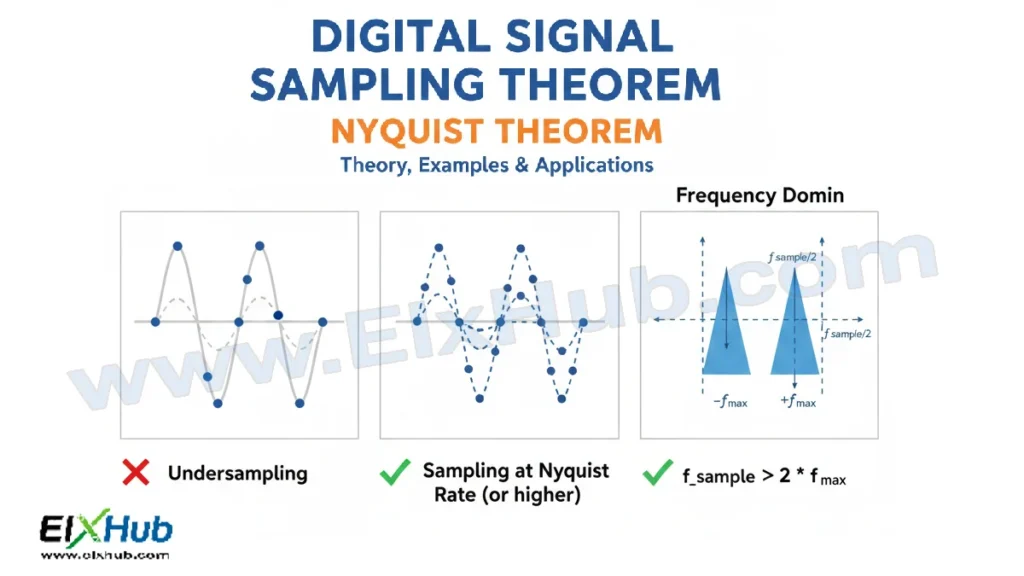
A continuous-time signal can be completely and perfectly reconstructed from its samples if the sampling frequency is at least twice the highest frequency present in the signal.
Mathematically:
fs ≥ 2fmax
Where:
fs is the sampling frequency
fmax is the maximum frequency component of the signal
The value 2fmax is known as the Nyquist Rate.
Nyquist Rate and Nyquist Frequency
The Nyquist Rate is the minimum sampling rate required to avoid loss of information.
Nyquist Rate = 2 × Highest signal frequency
The Nyquist Frequency is half of the sampling frequency.
Nyquist Frequency = fs / 2
Signals with frequency components higher than the Nyquist Frequency cannot be correctly represented after sampling.
Why Sampling at Twice the Frequency is Required
When a signal is sampled, copies of its frequency spectrum appear at multiples of the sampling frequency. If the sampling frequency is too low, these copies overlap with the original spectrum, causing distortion.
Sampling at or above twice the highest signal frequency ensures that these spectral copies remain separated, allowing accurate signal reconstruction using filtering.
Aliasing Explained
Aliasing is the most critical consequence of improper sampling. It occurs when a signal is sampled at a frequency lower than the Nyquist Rate.
When aliasing occurs:
High-frequency components appear as lower frequencies
The reconstructed signal becomes distorted
Information loss is permanent
Once aliasing occurs, no digital processing can recover the original signal.
Example of Aliasing
Consider an analog signal with a maximum frequency of 5 kHz.
Required minimum sampling frequency:
fs ≥ 2 × 5 kHz = 10 kHz
If the signal is sampled at 6 kHz:
The Nyquist Frequency becomes 3 kHz
Frequencies above 3 kHz fold back into the lower frequency range
The digital representation becomes incorrect
This is why audio CDs use a sampling rate of 44.1 kHz, which safely covers the human hearing range up to 20 kHz.
Anti-Aliasing Filters
To prevent aliasing, an analog low-pass filter called an anti-aliasing filter is placed before the ADC.
Functions of an anti-aliasing filter:
Removes frequency components above Nyquist Frequency
Protects the ADC from high-frequency noise
Ensures accurate digital representation
Anti-aliasing filters are essential in all practical ADC systems.
Signal Reconstruction and Interpolation
After sampling and digital processing, signals often need to be converted back into analog form using a Digital-to-Analog Converter.
Reconstruction involves:
Passing the sampled signal through a reconstruction filter
Smoothing discrete samples into a continuous waveform
If the sampling theorem is satisfied, perfect reconstruction is theoretically possible.
Practical Sampling Considerations
In real systems, engineers often sample at rates higher than the Nyquist Rate. This is known as oversampling.
Advantages of oversampling:
Reduced filter complexity
Improved noise performance
Better signal accuracy
Sigma-Delta ADCs heavily rely on oversampling to achieve high resolution.
Sampling in Time and Frequency Domain
In the time domain, sampling converts a continuous waveform into discrete pulses.
In the frequency domain, sampling causes repetition of the signal spectrum at multiples of the sampling frequency.
Understanding both domains is essential for advanced digital electronics and signal processing.
Real-World Applications of Sampling Theorem
Audio recording and playback systems
Digital communication systems
Medical imaging and diagnostics
Radar and sonar systems
Speech recognition systems
Video processing and streaming
Data acquisition systems
Every digital system that interacts with analog signals relies on correct sampling.
Sampling Theorem in Communication Systems
In communication systems, sampling determines bandwidth efficiency and data accuracy. Undersampling leads to interference and decoding errors, while oversampling improves reliability at the cost of higher data rates.
Nyquist’s work also forms the basis of channel capacity and modulation theory.
Common Misconceptions About Sampling
Sampling at exactly twice the frequency is always enough
Higher resolution can fix aliasing
Digital filters can remove aliasing after sampling
In reality:
Sampling slightly above Nyquist is safer
Aliasing is irreversible
Analog filtering is mandatory
Advantages of Proper Sampling
Accurate digital representation
Minimal distortion
Efficient signal processing
Reliable system performance
Limitations and Challenges
High sampling rates increase data size
Hardware limitations may restrict sampling speed
Noise and jitter affect sampling accuracy
Designers must balance accuracy, cost, and performance.
Conclusion
The Digital Signal Sampling Theorem is the foundation of digital electronics and signal processing. It defines how analog signals can be converted into digital form without losing information. Concepts such as Nyquist Rate, aliasing, anti-aliasing filters, and reconstruction are essential for designing reliable digital systems. A strong understanding of the sampling theorem enables engineers to build efficient, accurate, and high-performance electronic systems across a wide range of applications.
Image Reference Table
| Filename | Description | Alt Text |
|---|---|---|
| sampling-theorem-waveform.png | Analog signal and sampled signal | Signal sampling waveform |
| nyquist-rate-diagram.png | Nyquist rate frequency illustration | Nyquist sampling theorem |
| aliasing-effect.png | Aliasing distortion example | Aliasing in sampling |
| anti-aliasing-filter.png | Anti-aliasing filter before ADC | Anti-aliasing filter |
| signal-reconstruction.png | Signal reconstruction from samples | Signal reconstruction |
SEO Title
Digital Signal Sampling Theorem (Nyquist Theorem) Explained with Examples
Meta Description
Learn the Digital Signal Sampling Theorem (Nyquist Theorem). Understand sampling frequency, aliasing, reconstruction, and real-world applications in digital electronics.