Introduction
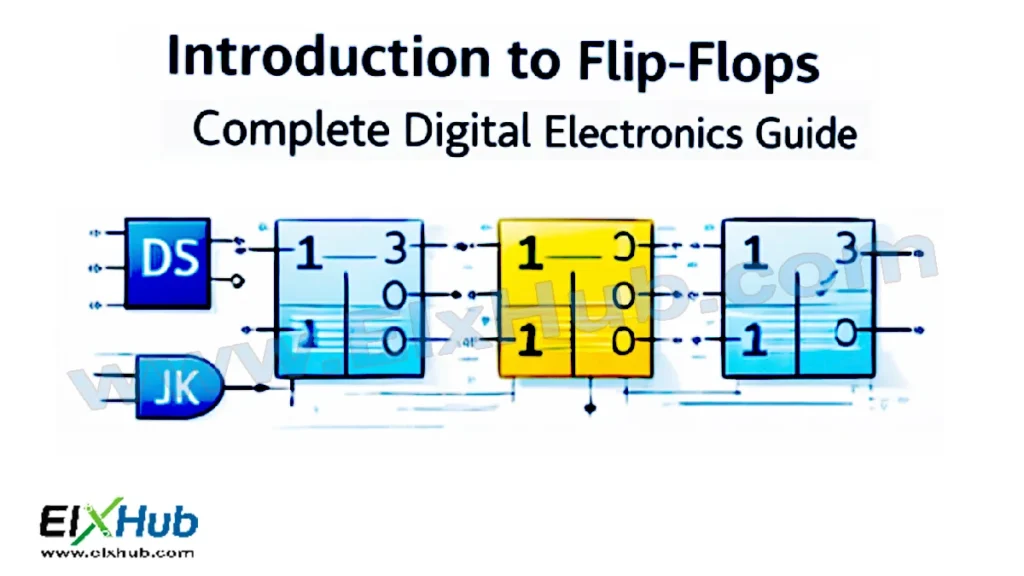
Flip-flops are the fundamental building blocks of sequential digital circuits. Unlike combinational circuits, which depend only on current inputs, sequential circuits store information and depend on both current inputs and previous states. Flip-flops are used for data storage, synchronization, counters, and memory devices in digital systems.
This article explains flip-flops in detail, including types, working principles, truth tables, timing diagrams, and practical applications. Beginners will gain a solid foundation for sequential circuit design.
What Is a Flip-Flop
A flip-flop is a bistable circuit that has two stable states: 0 and 1. It can store a single bit of data and change its output based on input signals and a clock. Flip-flops are the building blocks of registers, counters, and memory.
Image Placeholder (Horizontal): Flip-flop basic block diagram showing input, output, and clock
Types of Flip-Flops
1. SR Flip-Flop (Set-Reset)
The SR flip-flop has two inputs: S (Set) and R (Reset), and two outputs: Q and Q’.
Image Placeholder (Horizontal): SR flip-flop logic diagram
Truth Table:
| S | R | Q(next) | Q’(next) |
|---|---|---|---|
| 0 | 0 | Q | Q’ |
| 0 | 1 | 0 | 1 |
| 1 | 0 | 1 | 0 |
| 1 | 1 | Invalid | Invalid |
Characteristics:
• Used for basic memory storage
• Cannot have S=R=1 (undefined state)
2. D Flip-Flop (Data or Delay)
The D flip-flop has a single data input D and stores it on the rising or falling edge of the clock.
Image Placeholder (Horizontal): D flip-flop logic diagram
Truth Table:
| D | Q(next) | Q’(next) |
|---|---|---|
| 0 | 0 | 1 |
| 1 | 1 | 0 |
Advantages:
• Eliminates invalid state of SR flip-flop
• Widely used for data storage and synchronization
3. JK Flip-Flop
The JK flip-flop is an improvement over SR flip-flop, where the J and K inputs correspond to Set and Reset but allow toggle operation when both are 1.
Image Placeholder (Horizontal): JK flip-flop logic diagram
Truth Table:
| J | K | Q(next) | Operation |
|---|---|---|---|
| 0 | 0 | Q | No change |
| 0 | 1 | 0 | Reset |
| 1 | 0 | 1 | Set |
| 1 | 1 | Q’ | Toggle |
Applications:
• Counters
• Shift registers
• Memory storage
4. T Flip-Flop (Toggle)
The T flip-flop toggles its output on each clock pulse when T=1. It is derived from JK flip-flop by connecting J and K together.
Image Placeholder (Horizontal): T flip-flop logic diagram
Truth Table:
| T | Q(next) | Operation |
|---|---|---|
| 0 | Q | No change |
| 1 | Q’ | Toggle |
Applications:
• Binary counters
• Frequency division
• Toggle operations in digital circuits
Timing Diagrams of Flip-Flops
Timing diagrams are essential to understand flip-flop behavior with respect to clock pulses. They show when the output changes and how inputs affect the next state.
Image Placeholder (Horizontal): Flip-flop timing diagram illustration
Flip-Flops in Registers and Counters
Registers
Registers are groups of flip-flops used to store multiple bits. They are used in:
• Microprocessors
• Shift registers for serial-to-parallel conversion
• Data storage for temporary computation
Counters
Counters use T or JK flip-flops to count events or generate sequential outputs. Types of counters:
• Asynchronous (ripple) counters
• Synchronous counters
Image Placeholder (Horizontal): 4-bit binary counter using flip-flops
Applications of Flip-Flops
• Memory units in digital computers
• Data storage in microcontrollers
• Frequency dividers and timers
• Sequential logic circuits in digital systems
• Shift registers and communication protocols
Common Beginner Mistakes
• Connecting inputs incorrectly, causing invalid states
• Ignoring clock edge triggering
• Misinterpreting timing diagrams
• Not understanding toggle operations in JK and T flip-flops
FAQs About Flip-Flops
What is the difference between combinational and sequential circuits?
Combinational circuits depend only on current inputs. Sequential circuits use current inputs and previous states.
Which flip-flop is best for beginners?
D flip-flop is simplest and avoids invalid states.
Can flip-flops be used in microcontrollers?
Yes, flip-flops are used internally in registers, counters, and memory modules.
Related Datasheet on ElxHub
Checkout Datasheet of Dual Flip-Flop: 74HC74
Conclusion
Flip-flops are essential for sequential digital circuits. Understanding SR, D, JK, and T flip-flops, their truth tables, timing diagrams, and applications is crucial for building counters, registers, memory units, and other sequential systems. Mastery of flip-flops forms the foundation for advanced digital electronics and microcontroller projects.
SEO Title
Flip-Flops in Digital Electronics – Types, Working, and Applications
Meta Description
Learn flip-flops in digital electronics. Complete guide covering SR, D, JK, T flip-flops, working, truth tables, and practical applications for beginners.