Introduction
Multiplexers and demultiplexers are fundamental digital circuits used for data selection, routing, and transmission. They play a vital role in communication systems, microprocessors, memory addressing, and digital signal processing. These circuits help reduce wiring complexity while increasing system efficiency.
This article explains multiplexers and demultiplexers from basic concepts to advanced applications in a beginner-friendly yet professional manner.
What Is a Multiplexer
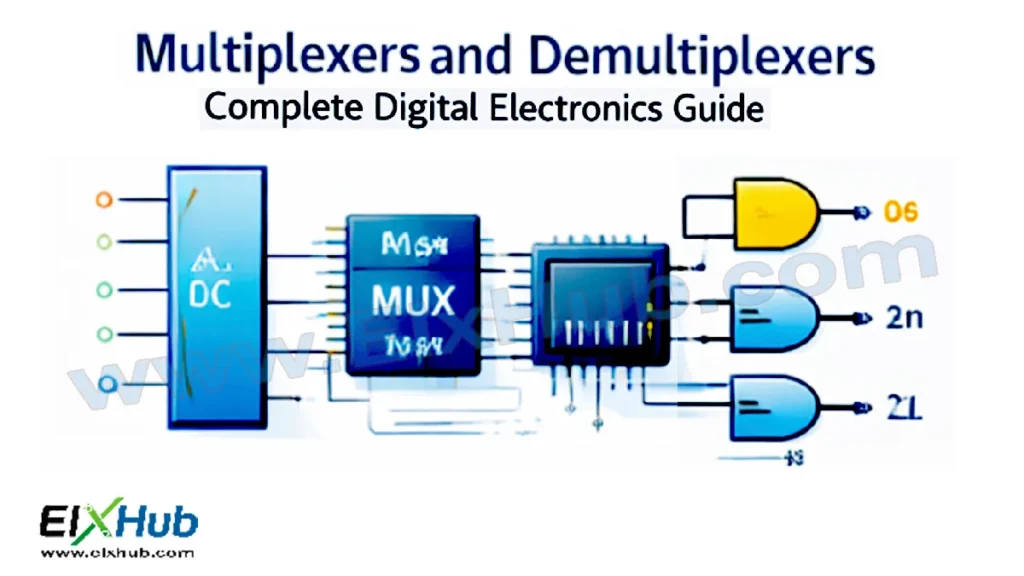
A multiplexer (MUX) is a combinational digital circuit that selects one input from multiple inputs and forwards it to a single output line. The selection is controlled using select lines.
A multiplexer is often described as a many-to-one data selector.
Image Placeholder (Horizontal): Multiplexer block diagram showing multiple inputs and one output
Why Multiplexers Are Important
Multiplexers are used to:
• Reduce the number of data lines
• Efficiently transmit data
• Select data sources dynamically
• Optimize digital system design
Without multiplexers, digital circuits would require excessive wiring and hardware.
Basic Working Principle of Multiplexer
A multiplexer uses select lines to choose which input is connected to the output. The number of select lines determines how many inputs can be selected.
For example:
• 1 select line → 2 inputs
• 2 select lines → 4 inputs
• 3 select lines → 8 inputs
Types of Multiplexers
2-to-1 Multiplexer
A 2-to-1 multiplexer has:
• 2 data inputs
• 1 select line
• 1 output
Image Placeholder (Horizontal): 2-to-1 multiplexer logic diagram
Operation
When the select line is 0, Input 0 appears at the output.
When the select line is 1, Input 1 appears at the output.
4-to-1 Multiplexer
A 4-to-1 multiplexer uses two select lines to choose one of four inputs.
Image Placeholder (Horizontal): 4-to-1 multiplexer block diagram with select lines
This type is widely used in arithmetic circuits and data routing.
8-to-1 and Higher Order Multiplexers
Larger multiplexers are built using smaller multiplexers. For example, an 8-to-1 MUX can be built using two 4-to-1 multiplexers and additional logic.
Truth Table of a Multiplexer
The truth table defines how select lines control the output.
Image Placeholder (Horizontal): Multiplexer truth table illustration
Truth tables help in understanding the logical behavior and designing correct circuits.
Applications of Multiplexers
Multiplexers are used in:
• Data communication systems
• CPU data routing
• Analog-to-digital converters
• Memory addressing
• Signal selection circuits
What Is a Demultiplexer
A demultiplexer (DEMUX) is a digital circuit that takes one input and routes it to one of many outputs based on select lines.
A demultiplexer is described as a one-to-many data distributor.
Image Placeholder (Horizontal): Demultiplexer block diagram with one input and multiple outputs
Why Demultiplexers Are Needed
Demultiplexers are used to:
• Distribute data efficiently
• Control output devices
• Route signals in communication systems
• Decode address lines
Working Principle of Demultiplexer
A demultiplexer receives a single input and uses select lines to determine which output line will receive the data.
Only one output is active at a time.
Types of Demultiplexers
1-to-2 Demultiplexer
This demultiplexer has:
• 1 input
• 1 select line
• 2 outputs
Image Placeholder (Horizontal): 1-to-2 demultiplexer logic diagram
1-to-4 Demultiplexer
A 1-to-4 demultiplexer uses two select lines to control four outputs.
Image Placeholder (Horizontal): 1-to-4 demultiplexer block diagram
Higher Order Demultiplexers
Larger demultiplexers are created by cascading smaller ones, similar to multiplexers.
Multiplexer vs Demultiplexer
Multiplexer selects one input from many and sends it to one output.
Demultiplexer takes one input and sends it to one of many outputs.
They are complementary circuits and often used together.
Multiplexers as Data Selectors
In CPUs, multiplexers select:
• Register outputs
• ALU inputs
• Memory data paths
This allows flexible data movement inside processors.
Demultiplexers as Decoders
Demultiplexers are commonly used as:
• Address decoders
• Chip select generators
• Output selectors
Image Placeholder (Horizontal): Demultiplexer used as address decoder
Common ICs for Multiplexers and Demultiplexers
Popular ICs include:
• 74151 (8-to-1 multiplexer)
• 74153 (dual 4-to-1 multiplexer)
• 74138 (demultiplexer / decoder)
These ICs are widely used in digital and embedded systems.
Real-Life Practical Examples
Data Transmission
Multiplexers combine multiple signals into one line for transmission. Demultiplexers separate them at the receiver.
Memory Selection
Demultiplexers activate specific memory chips based on address lines.
LED Control
A single data line can control multiple LEDs using demultiplexers.
Common Beginner Mistakes
• Confusing select lines with data inputs
• Incorrect truth table interpretation
• Floating select lines
• Wrong IC pin connections
Avoiding these mistakes ensures correct circuit operation.
FAQs
Can a multiplexer act as a demultiplexer?
No, their operations are fundamentally different.
Why are multiplexers preferred over switches?
They are faster, programmable, and reliable.
Are multiplexers used in analog circuits?
Yes, analog multiplexers exist for signal switching.
Conclusion
Multiplexers and demultiplexers are essential digital building blocks that enable efficient data routing and system design. Mastering these circuits prepares you for advanced topics such as microprocessors, communication systems, and digital signal processing.
SEO Title
Multiplexers and Demultiplexers Explained – Working, Types, and Applications
Meta Description
Learn multiplexers and demultiplexers in digital electronics with detailed working, types, truth tables, and real-world applications.