
Understanding Potential Dividers A Voltage Divider is one of the most fundamental circuits in electronics. It allows you to “tap off” a fraction of a source voltage by placing two resistors in series. This is essential when you need to provide a specific voltage to a component—like a sensor—that cannot handle the full power of your main battery or power supply. In this lab, you can experiment with resistor ratios to see exactly how much voltage is “dropped” across each component.
Voltage Divider Lab
Interactive Circuit Simulation
Lab Bench Notes:
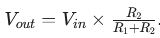
The Ratio Rule: The output voltage depends entirely on the ratio of the two resistors. If R1 and R2 are equal, the voltage is cut exactly in half.
The Formula: The math behind this simulation is :
The “Loading” Effect: This lab simulates an ideal voltage divider. In the real world, if you connect a heavy “load” (like a motor) to the Vout pin, the voltage will drop significantly. For precision tasks, a voltage divider is usually followed by an Op-Amp buffer.